
VOC Emissions from Natural Latex Pillows: HS-SPME-GC/MS Characterization and Health Implications
Article Sidebar
Main Article Content
Abstract
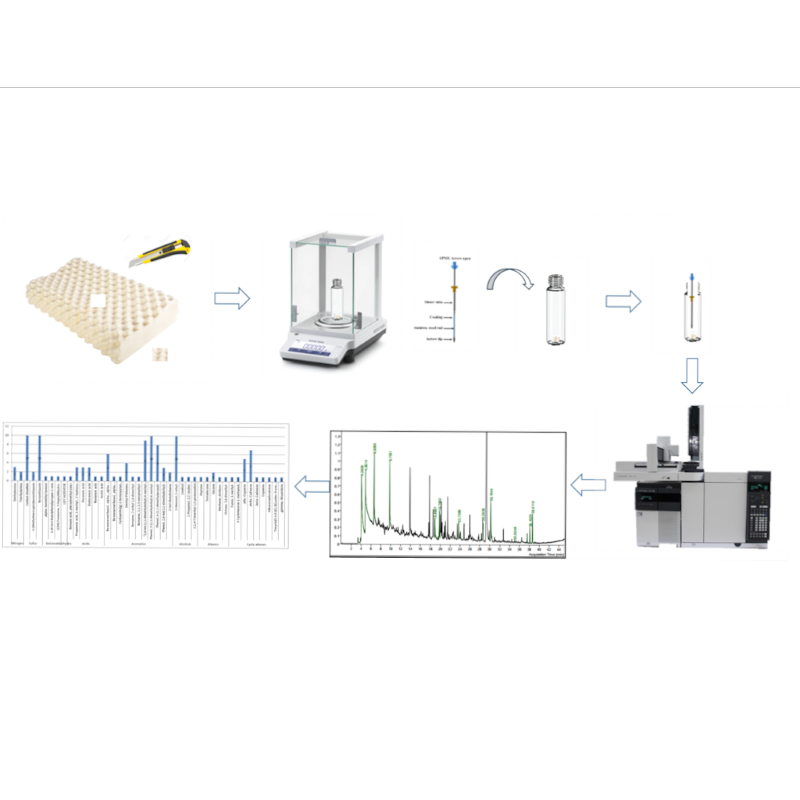
Natural rubber pillows are widely used household products; however, their production process may release volatile organic compounds (VOCs) that can affect indoor air quality and human health. This study aimed to identify and characterize VOCs in commercial rubber pillows and evaluate their potential health implications based on toxicological references. Ten pillow samples (P01–P10) were analyzed using headspace solid-phase microextraction coupled with gas chromatography–mass spectrometry (HS-SPME–GC–MS). VOC identification was performed by comparison with NIST 14 and Wiley 10 mass spectral libraries, using a match score acceptance criterion of ≥ 90%. Semi-quantification was conducted based on relative peak area normalization. A total of 44 VOCs were identified and classified into nine chemical categories. Frequently detected compounds in all samples included sulfur compounds (e.g., carbon disulfide and benzothiazole); aromatic hydrocarbons (e.g., toluene and styrene); alcohols (e.g., 2-ethyl-1-hexanol and linalool); aromatic compounds (e.g., benzenemethanol, α,α-dimethyl-, and diethyl phthalate); and cyclic alkenes (e.g., α-copaene and δ-cadinene). Benzothiazole and phenol, 2-(1,1-dimethylethyl)-6-methyl-, both considered toxicologically relevant compounds, were consistently detected in all samples. The presence of benzothiazole was attributed to its role in the vulcanization process, whereas amines were observed only in selected samples (P04, P06, P08). Several detected VOCs have been identified as causing potential health risks, including neurotoxicity (carbon disulfide), mucosal irritation (amines), and endocrine disruption (phthalates). These findings indicate that natural rubber pillows may act as sources of diverse VOC emissions, predominantly sulfur- and aromatic-derived compounds. Notably, this is the first study on finished pillows to provide comprehensive evaluations of VOC emissions from them rather than raw materials. Although absolute concentrations were not determined, the results highlight the need for further exposure and risk assessment studies. These findings indicate that natural rubber pillows may act as sources of diverse VOC emissions, predominantly sulfur- and aromatic-derived compounds, particularly under prolonged exposure conditions during sleep. From a practical perspective, these results suggest that manufacturers should consider emission-reduction strategies, including process optimization and the use of low-emission additives, and support the development of eco-labeled, low-VOC products in line with international indoor air quality guidelines in order to enhance consumer safety.
Article Details

This work is licensed under a Creative Commons Attribution-NonCommercial-NoDerivatives 4.0 International License.
The content and information in the article published in Journal of Rajamangala University of Technology Srivijaya It is the opinion and responsibility of the author of the article. The editorial journals do not need to agree. Or share any responsibility.
References
Agatonovic-Kustrin, S., Gegechkori, V., Kobakhidze, T. and Morton, D. 2023. Solid-phase microextraction techniques and application in food and horticultural crops. Molecules 28(19): 1-14.
Capíková, A., Tesařová, D., Hlavaty, J., Ekielski, A. and Mishra, P.K. 2019. Estimation of volatile organic compounds (VOCs) and human health risk assessment of simulated indoor environment consisting of upholstered furniture made of commercially available foams. Advances in Polymer Technology 2019(1): 1-10.
Caroprese, A., Gabbanini, S., Beltramini, C., Lucchi, E. and Valgimigli, L. 2009. HS‐SPME‐GC‐MS analysis of body odor to test the efficacy of foot deodorant formulations. Skin Research and Technology 15(4): 503-510.
Chen, X., Zhang, B., Wang, D., Chen, L., Du, Z. and Wu, Y. 2022. Traceability of VOCs in tire inner liner by chromatography-mass spectrometry. Environmental Science and Pollution Research 29(7): 9685-9692.
European Commission. 2014. Commission Decision 2014/391/EU of 23 June 2014 establishing the ecological criteria for the award of the EU Ecolabel for bed mattresses. Official Journal of the European Union. Available Source: https://www.eur-lex.europa.eu /legalcontent/EN/TXT/?uri=CELEX:02014D0391-20220718, August 24, 2025.
European Commission. 2014. EU Ecolabel bed mattresses: User manual. Official Journal of the European Union. Available Source: https://api.eublomsten.dk/api/docs/ CriteriaDocumentFiles/1008, March 20, 2026.
Idris, N.F., Le-Minh, N., Hayes, J.E. and Stuetz, R.M. 2022. Performance of wet scrubbers to remove VOCs from rubber emissions. Journal of Environmental Management 305: 1-13.
Jeleń, H.H. 2006. Solid-phase microextraction in the analysis of food taints and off-flavors. Journal of chromatographic science 44(7): 399-415.
Kamarulzaman, N.H., Idris, N.F. and Nor, Z.M. 2012. Characteristics of odour concentration from rubber processing factories via olfactometry technique. Chemical Engineering Transactions 30: 121-126.
Kamarulzaman, N.H., Le-Minh, N. and Stuetz, R.M. 2019. Identification of VOCs from natural rubber by different headspace techniques coupled using GC-MS. Talanta 191: 535-544.
Khalid, M. and Abdollahi, M. 2021. Environmental distribution of personal care products and their effects on human health. Iranian journal of pharmaceutical research 20(1): 216-253.
Liu, J.-Q., Han, H.-L., Zhang, Q., Ding, S.-N., Wang, Z.-J. and Lv, Q. 2025. Nontargeted analysis of potential chemicals in latex pillows using gas chromatography–Orbitrap high resolution mass spectrometry. Microchemical Journal 218: 115275.
Nornanysya, F.K., Aminah, S.M. and Samsuri, A. 2013. Odourless natural rubber (ONR). Journal of Rubber Research 16(1): 15-35.
Oshima, N., Tahara, M., Sakai, S. and Ikarashi, Y. 2021. Analysis of volatile organic compounds emitted from bedding products. BPB Reports 4(6): 182-192.
Pajarito, B.B., Castañeda, K.C., Jeresano, S.D.M. and Repoquit, D.A.N. 2018. Reduction of offensive odor from natural rubber using zinc‐modified bentonite. Advances in Materials Science and Engineering 2018(1): 1-8.
Ramírez, N., Marcé, R.M. and Borrull, F. 2010. Development of a thermal desorption-gas chromatography–mass spectrometry method for determining personal care products in air. Journal of Chromatography A 1217(26): 4430-4438.
Ramli, R., Chai, A.B., Kamaruddin, S., Ho, J.H., Mohd. Rasdi, F.R. and De Focatiis, D.S.A. 2021. Development of latex foam pillows from deproteinized natural rubber latex. Journal of Rubber Research 24(4): 615-630.
Sakdapipanich, J. and Insom, K. 2006. High-resolution gas chromatography-mass spectrometry - Characterization and mechanism to generate the obnoxious odor in natural rubber. Kautschuk Gummi Kunststoffe rubberpoint 59(7-8): 382-387.
Shinoda, R., Takahashi, K., Ichikawa, S., Wakayama, M., Kobayashi, A., Miyagawa, S. and Uchimura, T. 2020. Using SPME-GC/REMPI-TOFMS to measure the volatile odor-active compounds in freshly cooked rice. American Chemical Society Omega 5(32): 20638-20642.
Unites Stated. Environmental Protection Agency. 2023. Volatile organic compounds’ impact on indoor air quality. Available Source: https://www.epa.gov/indoor-air-quality-iaq/volatile-organic-compounds-impact-indoor-air-quality, March 23, 2026.
World Health Organization. 2010. WHO guidelines for indoor air quality: Selected pollutants. WHO Regional Office for Europe. Available Source:https://www.who.int/publications /i/item/9789289002134, March 23, 2026.
