
Physical and Combustion Properties of Charcoal Briquettes Produced from Mangrove Wood and Coconut Shell Waste
Article Sidebar
Main Article Content
Abstract
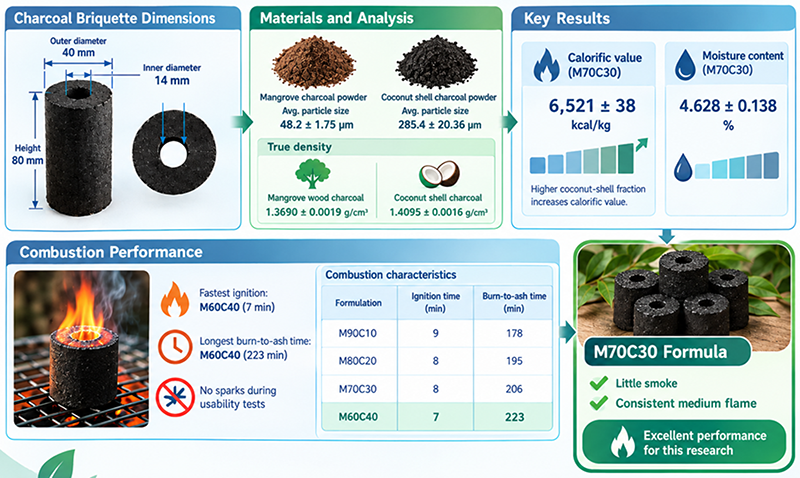
This research examines the physical and combustion properties of charcoal briquettes produced from mangrove wood and coconut shell agricultural residues, which were fabricated using a cylindrical compression mould. The seven formulations were prepared with mangrove wood and coconut shell ratios of 100 : 0, 90 : 10, 80 : 20, 70 : 30, 60 : 40, 50 : 50, and 0 : 100. The entire mixture consists of 0.5 kg of tapioca starch (binding agent) and 3 L of tap water. The charcoal briquettes have an outer diameter of 40 mm, an inner diameter of 14 mm, and a height of 80 mm. The properties analysed included physical properties: particle size, true density, moisture content and combustion properties: total heat value, and fuel usage characteristics. The particle size analysis revealed that mangrove charcoal powder had a finer average particle size of 48.2 ± 1.75 µm compared to coconut shell charcoal powder of 285.4 ± 20.36 µm. The true densities of mangrove wood and coconut shell charcoals were 1.3690 ± 0.0019 g/cm3 and 1.4095 ± 0.0016 g/cm3, respectively, indicating similar intrinsic density. Every formulation satisfied the Community Product Standard for Charcoal Briquettes (M.P.Ch. 238/2547) and had a gross calorific value ranging from 5,897 ± 510 kcal/kg to 6,886 ± 420 kcal/kg and a moisture content ranging from 4.211 ± 0.127% to 4.887 ± 0.164%. A higher coconut-shell fraction generally increased calorific value. During combustion, formulation M60C40 ignited fastest (7 min) and had the longest burn-to ash-time, 223 min, making it well-suited for long-duration applications. No formulation produced sparks during usability tests. In summary, the M70C30 formula releases little smoke and provides a consistent medium flame, indicating excellent performance for this research.
Article Details

This work is licensed under a Creative Commons Attribution-NonCommercial-NoDerivatives 4.0 International License.
The content and information in the article published in Journal of Rajamangala University of Technology Srivijaya It is the opinion and responsibility of the author of the article. The editorial journals do not need to agree. Or share any responsibility.
References
Amnouy, K., Worapot, S., Peerawat, L. and Reungruthai, S. 2019. A study of the effect of mixture material in coconut shell charcoal briquette on mechanical and thermal properties. Thai Industrial Engineering Network Journal 5(2): 67–75.
Amon, V. 2021. Utilization of fruit orchard waste: Durian and mangosteen for charcoal briquette production. Rajamangala University of Technology Tawan-Ok Research Journal 14(2): 66–71.
Anan, W., Khunnapat, S., Wimol, P., Peerapong, N., Sujitra, S., Kittikhun, S., Apichart, H. and Chinoros, l. 2022. Charcoal briquette production process from industrial waste charcoal. Science Journal, Chandrakasem Rajabhat University 32(2): 89–94.
ASTM International. 2019. ASTM D5865/D5865M-19: Standard test method for gross calorific value of coal and coke. ASTM International. doi.org Available Source: https://store.astm.org/d5865_d5865m-19.html, December 18, 2025.
Canales, R., Prieto, F., Prieto, J., Acevedo, O. and Otazo, E. 2022. Evaluation of three lignocellulose biomass materials (barley husk, corn cobs, agave leaves) as precursors of activated carbon. Revista Facultad de Ciencias Universidad Nacional de Colombia, Sede Medellín 11(1): 17–39.
Chaney, J. 2010. Combustion characteristics of biomass briquettes. Doctor of Philosophy (thesis). University of Nottingham.
Department of Alternative Energy Development and Efficiency. 2024. Renewable energy. Available Source:
http://services.dede.go.th/opendata/index.html, September 15, 2024.
Hardiansyah, T., Arif, N., Apri, H.I., Iwan, R., Mohammad, B. and Widya, F. 2023. Briquettes made of branches wood of three mangrove species bonded by starch adhesive. Materials 16: 5266.
Jomsurang, V. and Anamai, D. 2024. Applying the principles of diffusion theory to drive international SDGs towards sustainable development at the localizing in the form of the BCG model. Asian Political Science Review 8(1): 27–38.
Jutapol, J., Lumpoon, L., Pitinan, A. and Surasing, A. 2022. Study of the optimal ratios and properties of charcoal briquettes from bamboo. Agriculture and Technology Journal 3(3): 81–93.
Kabir, A.R., Anwar, S.S., Yusup, S., Sham, D.S., Inayat, M. and Aminu, U.H. 2022. Exploring the potential of coconut shell biomass for charcoal production. Ain Shams Engineering Journal 13(1): 101499.
Kritsada, B. and Nirubol, C. 2020. Study of charcoal briquette from longan wood. Naresuan Phayao Journal 13(2): 51–56.
Lomunyak, G., Osodo, B., Njoka, F. and Kombe, E. 2024. Characterization, optimization and emission analysis of manually-made charcoal dust briquettes with starch, paper and algae binders. Heliyon 10: e40991.
Malte, M., Nicolai, M., William, H., Sarah, C.B.R., Katja, F., Reto, K., David, J.F. and Myles, R.A. 2009. Greenhouse-gas emission targets for limiting global warming to 2 °C. Nature (458): 1158–1162.
Nuryawan, A., Simatupang, J., Risnasari, I., Nur, T.B., Fatriasari, W., Basyuni, M., Tambunan, H., Utami, S.S. and Jeong, B. 2025. Physical, chemical, mechanical, and thermal properties of charcoal briquettes produced from mangrove branch wood. Frontiers in Materials (12): 1611316.
Onuegbu, T.U., Ekpunobi, U.E., Ogbu, I.M., Ekeoma, M.O. and Obumselu, F.O. 2011. Comparative studies of ignition time and water boiling test of coal and biomass briquettes blend. International Journal of Research and Reviews in Applied Sciences 7(2): 153–159.
Pattaraanong, K., Warunee, T., Adisak, N. and Somchart, S. 2021. Assessment of seasonal availability and spatial distribution of bio-feedstock for power generation in Thailand. BioEnergy Research 14: 70–90.
Rahman, R., Widodo, S., Azikin, B. and Tahir, D. 2019. Chemical composition and physical characteristics of coal and mangrove wood as alternative fuel. Journal of Physics: Conference Series 1341: 052008.
Ratchatorn, T. and Jaruwan, W. 2022. Utilization of waste from biomass for fuel briquettes production. Thai Science and Technology Journal 30(6): 124–136.
Roseleena, A., Rodeeyah, C. and Nurmayamean, S. 2019. Production of charcoal from agricultural residues. YRU Journal of Science Technology 4(1): 47–53.
Saleem, M. 2022. Possibility of utilizing agriculture biomass as a renewable and sustainable future energy source. Heliyon 8: e08905.
Sirichai, J. and Changwat, C. 2022. The study on the production of charcoal briquettes from pomelo peels. Kasem Bundit Engineering Journal 12(1): 55–74.
Siwakorn, N., Nuttaphon, S., Pasawat, S., Wiriya, S., Kantapong, K., Chanin, O., Kanchana, S. and Kittipong, L. 2026. Insights into the co-utilization of cassava industry waste and invasive woody biomass for charcoal briquettes production. Carbon Resources Conversion 100416: 2588–9133.
Titiporn, C. and Chotika, Y. 2018. Utilization of briquettes charcoal from pineapple peel. Life Sciences and Environment Journal 19(2): 280–286.
Suksuwan, W., Hayee-asae, N., Hemma, I., Batcha, M.F.M., Palamanit, A. and Wae-hayee, M. 2021. Effect of equivalent ratio on thermal energy and exhaust gas properties from gasification of oil palm empty fruit bunch using household gasifier. IOP Conference Series: Earth and Environmental Science (765): 012070.
Winfried, H. and Claudia, K. 2018. The UN sustainable development goals (SDGs) in the transnational multilevel system. Heidelberg Journal of International Law 2: 375.
Yuliah, Y., Kartawidjaja, M., Suryaningsih, S. and Ulfi, K. 2017. Fabrication and characterization of rice husk and coconut shell charcoal based bio-briquettes as alternative energy source. IOP Conference Series: Earth and Environmental Science (65): 012021.
Zamora, C.R., Sessions, J., Smith, D. and Marrs, G. 2015. Effect of grinder configuration on forest biomass bulk density, particle size distribution and fuel consumption. Biomass and Bioenergy (81): 44–54.
