
Plant Community Structure and Carbon Sequestration of the Forest Restoration Areas at Kamnoetvidya Science Academy
Article Sidebar
Main Article Content
Abstract
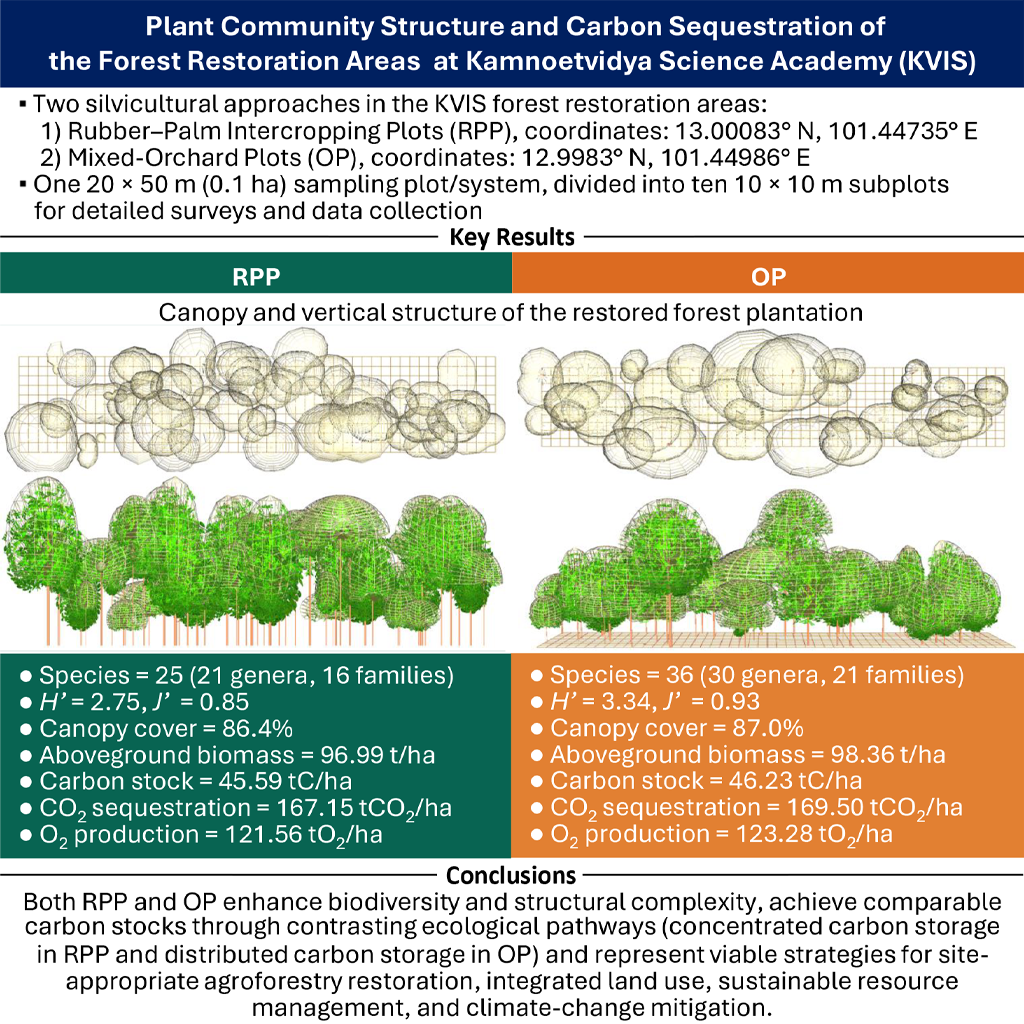
This study evaluated the plant community structure, species diversity, and carbon sequestration potential of two distinct forest restoration models at Kamnoetvidya Science Academy, Rayong Province, Thailand. Two silvicultural approaches were observed: (1) Rubber–Palm Intercropping Plots (RPP) and (2) Mixed-Orchard Plots (OP). Vegetation data were collected from 20 x 50 m sample plots in each restoration approach, with each plot subdivided into ten 10 × 10 m subplots, to determine species composition, canopy architecture, and the Importance Value Index (IVI). Biodiversity was quantified using the Shannon–Wiener Index, while biomass and carbon stocks were estimated via established allometric equations. The results revealed higher taxonomic richness in OP (36 species) compared to RPP (25 species), with OP exhibiting higher diversity and evenness indices. Phytosociological analysis identified Hevea brasiliensis as the sole dominant species in RPP, whereas OP displayed a co-dominance of various fruit and indigenous forest species. Despite differences in composition, total carbon stocks were comparable between the two systems, with RPP yielding 45.59 tC/ha and OP yielding 46.23 tC/ha. Carbon distribution was highly concentrated in rubber trees within RPP, while OP exhibited a more heterogeneous distribution across multiple taxa. These findings demonstrate that both integrated agricultural models effectively enhance biodiversity and structural complexity while providing substantial carbon sinks. Consequently, RPP and OP represent viable strategies for rehabilitating degraded agricultural landscapes, contributing to both sustainable land management and global climate change mitigation efforts.
Article Details

This work is licensed under a Creative Commons Attribution-NonCommercial-NoDerivatives 4.0 International License.
The content and information in the article published in Journal of Rajamangala University of Technology Srivijaya It is the opinion and responsibility of the author of the article. The editorial journals do not need to agree. Or share any responsibility.
References
Ahmad, A., Khan, M., Ahmad, T., Ahmad, S., Ullah, S. and Farooqi, A. 2025. Carbon dynamics with stand structure and species diversity in the Hindu Kush Himalaya ranges of Pakistan. Scientific Reports 15(1): 35440.
Atkinson, J., Brudvig, L.A., Mallen-Cooper, M., Nakagawa, S., Moles, A.T. and Bonser, S.P. 2022. Terrestrial ecosystem restoration increases biodiversity and reduces its variability, but not to reference levels: A global meta-analysis. Ecology Letters 25(7): 1725-1737.
Chazdon, R.L., Norden, N., Colwell, R.K. and Chao, A. 2023. Monitoring recovery of tree diversity during tropical forest restoration: Lessons from long-term trajectories of natural regeneration. Philosophical Transactions of the Royal Society B: Biological Sciences 378(1867): 20210069.
da Rosa, C.M. and Marques, M.C. 2022. How are biodiversity and carbon stock recovered during tropical forest restoration? Supporting the ecological paradigms and political context involved. Journal for Nature Conservation 65: 126115.
da Silva Junior, R.G., Ângelo, A.C., Cosmo, N.L., Rios, R.C., Bressiani, L.S.T., Mastella, A.D.F., Schneider, C.R., de Souza, K.K.F., Isernhagen, I., Capellesso, E.S. and Oliveira, E.S. 2026. Effect of planting mixed and facilitating species on the regenerating community. Brazilian Journal of Botany 49: 21.
Dangwal, B., Rana, S.K., Negi, V.S. and Bhatt, I.D. 2022. Forest restoration enhances plant diversity and carbon stock in the sub-tropical forests of western Himalaya. Trees, Forests and People 7: 100201.
Hasannudin, D.A.L., Nurrochmat, D.R. and Ekayani, M. 2022. Agroforestry management systems through landscape-life scape integration: A case study in Gowa, Indonesia. Biodiversitas 23(4): 1864-1874.
Hytönen, J., Kaakkurivaara, N., Kaakkurivaara, T. and Nurmi, J. 2018. Biomass equations for rubber tree (Hevea brasiliensis) components in southern Thailand. Journal of Tropical Forest Science 30(4): 588–596.
Intergovernmental Panel on Climate Change. 2006. 2006 IPCC guidelines for national greenhouse gas inventories, Volume 4: Agriculture, forestry and other land use. The Institute for Global Environmental Strategies, Hayama.
Intergovernmental Panel on Climate Change. 2022. Climate Change 2022: Mitigation of Climate Change. Contribution of Working Group III to the Sixth Assessment Report of the Intergovernmental Panel on Climate Change. Cambridge University Press, Cambridge.
Keller, N., Niklaus, P.A., Ghazoul, J., Marfil, T., Godoong, E. and Philipson, C.D. 2023. Biodiversity consequences of long-term active forest restoration in selectively-logged tropical rainforests. Forest Ecology and Management 549: 121414.
Koch, A. and Kaplan, J.O. 2022. Tropical forest restoration under future climate change. Nature Climate Change 12(3): 279-283.
Koutika, L.S. 2022. Boosting C sequestration and land restoration through forest management in tropical ecosystems: A mini-review. Ecologies 3(1): 13-29.
Kutintara, U. 1999. The Basic Ecological for Forestry. Faculty of Forestry, Kasetsart University, Bangkok. (in Thai)
Magurran, A.E. 1988. Ecology Diversity and Its Measurement. Croom Helm, London.
Marod, D. and Kutintara, U. 2009. Forest Ecology. Faculty of Forestry, Kasetsart University, Bangkok. (in Thai)
Murniati, Suharti, S., Minarningsih, Nuroniah, H.S., Rahayu, S. and Dewi, S. 2022. What makes agroforestry a potential restoration measure in a degraded conservation forest?. Forests 13(2): 267.
Nero, B.F. 2021. Structure, composition and diversity of restored forest ecosystems on mine-spoils in South-Western Ghana. PLoS One 16(6): e0252371.
Ogawa, H., Yoda, K., Ogino, K. and Kira, T. 1965. Comparative ecological studies on three main type of forest vegetation in Thailand. II. Plant biomass. Nature and Life in Southeast Asia 4: 49-80.
Pasion, B.O., Barrias, C.D.P., Asuncion, M.P., Angadol, A.H., Pabiling, R.P., Pasion Jr., A., Braulio, A.A., and Baysa Jr., A.M. 2021. Assessing tree diversity and carbon density of a riparian zone within a protected area in southern Philippines. Journal of Asia-Pacific Biodiversity 14(1): 78-86.
Pearson, T., Walker, S. and Brown, S. 2005. Sourcebook for Land Use, Land-Use Change and Forestry Projects. World Bank, Washington, D.C.
Perles-Garcia, M.D., Kunz, M., Fichtner, A., Härdtle, W. and von Oheimb, G. 2021. Tree species richness promotes an early increase of stand structural complexity in young subtropical plantations. Journal of Applied Ecology 58(10): 2305-2314.
Pielou, E.C. 1975. Ecological Diversity. John Wiley & Sons, New York.
Rosenfield, M.F., Jakovac, C.C., Vieira, D.L.M., Poorter, L., Brancalion, P.H.S., Vieira, I.C.G., de Almeida, D.R.A., Massoca, P., Schietti, J., Albernaz, A.L.M., Ferreira, M.J. and Mesquita, R.C.G. 2023. Ecological integrity of tropical secondary forests: Concepts and indicators. Biological Reviews 98(2): 662-676.
Thailand Greenhouse Gas Management Organization. 2016 Thailand Voluntary Emission Reduction Program Reference Manual: Forestry and Agriculture Sector. Thailand Greenhouse Gas Management Organization (Public Organization), Bangkok. (in Thai)
Uttaruk, Y., Khoa, P.V. and Laosuwan, T. 2024. A guideline for greenhouse gas emission reduction and carbon sequestration in forest sector based on Thailand voluntary emission reduction programme. Sains Malaysiana 53(3): 477-486.
Siarudin, M., Rahman, S.A., Artati, Y., Indrajaya, Y., Narulita, S., Ardha, M.J. and Larjavaara, M. 2021. Carbon sequestration potential of agroforestry systems in degraded landscapes in West Java, Indonesia. Forests 12(6): 714.
Siddesh, R., Pathak, H., Chavan, S.B., Halli, H.M., Kakade, V.D., Morade, A.S., Salunkhe, S., Nangare, D.D., Salunkhe, V.N., Singh, A.K., Pradhan, A. and Reddy, K.S. 2025. Fruit tree-based restoration strategy to mitigate greenhouse gas emissions, and enhance the profitability of degraded land in semi-arid tropics. Science of The Total Environment 1000: 18049.
Smitinand, T. 2014. Thai Plant Names. The Forest Herbarium, Department of National Parks, Wildlife and Plant Conservation, Bangkok. (in Thai)
Sukprung, T., Maelim, S. and Teejuntuk, S. 2021. Restoration on mixed deciduous forest at Mae Thang Watershed Conservation and Development Study Unit, Phrae province. Thai Journal of Science and Technology 10(2): 208-222.
Zhang, H., Feng, H., Qu, X., Yang, M., Huang, M., Jacobs, D.F. and Guo, J. 2026. Species mixing promotes plant biomass accumulation and nutrient cycling in forest plantations. Communications Biology 9(1): 348.
