
Development of Biodegradable Plant Pots from Chitosan Reinforced with Natural Fibers for Agricultural Applications
Article Sidebar
Main Article Content
Abstract
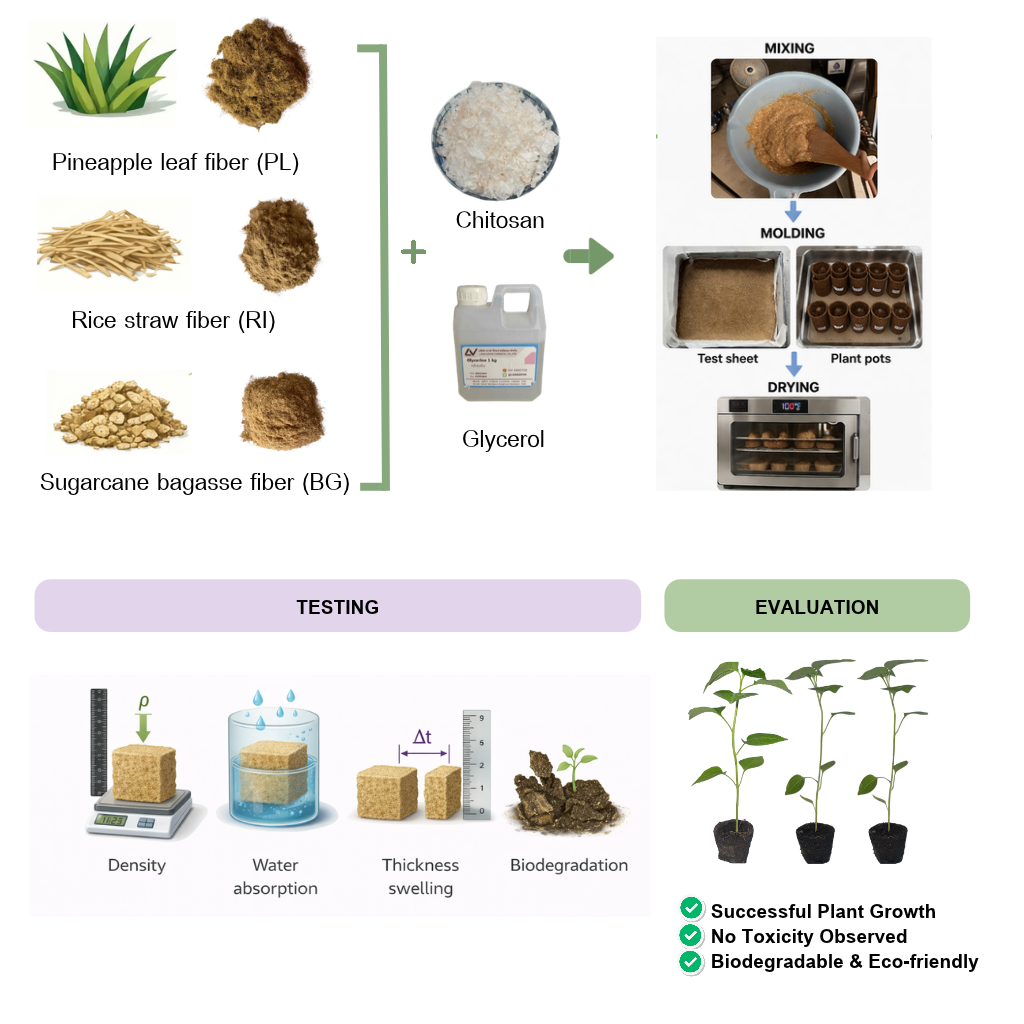
This study aimed to develop biodegradable composite materials based on chitosan reinforced with natural fibers, including pineapple leaf fiber (PL), rice straw (RI), and sugarcane bagasse (BG), for use as biodegradable plant pots. The fibers were incorporated into a chitosan matrix at fiber-to-chitosan ratios of 1:0.08, 1:0.12, 1:0.16, 1:0.20, and 1:0.24 by weight, with glycerol used as a plasticizer. The composites were then fabricated using a molding and drying process. The effects of fiber type and composition on density, water absorption, thickness swelling, and biodegradation behavior were investigated. The results showed that fiber type significantly influenced the composite properties. PL-reinforced composites exhibited the highest density, water absorption, thickness swelling, and biodegradation rate, attributed to their high cellulose content and fibrillated structure. PL-reinforced composites exhibited the highest density (0.907 g/cm³) and biodegradation (97%), attributed to their high cellulose content and fibrillated structure. In contrast, RI composites showed the lowest density and biodegradation, while BG composites demonstrated intermediate behavior. Increasing chitosan content improved dimensional stability by reducing thickness swelling. Soil burial tests confirmed that all composites were biodegradable, with degradation increasing over time. Among the formulations investigated, the fiber-to-chitosan ratio of 1:0.16 was selected as the most suitable formulation for pot fabrication and plant cultivation tests due to its balanced dimensional stability and biodegradation performance. Furthermore, the developed composites were successfully fabricated into hollow pot structures using a two-part mold system. A plant cultivation test demonstrated that all biodegradable pots supported plant growth without visible toxicity and exhibited performance comparable to conventional plastic nursery bags.
Article Details

This work is licensed under a Creative Commons Attribution-NonCommercial-NoDerivatives 4.0 International License.
The content and information in the article published in Journal of Rajamangala University of Technology Srivijaya It is the opinion and responsibility of the author of the article. The editorial journals do not need to agree. Or share any responsibility.
References
Asim, M., Abdan, K., Jawaid, M., Nasir, M., Dashtizadeh, Z., Ishak, M.R. and Hoque, M.E. 2015. A review on pineapple leaves fibre and its composites. International Journal of Polymer Science 2015(1): 950567.
Chaichan, W. and Sawain, A. 2017. Plant pots from co-production of spent coffee grounds, shell lime and rubber wood sawdust. Rajamangala University of Technology Srivijaya.
Chaichan, W., Sawain, A. and Chaichan, W. 2018. Plant nutrients and biodegradable period of biological plant pot. Wichcha Journal 37: 12-26.
Chaichan, W., Sawain, A. and Chaichan, W. 2019. Optimum ratio for co-producing plant pot from organic residues. Journal of Southern Technology 12(1): 193-205.
Chaves, D.M., Araújo, J.C., Gomes, C.V., Gonçalves, S.P., Fangueiro, R. and Ferreira, D.P. 2024. Extraction, characterization and properties evaluation of pineapple leaf fibers from Azores pineapple. Heliyon 10(4): e26698.
Chokshi, S., Parmar, V., Gohil, P. and Chaudhary, V. 2022. Chemical composition and mechanical properties of natural fibers. Journal of Natural Fibers 19(10): 3942-3953.
Ghosh, S., Verma, D., Kumar, K., Pramanik, R., Balo, S., Mahata, D., Saini, A.K. and Mani, A. 2025. Microplastics in agricultural soils: An emerging threat to soil health, microbial ecology, crop productivity, and food safety. International Journal of Plant & Soil Science 37(5): 61-74.
Hajiha, H. and Sain, M. 2015. The use of sugarcane bagasse fibres as reinforcements in composites, pp. 525-549. In Faruk, O. and Sain, M., eds. Biofiber Reinforcements in Composite Materials. 2015: 525-549.
Ibrahim, F.H., Setiawan, R.A., Steven, S. and Mardiyati, Y. 2025. Towards sustainable composites: Fabrication, characterization, and biodegradation of all-cellulose composites (ACC) from ramie and luffa. Results in Engineering 26: 104695.
Iriany, A., Chanan, M., Hasanah, F. and Hariyanti, N.Y. 2022. Biodegradable pot made from water hyacinth and banana pseudostem for cocoa nursery. IOP Conference Series: Earth and Environmental Science 985(1): 012005.
Juming, N., Doloh, R., Khanong, P. and Kaewmanee, J. 2022. Production of plant pots from coffee grounds, water hyacinth and coconut fiber. Proceedings of the National Science and Technology Conference: 10-11.
Kamande, S.W., Kariuki, S.W. and Murithi, G. 2026. Impact of lignin on water absorption and thickness swelling of particleboard: A comprehensive review. Advances in Materials Science and Engineering 2026(1): 9065314.
Mahmud, M.A., Abir, N., Belal, S.A. and Gafur, M.A. 2025. Chemical characterization and tensile properties of a sugarcane bagasse-chemically modified starch composite structure developed for packaging purposes. Results in Materials 25: 100634.
Manafi-Dastjerdi, M., Ebrahimi-Nik, M., Rohani, A. and Lawson, S. 2022. Production of biodegradable pots from cattle manure and wood waste. Environmental Science and Pollution Research 29(14): 20265-20278.
Niju, S. and Swathika, M. 2019. Delignification of sugarcane bagasse using pretreatment strategies for bioethanol production. Biocatalysis and Agricultural Biotechnology 20: 101263.
Piyang, T., Chaichan, W. and Sagulsawasdipan, K. 2018. Environment-friendly plant pot production from palm oil sludge and mushroom waste. Rajamangala University of Technology Srivijaya Research Journal 10(3): 497-511.
Rosado, M.J., Rencoret, J., Marques, G., Gutiérrez, A. and Del Río, J.C. 2021. Structural characteristics of the guaiacyl-rich lignins from rice husks and straw. Frontiers in Plant Science 12: 640475.
Sethupathi, M., Khumalo, M.V., Skosana, S.J. and Muniyasamy, S. 2024. Recent developments of pineapple leaf fiber utilization in polymer composites. Separations 11(8): 245.
Sharma, N., Allardyce, B.J., Rajkhowa, R. and Agrawal, R. 2023. Rice straw-derived cellulose: A comparative study of various pre-treatment technologies and its conversion to nanofibres. Scientific Reports 13(1): 16327.
Somakul, P. and Ngencharoen, S. 2020. Biodegradable nursery pot from beverage labelling waste and coconut bagasse. Proceedings of the KU SRC Annual Conference 28.
Srisunont, T., Wongsakoonkan, W., Tongphanpharn, N., Ratanasongtham, P. and Srisunont, C. 2024. A brief overview of biodegradable pots for sustainable environment in Thailand. Current Applied Science and Technology: e0260109.
Sufian, A.A.M., Othman, S.A., Hasrin, N.I. and Harun, S.N.I. 2020. Future of pineapple leaf paper: A review. International Journal of Engineering Advanced Research 1(2): 1-5.
Tanpaiboonkul, N., Budnumpetch, T., Sukaranandara, K. and Phothilangka, P. 2022. Biodegradable pots from water hyacinth using cassava starch and cassava pulp as binder. Huachiew Chalermprakiet Science and Technology Journal 8(1): 56-69.
Tibalia, E.M.S.E., Wintoko, J. and Purnomo, C.W. 2023. Biodegradable food container from rice straw and sugarcane bagasse. IOP Conference Series: Earth and Environmental Science 1275(1): 012012.
Yang, H.S., Kim, D.J. and Kim, H.J. 2003. Rice straw–wood particle composite for sound absorbing wooden construction materials. Bioresource Technology 86(2): 117-121.
Yogeshwaran, V. and Priya, A. 2020. Removal of hexavalent chromium from aqueous solution using treated sugarcane bagasse powder. Journal of the Indian Chemical Society 97(9b): 1467-1477.
Zhang, Y., Ghaly, A. and Li, B.X. 2012. Physical properties of rice residues under different conditions. American Journal of Applied Sciences 9: 1757-1768.
