
Enrichment of Bioactive Compounds from Lotus (Nelumbo nucifera ‘Roseum Plenum’) Tea through Fermentation
Article Sidebar
Main Article Content
Abstract
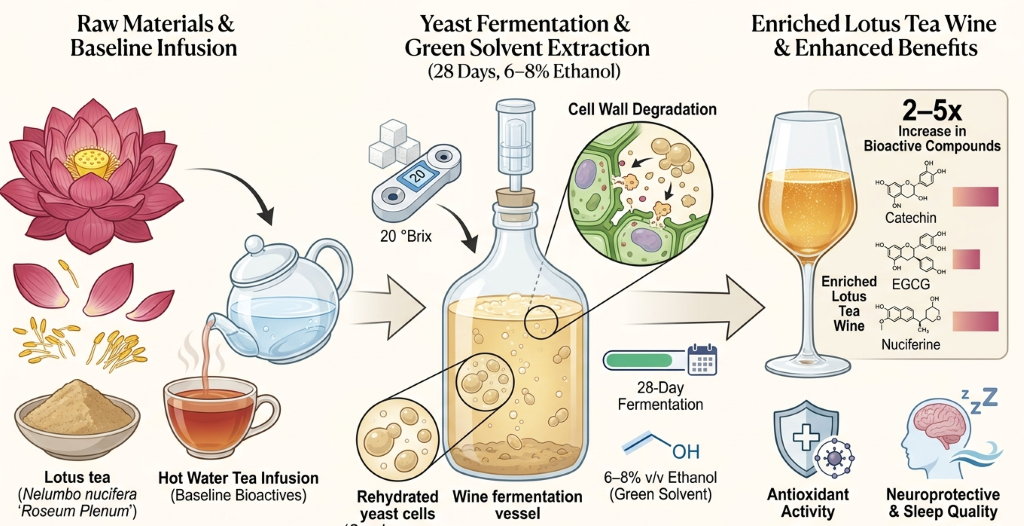
Lotus tea, tea made from the Double red lotus (Nelumbo nucifera ‘Roseum Plenum’). This advantageous characteristic is caused by its bioactive compounds, which include flavonoids and alkaloids. However, stirring the tea with hot water rapidly extracts the active compounds, which may result in a lower overall yield. Additionally, the related flavonoids and alkaloids have good solubility in alcohol. This study aimed to evaluate the feasibility of using lotus tea as a substrate for wine fermentation and to investigate the effect of fermentation on the extraction and enrichment of bioactive compound. Lotus tea and tea infusion used as substrate for the fermentation and HPLC utilized for measuring interesting bioactive compounds. The results indicate that both lotus tea and tea infusion underwent steady fermentation, producing ethanol levels of approximately 6% (v/v) within the first 7 days. All samples displayed characteristics typical of sweet wine, with alcohol content ranging from 6-8% (v/v) by day 28. Fermentation increased the concentrations of bioactive compounds, including catechin, epigallocatechin gallate (EGCG), and nuciferine, to approximately 2–5 times those in the original tea infusion, indicating enhanced extraction during fermentation. While fermentation increased the content of bioactive compounds in lotus tea, further in vivo and clinical investigations are necessary to establish the biological relevance of these findings and assess any potential health effects.
Article Details

This work is licensed under a Creative Commons Attribution-NonCommercial-NoDerivatives 4.0 International License.
The content and information in the article published in Journal of Rajamangala University of Technology Srivijaya It is the opinion and responsibility of the author of the article. The editorial journals do not need to agree. Or share any responsibility.
References
Cai, Z.Y., Li, X.M., Liang, J.P., Xiang, L.P., Wang, K.R., Shi, Y.L., Yang, R., Shi, M., Ye, J.H., Lu, J.L., Zheng, X.Q. and Liang, Y.R. 2018. Bioavailability of tea catechins and its improvement. Molecules 23(9): 2346.
Chemat, F., Vian, M.A. and Cravotto, G. 2012. Green extraction of natural products: Concept and principles. International Journal of Molecular Sciences 13(7): 8615-8627.
Chen, G., Zhu, M. and Guo, M. 2019. Research advances in traditional and modern use of Nelumbo nucifera: Phytochemicals, health promoting activities and beyond. Critical Reviews in Food Science and Nutrition 59(sup1): S189-S209.
Chen, S., Fang, L., Xi, H., Guan, L., Fang, J., Liu, Y., Wu, B. and Li, S. 2012. Simultaneous qualitative assessment and quantitative analysis of flavonoids in various tissues of lotus (Nelumbo nucifera) using high performance liquid chromatography coupled with triple quad mass spectrometry. Analytica Chimica Acta 724: 127-135.
Cuevas-Valenzuela, J., González-Rojas, Á., Wisniak, J., Apelblat, A. and Pérez-Correa, J.R. 2014. Solubility of (+)-catechin in water and water-ethanol mixtures within the temperature range 277.6–331.2 K: Fundamental data to design polyphenol extraction processes. Fluid Phase Equilibria 382: 279-285.
Dai, J. and Mumper, R.J. 2010. Plant phenolics: Extraction, analysis and their antioxidant and anticancer properties. Molecules 15(10): 7313-7352.
Deng, S.-P., Yang, Y.-L., Cheng, X.-X., Li, W.-R. and Cai, J.-Y. 2019. Synthesis, spectroscopic study and radical scavenging activity of kaempferol derivatives: Enhanced water solubility and antioxidant activity. International journal of molecular sciences 20(4): 975.
Du, X.-F., Pan, X., Guo, L. and Zhu, Y. 2016. Extractions and purification of nuciferine from Lotus leaves. Advance Journal of Food Science and Technology 10(2): 153-159.
Duncan, P.M. and Acton, G.W.B. 1967. Progressive Winemaking: A Textbook Covering Fully the Theory and Practice of Winemaking, and a Guide to the Production of Superior Wines of Popular Types. Amateur Winemaker.
Fleet, G.H. 1990. Growth of yeasts during wine fermentations. Journal of Wine Research 1(3): 211-223.
Fletcher, E. and Baetz, K. 2020. Multi-faceted systems biology approaches present a cellular landscape of phenolic compound inhibition in saccharomyces cerevisiae. Frontiers in Bioengineering and Biotechnology (8)2020: 539902.
Hussain, A., Bose, S., Wang, J.-H., Yadav, M.K., Mahajan, G.B. and Kim, H. 2016. Fermentation, a feasible strategy for enhancing bioactivity of herbal medicines. Food Research International 81: 1-16.
Jackson, R.S. 2020. Wine Science: Principles and Applications. Academic press.
Lin, H.-Y., Kuo, Y.-H., Lin, Y.-L. and Chiang, W. 2009. Antioxidative effect and active components from leaves of Lotus (Nelumbo nucifera). Journal of agricultural and food chemistry 57(15): 6623-6629.
Liu, B., Asadzadeh, B., and Yan, W. 2019. Solubility determination and modeling of EGCG peracetate in 12 pure solvents at temperatures from 278.15 to 318.15 K. Journal of Chemical & Engineering Data 64(12): 5218-5224.
Luo, X., Dong, M., Liu, J., Guo, N., Li, J., Shi, Y. and Yang, Y. 2024. Fermentation: ณmprovement of pharmacological effects and applications of botanical drugs. Frontiers in Pharmacology 2024(15): 1430238.
