
Dual-Heat-Zone Biomass-Assisted Pyrolysis of Polyethylene Waste for Community-Scale Fuel Recovery in Nakhon Phanom, Thailand
Article Sidebar
Main Article Content
Abstract
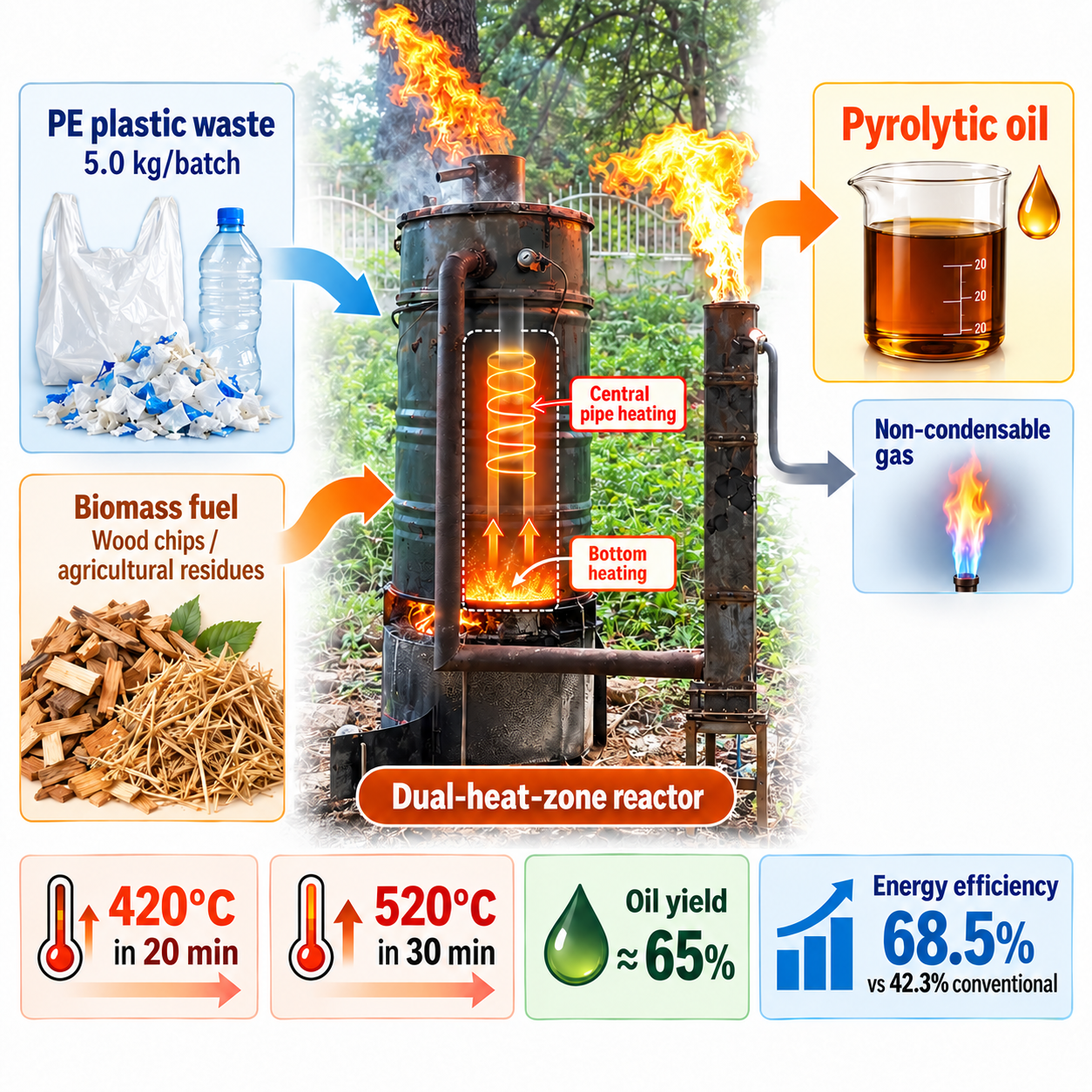
This study aimed to design, fabricate, and evaluate the performance of a dual-heat-zone (central-pipe), biomass-assisted pyrolysis system for converting polyethylene (PE) plastic waste into pyrolytic oil at rural community scale. The developed system incorporated a central heat-transfer pipe inside the pyrolysis reactor, enabling simultaneous heat transfer from both the bottom (external jacket) and the interior (central pipe) of the reactor. Performance was assessed against a conventional reactor, defined here as a bottom-heated reactor of identical volume, wall material, and PE feedstock loading, heated only through the external jacket The performance was measured based on the reactor temperature profile, cumulative oil yield, and energy efficiency (η), defined as the ratio of chemical energy recovered in the pyrolytic oil to the total thermal energy supplied by the biomass fuel over the run using thermodynamic energy equations (Eq. (3)). Experimental results demonstrated that the system could rapidly increase the reactor temperature from approximately 30°C to 420°C within 20 minutes, and up to 520°C within 30 minutes (mean ± SD, n = 3). The heat transfer rate (Q) from the biomass stove to the reactor reached 15.8 kW, while the cumulative oil yield (Y oil) reached approximately 65% at 30 minutes (± SD, n = 3). Under these specific test conditions (single reactor unit, 5.0 kg PE per batch, n = 3 replicates), the energy efficiency of the pyrolysis system was found to be 68.5%, compared with 42.3% for the conventional bottom-heated reactor tested under the same conditions. These results should be interpreted as preliminary, single-configuration findings rather than generalized performance guarantees. A linear regression analysis was applied to correlate reactor temperature with oil yield (R² = 0.974, P-value < 0.001). Preliminary, non-replicated field observations at two community sites in Nakhon Phanom Province suggested an income-generation potential of approximately 30,000 THB/month, motivating a more rigorous field-trial protocol as a next step. This economic estimate is based on assumptions regarding oil price, daily production volume, and operating cost, as explicitly stated in Section 3.5, and should be treated as indicative rather than confirmed. Preliminary characterization of the pyrolytic oil indicated properties broadly consistent with a diesel-range fuel; full quality data are required before the product is described as a finished “fuel oil.” The fabrication cost of approximately 20,000 THB/unit supports the system's potential viability for community-scale deployment, consistent with the principles of the circular economy and the Sustainable Development Goals. The main limitations of this study include the use of a single plastic type (PE), a single reactor scale, a short 30-minute test duration, and the current lack of data on pyrolytic oil quality and environmental emissions data. These limitations are addressed as priorities for follow-up work.
Article Details

This work is licensed under a Creative Commons Attribution-NonCommercial-NoDerivatives 4.0 International License.
The content and information in the article published in Journal of Rajamangala University of Technology Srivijaya It is the opinion and responsibility of the author of the article. The editorial journals do not need to agree. Or share any responsibility.
References
Abnisa, F. and Wan Daud, W.M.A. 2014. A review on co-pyrolysis of biomass: An optional technique to obtain a high-grade pyrolysis oil. Energy Conversion and Management 87: 71–85.
Anuar Sharuddin, S.D., Abnisa, F., Wan Daud, W.M.A. and Aroua, M.K. 2016. A review on pyrolysis of plastic wastes. Energy Conversion and Management 115: 308–326.
Bridgwater, A.V. 2004. Biomass fast pyrolysis. Thermal Science 8(2): 21–49.
Bridgwater, A.V. 2012. Review of fast pyrolysis of biomass and product upgrading. Biomass and Bioenergy 38: 68–94.
Cengel, Y.A. and Ghajar, A.J. 2014. Heat and Mass Transfer: Fundamentals and Applications (5th ed). McGraw-Hill: New York.
Chaiyat, N., Chaongew, S., Ondokmai, P. and Makarkard, P. 2020. Levelized energy and exergy costings per life cycle assessment of a combined cooling, heating, power and tourism system of San Kamphaeng hot spring, Thailand. Renewable Energy 146: 828–842.
Chamsing, A., Salokhe, V. and Singh, G. 2006. Energy consumption analysis for small-scale combined rice milling and husk gasification systems. Agricultural Engineering International: CIGR Journal 8: Manuscript EE 06 002.
Demirbas, A. 2004. Pyrolysis of municipal plastic wastes for recovery of gasoline-range hydrocarbons. Journal of Analytical and Applied Pyrolysis 72(1): 97–102.
Demirbas, A. 2008. Biofuels sources, biofuel policy, biofuel economy and global biofuel projections. Energy Conversion and Management 49(8): 2106–2116.
Demirbas, M.F., Balat, M. and Balat, H. 2009. Potential contribution of biomass to sustainable energy development. Energy Conversion and Management 50(7): 1746–1760.
Dincer, I. and Rosen, M. A. 2013. Exergy: Energy, Environment and Sustainable Development (2nd ed). Elsevier: Oxford.
Genuino, H.C., Pilar Ruiz, M., Heeres, H.J. and Kersten, S.R.A. 2023. Pyrolysis of mixed plastic waste: Predicting the product yields. Waste Management 156: 208–215.
Holman, J.P. 2010. Heat Transfer (10th ed). McGraw-Hill: New York.
Incropera, F.P., DeWitt, D.P., Bergman, T.L. and Lavine, A.S. 2011. Fundamentals of Heat and Mass Transfer (7th ed). Wiley: Hoboken.
Islam, M.N., Islam, M.N., Alam Beg, M.R. and Islam, M.R. 2005. Pyrolytic oil from fixed bed pyrolysis of municipal solid waste and its characterization. Renewable Energy 30(3): 413–420.
Kaminsky, W., Predel, M. and Sadiki, A. 2004. Feedstock recycling of polymers by pyrolysis in a fluidized bed. Polymer Degradation and Stability 85(3): 1045–1050.
Kurniawan, A., Sugiarto, B. and Perdana, A. 2020. Design of bench scale pyrolysis reactor for plastic waste conversion into liquid fuel using biomass as heating source. Eksergi 17(1): 1–6.
Lee, K.H. 2009. Effects of pyrolysis conditions on the pyrolysis of polypropylene. Journal of Analytical and Applied Pyrolysis 86(1): 39–44.
Mastral, A.M., Murillo, R., Callen, M.S. and Garcia, T. 2000. Evidence of coal and tire interactions in coal-tire coprocessing for short residence times. Fuel Processing Technology 69(2): 127–140.
Mastral, J.F., Esperanza, E., Garcia, P. and Juste, M. 2002. Pyrolysis of high-density polyethylene in a fluidised bed reactor. Journal of Analytical and Applied Pyrolysis 63(1): 1–15.
Mohan, D., Pittman, C.U. and Steele, P.H. 2006. Pyrolysis of wood/biomass for bio-oil: A critical review. Energy & Fuels 20(3): 848–889.
National Renewable Energy Laboratory (NREL). 2021. Levelized cost of energy analysis. NREL: Golden. Available Source: https://www.nrel.gov/analysis/lcoe.html.
Onwudili, J.A., Insura, N. and Williams, P.T. 2009. Composition of products from the pyrolysis of polyethylene and polystyrene in a closed batch reactor. Journal of Analytical and Applied Pyrolysis 86(2): 293–303.
Pokson, C. and Chaiyat, N. 2022. Thermal performance of a combined cooling, heating, and power (CCHP) generation system from infectious medical waste. Case Studies in Chemical and Environmental Engineering 6: 100221.
Sajjakulnukit, B., Yingyuad, R., Maneekhao, V., Pongnarintasut, V., Bhattacharya, S.C. and Abdul Salam, P. 2005. Assessment of sustainable energy potential of non-plantation biomass resources in Thailand. Biomass and Bioenergy 29(3): 214–224.
Sakata, Y., Uddin, M.A. and Muto, A. 1999. Degradation of polyethylene and polypropylene into fuel oil by using solid acid and non-acid catalysts. Journal of Analytical and Applied Pyrolysis 51(1–2): 135–155.
Scheirs, J. and Kaminsky, W. 2006. Feedstock Recycling and Pyrolysis of Waste Plastics. Wiley: Chichester.
Williams, P.T. and Slaney, E. 2007. Analysis of products from the pyrolysis and liquefaction of single plastics and waste plastic mixtures. Resources, Conservation and Recycling 51(4): 754–769.
