
Natural Rubber Foam for Modular Acoustic Pods: Comparative Acoustic Performance and Full-Scale Prototype Performance Assessment
Article Sidebar
Main Article Content
Abstract
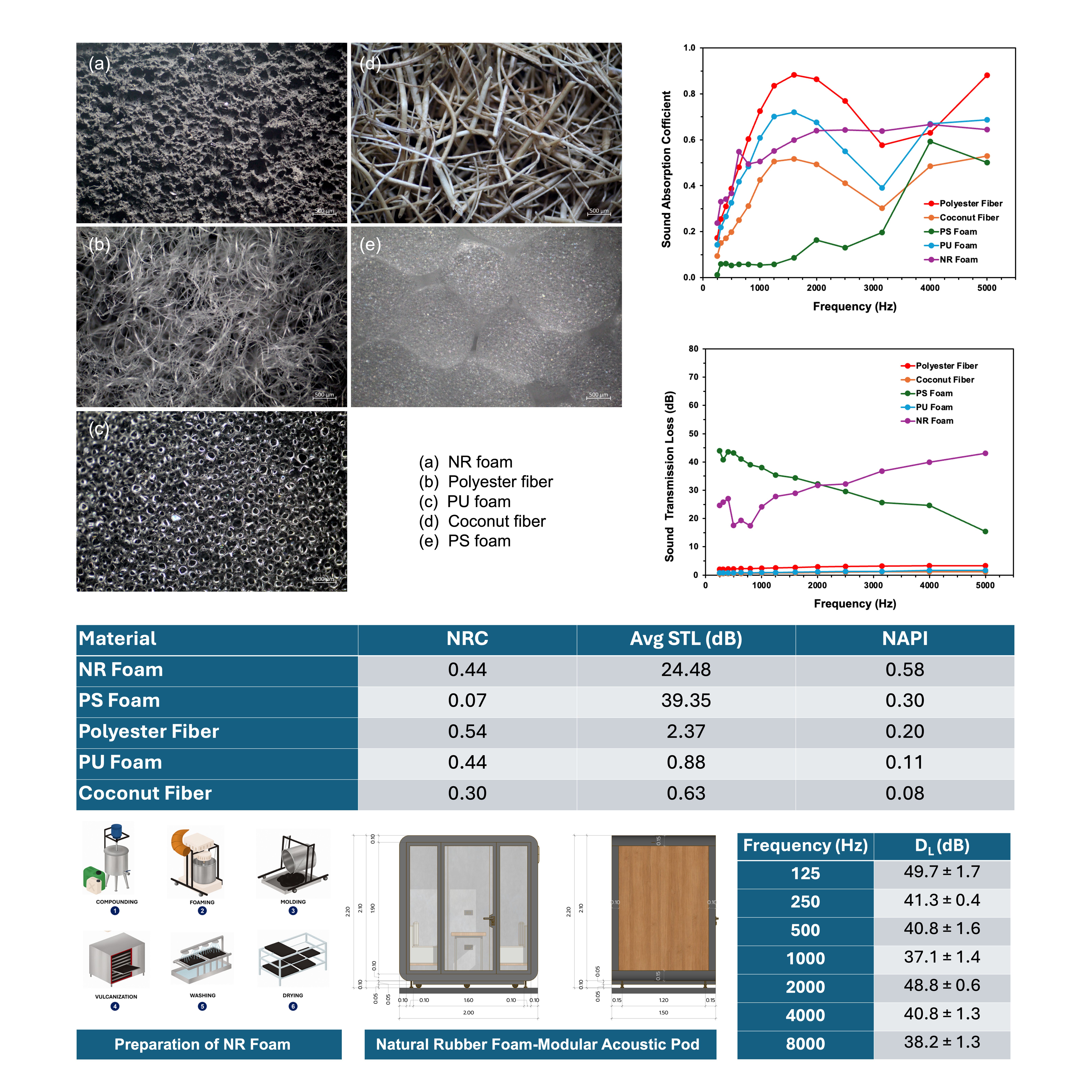
This study investigated the acoustic performance of bio-based natural rubber foam (NR foam) relative to conventional acoustic materials for modular acoustic pod applications through laboratory-scale material screening and full-scale prototype performance assessment. The novelty of this work lies in the introduction of the proposed Normalized Acoustic Performance Index (NAPI), a study-specific composite metric developed to compare the balance between sound absorption and material-level sound transmission resistance, together with a system-level assessment of a full-scale acoustic pod incorporating NR foam. Five materials, including NR foam, polyester fiber, polyurethane (PU) foam, polystyrene (PS) foam, and coconut fiber, were evaluated using impedance tube methods for sound absorption coefficient (SAC) and sound transmission loss (STL). Among the five materials investigated and the selected normalization reference values, NR foam yielded the highest NAPI value of 0.58, indicating the most balanced combination of sound absorption and material-level sound transmission resistance among the tested specimens. A full-scale acoustic pod incorporating NR foam within the wall cavities was subsequently constructed and evaluated under field measurement conditions. The pod exhibited octave-band sound level differences ranging from 37.1 to 49.7 dB, with an arithmetic mean of 42.4 dB across 125–8000 Hz. These values represent the combined acoustic performance of the complete enclosure and do not isolate the individual contribution of the NR foam layer. The developed NR foam exhibited a bulk density of 0.4238 g/cm³, a compressive strength of 80 kPa, a flexible interconnected open-cell structure, and HBF classification under the horizontal burning test conditions employed. Overall, the findings demonstrate the potential of NR foam as a bio-based material providing a balanced combination of sound absorption and material-level sound transmission resistance for modular acoustic enclosure applications.
Article Details

This work is licensed under a Creative Commons Attribution-NonCommercial-NoDerivatives 4.0 International License.
The content and information in the article published in Journal of Rajamangala University of Technology Srivijaya It is the opinion and responsibility of the author of the article. The editorial journals do not need to agree. Or share any responsibility.
References
Allard, J.F. and Atalla, N. 2009. Propagation of Sound in Porous Media: Modelling Sound Absorbing Materials (2nd ed.). John Wiley & Sons.
Asdrubali, F., D’Alessandro, F. and Schiavoni, S. 2015. A review of unconventional sustainable building insulation materials. Sustainable Materials and Technologies 4: 1–17.
ASTM D2240. 2021. Standard test method for rubber property–Durometer hardness. ASTM International.
ASTM D3574. 2022. Standard test methods for flexible cellular materials—Slab, bonded, and molded urethane foams. ASTM International.
ASTM E2611. 2019. Standard test method for normal incidence determination of porous material acoustical properties based on the transfer matrix method. ASTM International.
Del Rey, R., Alba, J., Arenas, J.P. and Sanchis, V.J. 2012. An empirical modelling of porous sound absorbing materials made of recycled foam. Applied Acoustics 73(6–7): 604-609.
Dissanayake, D.G.K., Weerasinghe, D.U., Thebuwanage, L.M. and Bandara, U.A.A.N. 2021. An environmentally friendly sound insulation material from post-industrial textile waste and natural rubber. Journal of Building Engineering 33: 101606.
Haapakangas, A., Hongisto, V., Hyönä, J., Kokko, J. and Keränen, J. 2014. Effects of unattended speech on performance and subjective distraction: The role of acoustic design in open-plan offices. Applied Acoustics 86: 1-16.
ISO 9772. 2020. Cellular plastics—Determination of horizontal burning characteristics of small specimens subjected to a small flame. International Organization for Standardization.
ISO 10534-2. 2001. Acoustics—Determination of sound absorption coefficient and impedance in impedance tubes—Part 2: Transfer-function method. International Organization for Standardization.
ISO 16283-1. 2014. Acoustics—Field measurement of sound insulation in buildings and of building elements—Part 1: Airborne sound insulation. International Organization for Standardization.
ISO 22955. 2021. Acoustics—Acoustic quality of open office spaces. International Organization for Standardization.
Jahncke, H. 2012. Open-plan office noise: The susceptibility and suitability of different cognitive tasks for work in the presence of irrelevant speech. Noise and Health 14(61): 315-320.
Kuttruff, H. 2016. Room Acoustics (6th ed.). CRC Press.
Maderuelo-Sanz, R., Nadal-Gisbert, A.V., Crespo-Amorós, J.E. and Parres-García, F. 2012. A novel sound absorber with recycled fibers coming from end-of-life tires (ELTs). Applied Acoustics 73(4): 402–408.
Najib, N.N., Ariff, Z.M., Bakar, A.A. and Sipaut, C.S. 2011. Correlation between the acoustic and dynamic mechanical properties of natural rubber foam: Effect of foaming temperature. Materials and Design 32(2): 505–511.
Neves de Alencar, L., Guedes Paiva, F.F., Okimoto, F.S., Boaventura Bacarin, G., Dognani, G., Salmazo, L.O., dos Santos, R.J., Camargo Cabrera, F. and Job, A.E. 2023. Natural rubber/wood composite foam: Thermal insulation and acoustic isolation materials for construction. Cellular Polymers 42(2): 55–72.
Samaei, S.E., Berardi, U., Asilian Mahabadi, H., Soltani, P. and Taban, E. 2023. Optimization and modeling of the sound absorption behavior of polyurethane composite foams reinforced with kenaf fiber. Applied Acoustics 202: 109176.
