
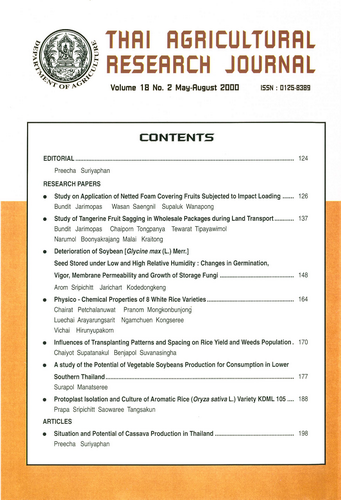
Influences of Transplanting Patterns and Spacing on Rice Yield and Weeds Population
DOI:
https://doi.org/10.14456/thaidoa-agres.2000.13Keywords:
rice, grain yield, suphan buri 90, transplanting, weed populationAbstract
Field experiment to investigate the effect of transplanting pattens and spacing on rice yield and weeds population was conducted at Weed Science Sub Division Experimental Farm, Bangkhen, Bangkok in 1999 wet season. Experimental design was randomized complete block with 4 replications. There were 6 treatments: wquare transplanting at 33.3 x 33.3 cm., 25.0 x 25.0 and 12.5 x 12.5 cm. spacing; and triangular transplanting at 33.3 x 33.3 cm., 25.0 x 25.0 cm. and 12.5 x 12.5 cm. spacing with Suphan Buri 90, photoperiod insensitive lowland rice was used as tested variety. Transplantingpatterns and spacings did not effect plant height, tiller production, panicle no/m2 , panicle length, rice grain yield, straw yield and weeds weight. Close spacing increased tiller no./m2, panicle no./m2, panicle no./m2, rice grain yield, and straw yield but decrease weeds weight. High yield as affected by closer spacing was mainily due to higher panicle number per unit area.
Downloads
Published
How to Cite
Issue
Section
License

This work is licensed under a Creative Commons Attribution-NonCommercial-NoDerivatives 4.0 International License.
Thai Agricultural Research Journal

