
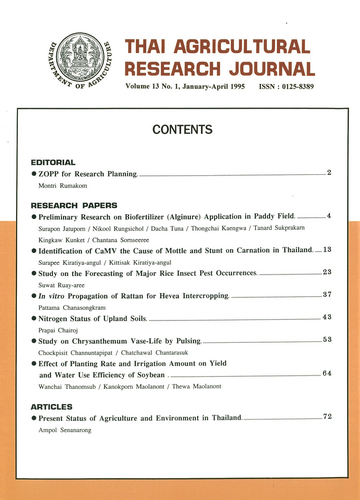
Effect of Planting Rate and Irrigation Amount on Yield and Water Use Efficiency of Soybean
DOI:
https://doi.org/10.14456/thaidoa-agres.1995.7Keywords:
soybean, evaporation, irrigation amount, yield componentsAbstract
Irrigation is an essential factor in improving yield and quality of soybean in improving yield and quality of soybean in the dry season. Effects of plant density and irrigation amount on yield and water use efficiency of soybean, CV. Nakhon Sawan 1 were examined during November 1993 to February 1994 at Chai Nat Field Crop Research Centre. A split plot design with 3 replicates was used. Three plant densities were main plots. Sub-plots comprised four irrigation levels based on the ratios of irrigation amount (IW) to cumulative evaporation (E) (i.e., 0.3, 0.5, 0.7 and 0.9). Interactions between plant densities and irrigation levels in yield an yield components were not significant. Thends in seed yield favoured higher rations of IW/E (up to 16%), although differences were not statisically different. Seed yields significantly increased with increasing plant densities up to the highest density (317 kg/rai at 20 plants/m^2 as compared to 395 kg/rai at 60 plant/m^2 ). Higher ratios of IW/E produced a larger seed, whereas plant density had no effect. Water use efficiency (WUE) decreased from 3.63 kg/rai/mm at IW/E 0.3 to 1.36 at IW/E 0.9 . Higher densities gave greater WUE (2.19 kg/rai/mm at 60 plant/m^2, compared to 1.76 at 20 plant/m^2) .
Downloads
Published
How to Cite
Issue
Section
License

This work is licensed under a Creative Commons Attribution-NonCommercial-NoDerivatives 4.0 International License.
Thai Agricultural Research Journal

