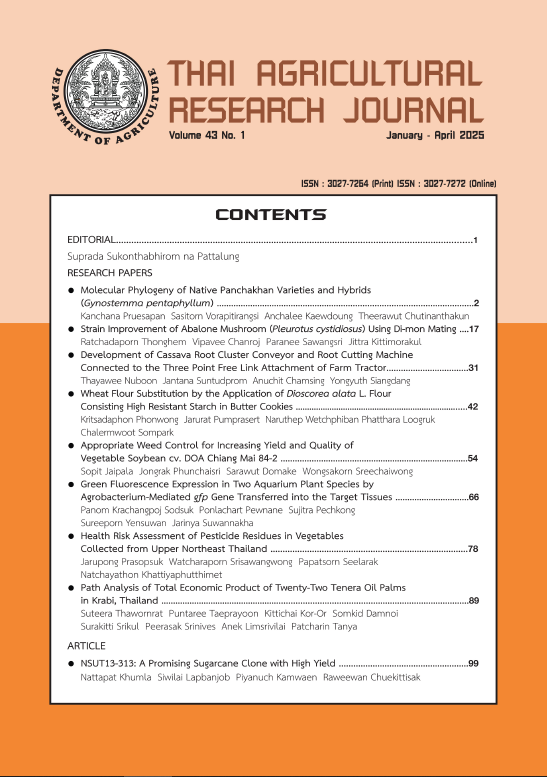
Health Risk Assessment of Pesticide Residues in Vegetables Collected from Upper Northeast Thailand
DOI:
https://doi.org/10.14456/thaidoa-agres.2025.7Keywords:
risk, pesticide residues, Chinese kale, chili, tomatoAbstract
This study aimed to monitor and assess the health risk from pesticide residue in vegetables planted in upper Northeast Thailand. Three types of vegetables, Chinese kale, tomato, and chili, were collected from 19 villages in Khon Kaen province, Nong Bua Lam Phu, Chaiyaphum, Bueng Kan, Nong Khai, Nakhon Phanom, Mukdahan, and Sakon Nakhon province for pesticide residue analysis. All vegetables were sampled at the harvesting period from November 2021 to October 2022. A total of 80 vegetable samples were extracted using the quick easy cheap effective rugged and safe (QuEChERS) multi-residue extraction and analyzed for the presence of 228 pesticides using liquid chromatography-tandem mass spectrometry (LC-MS/MS) at the laboratory of the Office of Agricultural Research and Development Region 3. Assessing the risk of pesticide residues in vegetables was done by 2 methods: 1) assessing based on the type and amount of pesticide residues detected in vegetables compared to the maximum residue limit (MRL) and 2) assessing based on hazard index (HI) obtained by calculating of the estimated dietary intake (EDI) compared to the acceptable daily intake (ADI). The results showed that pesticide residues were found in 43 samples (53.75%) from 80 samples collected. Pesticide residues exceeded MRL in 12 samples (15.0%). There were 19, 12, and 5 types of pesticide residues found from samples of Chinese kale, chili, and tomato, respectively, and their amounts were detected at the range of 0.01-0.91, 0.01-1.81, and 0.01-0.05 mg/kg, respectively. The assessment of consumption risk in terms of HI showed that the HI of Chinese kale, chili, and tomato were 51.19, 6.66, and 21.30%, respectively. The results indicated that these vegetables could be considered as acceptable for food safety.
References
จารุพงศ์ ประสพสุข. 2562. บทบาทของการปฏิบัติทางการเกษตรที่ดีต่อความเสี่ยงทางการเกษตรและการใช้สารเคมีกำจัดศัตรูพืชของเกษตรกรผู้ปลูกผักเชิงพาณิชย์ในจังหวัดขอนแก่น. วิทยานิพนธ์ปรัชญาดุษฎีบัณฑิต. สาขาเกษตรเชิงระบบ มหาวิทยาลัยขอนแก่น.
จารุพงศ์ ประสพสุข สุวิทย์ เลาหศิริวงศ์ อรุณี พรมคำบุตร และชุลีมาศ บุญไทย อิวาย. 2562. การประเมินความเสี่ยงสารเคมีกำจัดศัตรูพืชตกค้างในดินต่อสุขภาพของเกษตรกรผู้ปลูกคะน้าในจังหวัดขอนแก่น. วารสารวิชาการเกษตร. 37(3): 272-285.
จารุพงศ์ ประสพสุข. 2565. รายงานสรุปผลการวิเคราะห์สารพิษตกค้างในพืชผักและไม้ผลพื้นที่ภาคตะวันออกเฉียงเหนือตอนบน ปี 2561-2565. สำนักวิจัยและพัฒนาการเกษตรเขตที่ 3, ขอนแก่น กรมวิชาการเกษตร.
สำนักงานมาตรฐานสินค้าเกษตรและอาหารแห่งชาติ. 2551. วิธีชักตัวอย่างเพื่อตรวจหาสารพิษตกค้าง มกอช.9025-2551. ราชกิจจานุเบกษา ฉบับประกาศและงานทั่วไป เล่ม 125 ตอนพิเศษ 139ง. 18 สิงหาคม 2551. กรุงเทพฯ. แหล่งข้อมูล: https://www.acfs.go.th/ standard/download/pesticide_residues.pdf. สืบค้น: 10 กรกฎาคม 2566.
สำนักงานมาตรฐานสินค้าเกษตรและอาหารแห่งชาติ. 2556. การปฏิบัติทางการเกษตรที่ดีสำหรับพืชอาหารมาตรฐานสินค้าเกษตร มกษ. 9001-2556. กรุงเทพฯ. แหล่งข้อมูล: https://www.acfs.go.th/standard/ download/GAP_food%20crop.pdf. สืบค้น: 10 กรกฎาคม 2566.
สำนักงานมาตรฐานสินค้าเกษตรและอาหารแห่งชาติ. 2559ก. ข้อมูลการบริโภคอาหารของคนไทย. แหล่งข้อมูล: https://www.acfs.go.th/files/files/attach-files /867_20190606145951_625162.pdf. สืบค้น: 10 กรกฎาคม 2566
สำนักงานมาตรฐานสินค้าเกษตรและอาหารแห่งชาติ. 2559ข. สารพิษตกค้าง: ปริมาณสารพิษตกค้างสูงสุด. มาตรฐานสินค้าเกษตร มกษ. 9002-2559. กรุงเทพฯ. แหล่งข้อมูล: https://www.acfs.go.th/standard/ download/MAXIMUM-RESIDUE-LIMITS.pdf. สืบค้น: 10 กรกฎาคม 2566.
สำนักงานพัฒนาวิทยาศาสตร์และเทคโนโลยีแห่งชาติ. 2555. โครงการสำรวจและวิจัยมาตรฐานขนาดรูปร่างคนไทย. แหล่งข้อมูล: https://waa.inter.nstda.or.th/stks/ pub/2012/20120417-SizeThailand.pdf. สืบค้น: 14 มกราคม 2568.
Agriculture and Environment Research Unit. 2023. Pesticide Properties DataBase (PPDB). University of Hertfordshire. Available at: https://sitem.herts.ac.uk/aeru/ppdb/. Accessed: July 20, 2023.
Akoto, O., A.A. Azuure and K.D. Adotey. 2016. Pesticide residues in water, sediment and fish from Tono Reservoir and their health risk implications. SpringerPlus. 5: 1849.
Alla, S.A.G, N.M. Loutfy, A.H. Shendy and M.T. Ahmed. 2015. Hazard index, a tool for a long-term risk assessment of pesticide residues in some commodities, a pilot study. Regulatory Toxicology and Pharmacology. 73(3): 985-991.
BSI [British Standards]. 2008. Foods of plant origin Determination of pesticide residues using GC-MS and/or LC-MS-MS following acetonitrile extraction/partitioning and clean up by dispersive SPE-QuEChERS-method. BS EN 15662:2008. London: BSI Group, Chiswick High Road.
European Commission. 2023. European Commission Pesticides database
MRLs (EU) 2022/1343. Available at: https://food.ec.europa.eu/plants/pesticides/eu-pesticides-database_en. Accessed: July 20, 2023.
FAO/WHO [Food and Agricultural Organization/World Health Organization]. 2023. Pesticide residues in food and feed: Codex Alimentarius. Online Database. Available at: http:// www.codexalimentarius.net/pestres/data/ pesticides. Accessed: July 20, 2023.
Hawari, K., S. Mokh, M. Iskandarani, W. Halloum and F. Jaber. 2019. Pesticide residues in Lebanese apples and health risk assessment. Food Additives and Contaminants: Part B. 12(2): 81-89.
Liu, Y., K. Bei, W. Zheng, G. Yu and C. Sun. 2023. Pesticide residues risk assessment and quality evaluation of four characteristic fruits in Zhejiang Province, China. Frontiers in Environmental Science. 11:1124094.
Łozowicka, B., P. Kaczynski, E. Rutkowska, M. Jankowska and I. Hrynko. 2013. Evaluation of pesticide residues in fruit from Poland and health risk assessment. Agricultural Sciences. 4(5B): 106-111.
National Bureau of Agricultural Commodity and Food Standards. 2016. Food Consumption Data of Thailand. National Bureau of Agricultural Commodity and Food Standards. Bangkok.
Wołejko E., B. Łozowicka and P. Kaczyński. 2014. Pesticide residues in berries and juices and potential risk for consumers. Desalination and Water Treatment. 52(19-21): 3804–3818.
World Health Organization. 2020. WHO recommended classification of pesticides by hazard and guidelines to classification, 2019 edition, Geneva. Available at: https://iris.who.int/ bitstream/handle/10665/332193/9789240005662-eng.pdf?sequence=1. Accessed: July 20, 2023
Downloads
Published
How to Cite
Issue
Section
License
Copyright (c) 2025 Thai Agricultural Research Journal

This work is licensed under a Creative Commons Attribution-NonCommercial-NoDerivatives 4.0 International License.
Thai Agricultural Research Journal

