
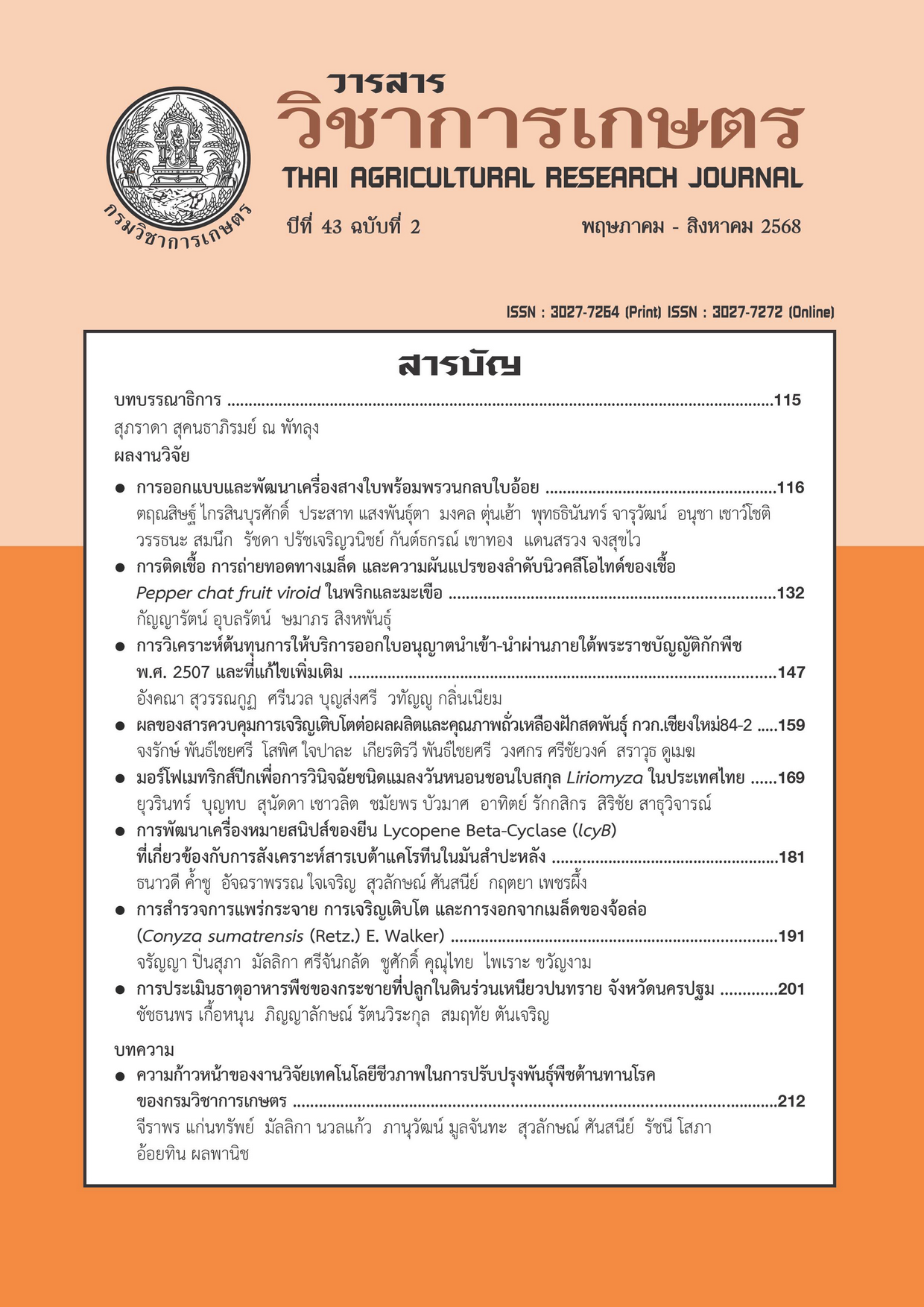
Effects of Growth Regulators on Yield and Quality of Vegetable Soybean cv. DOA Chiang Mai84-2
DOI:
https://doi.org/10.14456/thaidoa-agres.2025.13Keywords:
growth regulator, yield variance, vegetable soybean, BCRAbstract
The demand for vegetable soybean cv. DOA Chiang Mai84-2 has been increasing in the market. Increasing the yield of this soybean by extending the planting area was not practical due to the limitation of appropriate planting areas. To increase yield, the effects of spraying growth regulators at the flowering stage on the yield and quality of vegetable soybean cv. DOA Chiang Mai84-2 were investigated. The experiment was conducted at the Chiang Mai Field Crops Research Center in two dry seasons during the years 2022-2023. A randomized complete block design of six treatments with 4 replications was applied. The treatments were comprised of spraying soybean at the flowering stage (R1) with different growth regulators: 1) brassinolide 0.01 ppm, 2) gibberellic acids (GA3) 1 ppm, 3) abscisic acid (ABA) 1 ppm, 4) kinetin 5 ppm, 5) naphthalene acetic acid 10 ppm and 6) spraying water (control). The results showed that spraying all growth regulators gave a total yield of 1,397-1,511 kg/rai, a marketable yield of 1,335-1,464 kg/rai, and a standard pod yield (grade A) of 530-623 kg/rai, which were slightly different. The ABA spraying gave the highest grade A pod yield of 623 kg/rai, which was not different from other growth regulators but significantly higher than that of GA3 spraying. All growth regulator spraying treatments gave higher yields than that of water spraying, causing marketable yield increases of 19.5-31.1%. Nevertheless, all growth regulator treatments did not affect other yield components. The benefit-cost ratio of all spraying treatments was greater than 1, indicating that the investment was worthwhile. Therefore, spraying these growth regulators was recommended as an alternative method to increase the yield of vegetable soybean cv. DOA Chiang Mai84-2.
References
กรมวิชาการเกษตร. 2545. เกษตรดีที่เหมาะสมสำหรับถั่วเหลืองฝักสด. โรงพิมพ์ชุมนุมสหกรณ์การเกษตรแห่งประเทศไทย จำกัด. 26 หน้า.
กรมวิชาการเกษตร. 2568. ถั่วเหลืองฝักสดพันธุ์ กวก.เชียงใหม่ 84-2. แหล่งข้อมูล: http://doaplant.doa.go.th. สืบค้น: 3 กุมภาพันธ์ 2568.
กรมส่งเสริมการเกษตร. 2567. ข้อมูลสถิติทางการเกษตร. ระบบสารสนเทศการผลิตทางด้านการเกษตร. แหล่งข้อมูล: https://production.doae.go.th/site. สืบค้น: 3 กุมภาพันธ์ 2568.
กัณทิมา ทองศรี จวงจันทร์ ดวงพัตรา กนกวรรณ เที่ยงธรรม และจุฑามาศ ร่มแก้ว. 2564. ผลของสารจิบเบอเรลลินและบราสสิโนสเตียรอยด์ต่อการสร้างปมไรโซเบียม การเจริญเติบโต และผลผลิตเมล็ดพันธุ์ถั่วเหลืองสายพันธุ์ก้าวหน้าที่ปลูกในฤดูแล้งหลังนา. วารสารแก่นเกษตร. 49(6): 1424-1435.
เฉลิมพล แซมเพชร. 2542. ผลผลิตและองค์ประกอบผลผลิต. น. 162-187. ใน: สรีรวิทยาพืชไร่. นพบุรีการพิมพ์, เชียงใหม่.
ชูชีพ พิพัฒน์ศิถี. 2540. เศรษฐศาสตร์การวิเคราะห์โครงการ. ภาควิชาเศรษฐศาสตร์ มหาวิทยาลัยเกษตรศาสตร์. กรุงเทพมหานคร. 230 หน้า.
ธงชัย กังวาฬวงษ์ และนงลักษณ์ พันธุ์โอภาส. มมป. ผลผลิตและคุณภาพของถั่วเหลืองอันเนื่องมาจากการใช้แอลฟ่า-แนพธิลอเซติค แอซิด. กองเกษตรกรเคมี กรมวิชาการเกษตร.
สถาบันวิจัยพืชไร่. 2543. การผลิตถั่วเหลืองฝักสดอย่างถูกต้องและเหมาะสม. โชตนาพริ้นท์, เชียงใหม่. 16 หน้า.
Davies, P.J. 1995. The plant hormones: Their nature, occurrence, and functions. pp. 1-12. In: Davies, P.J. (Ed.), Plant Hormones: Physiology, Biochemistry, and Molecular Biology, Kluwer Academic Publishers. Dordrecht, The Netherlands.
Kamal, M., H. Takahashi, H. Mikoshiba and Y. Ota. 1995. Analysis of soybean yield components as affected by plant growth regulators applied at flowering stages. Japanese Journal of Tropical Agriculture. 39(3): 184-189.
Nonokawa, K., M. Kokubun, T. Nakajima, T. Nakamura and R. Yoshida, 2007. Roles of auxin and cytokinin in soybean pod setting. Plant Production Science. 10(2): 199-206.
Passos, A.M.A.D., P.M.D. Rezende, A.A.D. Alvarenga, D.P. Baliza, E.R. Carvalho and H.P.D. Alcântara. 2011. Yield per plant and other characteristics of soybean plants treated with kinetin and potassium nitrate. Ciência e Agrotecnologia. 35: 965-972.
Patil, P.M., P.R. Thombre, A.B. Thombre, D.B. Deosarkar and V.B. Gore. 2023. Effect of spraying NAA on soybean (Glycine max (L.) Merrill.) var. MAUS 71 growth, yield, and seed quality. The Pharma Innovation Journal. 12(12): 1037-1045.
Pires, J.L.F., J.A. Costa, A.L. Thomas and A.R. Maehler. 2000. Effect of population and spacing on soybean potential yield during ontogeny. Pesquisa Agropecuária Brasileira. 35(8): 1541-1547.
Reinoso, H.E., C.N. Travaglia and A.R. Bottini. 2011. ABA Increased Soybean Yield by Enhancing Production of Carbohydrates and Their Allocation in Seed. Intech Open Access Publisher.
Sarkar, P.K., M.S. Haque and M.A. Karim. 2002. Effects of GA3 and IAA and their frequency of application on morphology, yield contributing characters and yield of soybean. Pakistan Journal of Agronomy. 1(4): 119-122.
Soares, L.H., D. Dourado, E.B. Fagan, W.F. Teixeira and I.S. Pereira. 2017. Physiological, phenometric and productive changes in soybean crop due to the use of kinetin. Pesquisa Agropecuária Tropical. 47: 80-86.
Takahashi, H., M. Kamal, H. Mikoshiba and Y. OTA. 1996. Effect of abscisic acid application on pod formation and yield of soybean plants. Japanese Journal of Tropical Agriculture. 40(1): 1-6.
Takematsu, T. and Y. Tkeuchi. 1989. Effects of brassinosteroids on growth and yields of crops. Proceedings of the Japan Academy, Series B. 65(6): 149-152.
Yashima, Y., A. Kaihatsu, T. Nakajima and M. Kokubun. 2005. Effects of source/sink ratio and cytokinin application on pod set in soybean. Plant Production Science. 8(2): 139-144.
Yuan, L. and D.Q. Xu. 2001. Stimulation effect of gibberellic acid short-term treatment on the photosynthesis related to the increase in rubisco content in broad bean and soybean. Photosynthesis Research. 68: 39-47.
Downloads
Published
How to Cite
Issue
Section
License
Copyright (c) 2025 Thai Agricultural Research Journal

This work is licensed under a Creative Commons Attribution-NonCommercial-NoDerivatives 4.0 International License.
Thai Agricultural Research Journal

