
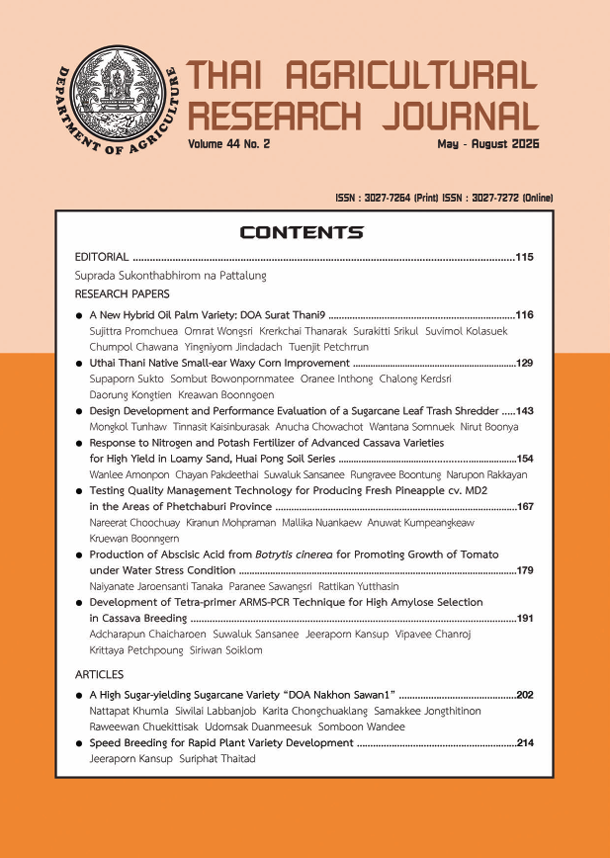
Response to Nitrogen and Potash Fertilizer of Advanced Cassava Varieties for High Yield in Loamy Sand, Huai Pong Soil Series
DOI:
https://doi.org/10.14456/thaidoa-agres.2026.13Keywords:
cassava varieties, fertilizer response, Huai Pong soil seriesAbstract
Cassava varieties differ in their responses to soil nutrient availability. Most cassava growing areas are dominated by sandy loam and sandy soils. This study aimed to determine an appropriate chemical fertilizer rate for advanced cassava varieties grown on Huai Pong soil series, a representative sandy loam soil, in order to develop recommendations for this soil type. The experiment was conducted during 2024/2025 growing season at Rayong Field Crops Research Center. Two experiments were arranged in a split plot design with 3 replications. In both experiments, the main plot consisted of four cassava varieties/genotypes: DOA Rayong9, CMR56-71-68, CMR58-75-110 and CMR59-55-202. The first experiment evaluated the response to nitrogen fertilizer. The subplot consisted of 5 nitrogen application rates: 0, 8, 16, 24 and 32 kg N/rai. All treatments received phosphate and potash fertilizers according to soil analysis recommendations (2–16 kg P2O-K2O /rai). The second experiment evaluated the response of potash fertilizer using the same experiment design. The subplot consisted of 5 potash application rates: 0, 8, 16, 24 and 32 kg K2O/rai. All treatments received nitrogen and phosphate fertilizers based on soil analysis recommendations (16–2 kg N–P2O5/rai). Results showed that CMR59-55-202 produced the highest fresh root yield of 6,423 kg/rai in the nitrogen experiment, with the application of 16 kg N/rai providing the highest net profit of 14,343 baht/rai. In the potash experiment, CMR59-55-202 also achieved the highest fresh root yield and starch yield, reaching 6,250 and 1,760 kg/rai, respectively. The application of 16 kg K2O/rai provided the highest net profit of 13,461 baht/rai. Overall, CMR59-55-202 exhibited greater yield potential than the standard variety DOA Rayong9. The optimum fertilizer rates for this variety under a Huai Pong soil series were 16 kg N/rai and 16 kg K2O/rai, which provided the highest fresh root yield, starch yield, and economic return.
References
กรมพัฒนาที่ดิน. 2548. ความรู้เรื่องชุดดินของประเทศไทย: ชุดดินห้วยโป่ง (Huai Pong Series). สำนักสำรวจดินและวางแผนการใช้ที่ดิน, กรุงเทพฯ.
กรมพัฒนาที่ดิน. 2560. คู่มือการจำแนกเนื้อดินและสมบัติดินเพื่อการใช้ประโยชน์ทางการเกษตร. กรุงเทพฯ. 242 หน้า.
กรมพัฒนาที่ดิน. 2564. ข้อมูลชุดดินเพื่อการใช้ประโยชน์ทางการเกษตร: ชุดดินห้วยโป่ง. กรุงเทพฯ. 2 หน้า.
กรมวิชาการเกษตร. 2564. คำแนะนำการใช้ปุ๋ยตามค่าวิเคราะห์ดินสำหรับพืชไร่เศรษฐกิจ. แหล่งข้อมูล: https://www.doa.go.th/share/showthread.php?tid=2446. สืบค้น: 31 ตุลาคม 2564.
กรมวิชาการเกษตร. 2565. รายงานแผนงานวิจัยและพัฒนาเทคโนโลยีการเพิ่มประสิทธิภาพระบบการผลิตมันสำปะหลังแบบบูรณาการและยั่งยืน ปีงบประมาณ พ.ศ. 2564. กรุงเทพฯ. 121 หน้า.
โชติ สิทธิบุศย์. 2539. แนวทางพัฒนาระบบการให้คำแนะนำการใช้ปุ๋ยกับพืชไร่. กรมวิชาการเกษตร, กรุงเทพฯ. 119 หน้า.
วัลลีย์ อมรพล. 2551. เอกสารวิชาการเรื่อง ธาตุอาหารและการใช้ปุ๋ยกับมันสำปะหลังในภาคตะวันออก. กรมวิชาการเกษตร, กรุงเทพฯ. 73 หน้า.
วัลลีย์ อมรพล ชยันต์ ภักดีไทย สุวลักษณ์ ศันสนีย์ รุ่งรวี บุญทั่ง และนฤพน รักขยัน. 2567. ศึกษาประสิทธิภาพการใช้ธาตุอาหารของมันสำปะหลังสายพันธุ์ก้าวหน้าเพื่อผลผลิตและแป้งสูงในกลุ่มดินทรายปนร่วน-ดินทราย ชุดดินสัตหีบหรือชุดดินห้วยโป่ง. หน้า 90–103. ใน: เอกสารประกอบการประชุมแถลงผลงานวิจัยมันสำปะหลังและอ้อย ประจำปี 2566. 6-7 สิงหาคม 2567. ณ ศูนย์วิจัยพืชไร่ระยอง.
อารันต์ พัฒโนทัย และธนรักษ์ เมฆขยาย. 2534. จากข้อมูลผลการทดลองสู่คำแนะนำเกษตรกร. ศูนย์วิจัยการปรับปรุงข้าวโพดและข้าวสาลีนานาชาติ. 88 หน้า.
Bray, R.H. and L.T. Kurtz. 1945. Determination of total, organic, and available forms of phosphorus in soils. Soil Science. 59(1): 39-46.
CIAT. 1992. Cassava: Research and Development Strategies for Asia. Centro Internacional de Agricultura Tropical. Cali, Colombia. 673 p.
Cock, J.H., D. Franklin, G. Sandoval and P. Juri. 1979. The ideal cassava plant for maximum yield. Crop Science. 19(2): 271–279.
El-Sharkawy, M.A. 2004. Cassava biology and physiology. Plant Molecular Biology. 56: 481–501.
FAO (Food and Agriculture Organization of the United Nations). 2013. Save and Grow: Cassava – A Guide to Sustainable Production Intensification. Rome. 142 p.
Howeler, R.H. 2002. Cassava Mineral Nutrition and Fertilization. pp. 115-147. In: Cassava: Biology, Production and Utilization, R.J. Hillocks, J.M. Thresh and A.C. Bellotti (eds.). CABI Publishing, New York, USA.
Howeler, R.H. 2014. Sustainable Soil and Crop Management of Cassava in Asia: A Reference Manual. International Center for Tropical Agriculture (CIAT) Publication No. 389. Cali, Colombia. 280 p.
Peech, M. 1965. Soil pH by Grass Electrode pH Meter. pp. 914-925. In: Method of Soil Analysis Part 2: Physical and Menerological Properties, Inching Statistics of Measurement and Sampling, C.A. Black, D.D. Evans, R.L. White, L.E. Ensminger, F.E. Clark and R.C. Dinsuer (eds). American Society of Agronomy Inc. Publisher, Madison, USA.
Schollenberger, C.L. and R.H. Simon. 1945. Determination of exchange capacity and exchangeable bases in soil-ammonium acetate method. Soil Science. 59(1): 13-24.
Walkley, A. and C.A. Black. 1934. An examination of Degtjareff method for determining soil organic matter and proposed modification of the chromic acid titration method. Soil Science. 37: 29-39.
Downloads
Published
How to Cite
Issue
Section
License
Copyright (c) 2026 Thai Agricultural Research Journal

This work is licensed under a Creative Commons Attribution-NonCommercial-NoDerivatives 4.0 International License.
Thai Agricultural Research Journal

