
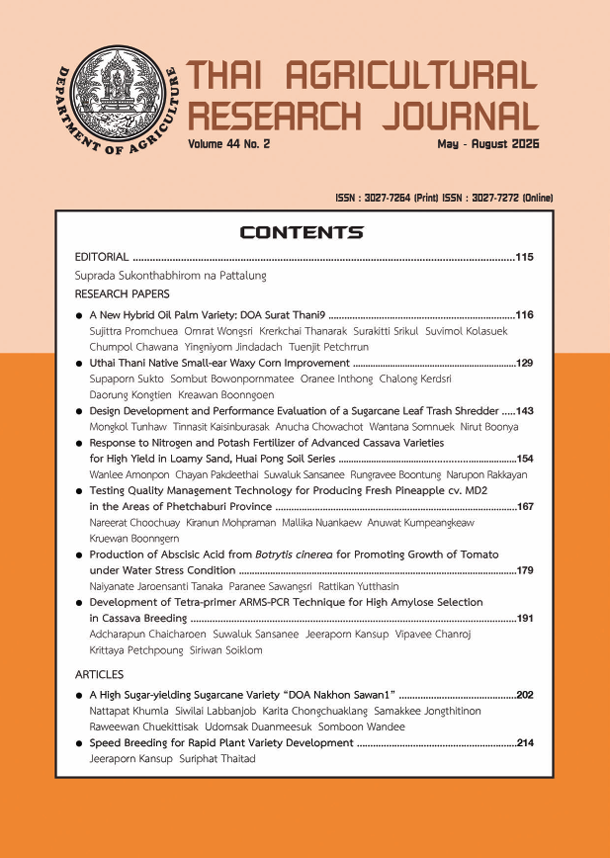
Uthai Thani Native Small-ear Waxy Corn Improvement
DOI:
https://doi.org/10.14456/thaidoa-agres.2026.11Keywords:
small-waxy corn, plant selection, response to selection, coefficient of determinationAbstract
Native waxy corn varieties widely cultivated in Uthai Thani Province are Tein Yao and Tein Kareing. As open-pollination, these varieties have apparent genetic deterioration due to contamination from cross-pollinated, leading to variations in yield and quality. This study aimed to collect, select, and improve the native small-ear waxy corn of Uthai Thani to enhance varietal uniformity, prolific ear formation, and yield potential. From 2018 to 2023, the populations were improved through three cycles S1NRS. Each selection cycle consisted of three steps: 1) self-pollination of population, 2) bulk half-sib pollination in population, and 3) randomly open pollination in population. Selection progress was evaluated in two growing seasons. Selection progress of Tein Yao improved population (YC3) and Tein Kareing improved population (KRC3) was compared to the base population, intermediate cycles, and commercial varieties. Results indicated that YC3 showed consistent positive responses to selection. Unhusked and husked yields increased by 169.1 and 116.2 kg/rai/cycle, respectively. The study also found that the total ear number and first ear number increased by 1,414 and 916 ears/rai, respectively, with high coefficients of determination. In contrast, KRC3 exhibited limited response to selection, with unhusked and husked yields of 61.4 and 39.6 kg/rai/cycle, although relatively high coefficients of determination were observed. Three cycles of S1NRS was effective for improving Tein Yao and Tein Kareing populations with enhanced uniformity, prolific ear production, and high yield. The improved populations can be utilized as open-pollinated varieties and as valuable genetic resources for additional breeding programs focused on waxy corn.
References
กมล เลิศรัตน์. 2536. การปรับปรุงพันธุ์พืชผสมข้าม. ภาควิชาพืชสวน คณะเกษตรศาสตร์ มหาวิทยาลัยขอนแก่น. 95 หน้า.
กรมวิชาการเกษตร. 2539. พันธุ์พืชไร่. โรงพิมพ์คุรุสภา, กรุงเทพฯ. 143 หน้า.
คมสัน อำนวยสิทธิ์. 2544. ข้าวโพดหวานฝักเล็กพันธุ์ “เทียนหวานพิษณุโลก”. วารสารเกษตรพระจอมเกล้า. 19(3): 58–65.
ฉลอง เกิดศรี วรรษมน มงคล เชาวนาถ พฤทธิเทพ สุภาพร สุขโต ปวีณา ไชยวรรณ์ ศุภวรรณ มาดหมาย สุพรรณณี เป็งคำ ภาคภูมิ ถิ่นคำ ฉัตรชีวิน ดาวใหญ่ ศิวกร เกียรติมณีรัตน์ สมบูรณ์ วันดี โสพิศ ใจปาละ สายชล บุญรัศมี อำไพ ประเสริฐสุข วิลัยรัตน์ แป้นแก้ว วิภารัตน์ ดำริเข้มตระกูล อนุชา เหลาเคน วลีรัตน์ วรกาญจนบุญ และธีรวุฒิ วงศ์วรัตน์. 2564. กิจกรรมงานวิจัยที่ 2 การวิจัยและพัฒนาพันธุ์ข้าวโพดข้าวเหนียว. หน้า 29-84. ใน: รายงานโครงการวิจัยการปรับปรุงพันธุ์ข้าวโพดฝักสด. กรมวิชาการเกษตร.
ปราโมทย์ พรสุริยา ประพฤติ พรหมสมบูรณ์ และหนูจันทร์ ศิริสุวรรณ์. 2563. การประเมินสายพันธุ์ข้าวโพดเทียนที่คัดเลือกจากพันธุ์พื้นเมือง. วารสารเกษตรศาสตร์และเทคโนโลยี. 1(3): 22-32.
ภราดร อุปพงษ์ กมล เลิศรัตน์ และพลัง สุริหาร. 2560. การคัดเลือกพันธุ์แบบหมู่ประยุกต์จำนวน 4 รอบ เพื่อเพิ่มลักษณะฝักดกในประชากรข้าวโพดเทียนสีม่วง. วารสารแก่นเกษตร. 45(1): 143-152.
วทัญญู ขามเกาะ พลัง สุริหาร กมล เลิศรัตน์ ดนุพล เกษไธสง และคมศร ลมไธสง. 2561. การตอบสนองต่อการคัดเลือกด้วยวิธีแบบวงจรพื้นฐานของผลผลิตในประชากรข้าวโพดข้าวเหนียวสีส้ม. วารสารแก่นเกษตร. 46(1): 43-50.
วสุ สันติมิตร สุชาดา บุญเลิศนิรันดร์ และอรุณี คงสอน. 2558. การพัฒนาเทคโนโลยีการปลูกข้าวโพดเทียนบ้านเกาะแบบมีส่วนร่วมภายใต้สภาพและปัญหาของเกษตรกร. มหาวิทยาลัยเทคโนโลยีราชมงคลราชมงคลสุวรรณภูมิ. 38 หน้า.
สถาบันวิจัยพืชไร่และพืชทดแทนพลังงาน. 2562. คู่มือ การบันทึกข้อมูลงานวิจัยพืชไร่และพืชทดแทนพลังงาน. กรมวิชาการเกษตร, กรุงเทพฯ. 290 หน้า.
สำนักคุ้มครองพันธุ์พืช. 2568. แบบบันทึกลักษณะประจำพันธุ์ ข้าวโพด. แหล่งข้อมูล: https://www.doa.go.th/pvp/?page_id=906. สืบค้น: 11 มีนาคม 2568.
สุภาพร สุขโต. 2555. ข้าวโพดตักหงายพืชท้องถิ่นจังหวัดเลย. หนังสือพิมพ์กสิกร. 85(3): 18-20.
สุภาพร สุขโต สมบัติ บวรพรเมธี อรนี อินทร์ทอง ฉลอง เกิดศรี สงัด ดวงแก้ว ดาวรุ่ง คงเทียน และเครือวัลย์ บุญเงิน. 2567. การคัดเลือกและปรับปรุงประชากรแบบ S1RS โดยไม่ทดสอบรุ่นลูกในข้าวโพดพื้นเมืองกะเหรี่ยงอุทัย. วารสารแก่นเกษตร. 52(2): 261-272.
อุดม วงศ์ชนะภัย เพ็ญลักษณ์ ชูดี และสุภาพร สุขโต. 2564. ความสำคัญของข้าวโพดฝักสดในภาคกลางและภาคตะวันตก. น. 1-17. ใน: การจัดการความรู้ เทคโนโลยีการผลิตข้าวโพดฝักสดที่เหมาะสมในเขตพื้นที่ภาคกลางและภาคตะวันตก. สำนักวิจัยและพัฒนาการเกษตรเขตที่ 5, ชัยนาท.
Ajala, S.O., J.G. Kling, S.K. Kim and A.O. Obajimi. 2003. Improvement of maize populations for resistance to downy mildew. Plant Breeding. 122(4): 328-333.
Allard, R.W. 1960. Principles of Plant Breeding. John Wiley & Sons, New York. 485 p.
Dhillon, B.S. and A.S. Khehra. 1989. Modified S1 recurrent selection in maize improvement. Crop Science. 29(1): 226-228.
Falconer, D.S. and T.F.C. Mackay. 1996. Introduction to Quantitative Genetics. 4th Ed, Longman Scientific and Technical, Harlow. 464 p.
Fehr, W.R. 1991. Principles of Cultivar Development. Vol 1. Macmillan Publishing Company, New York. 536 p.
Galarreta, J.I.R. and A. Álvarez. 2007. Six cycles of S1 recurrent selection in two Spanish maize synthetics. Spanish Journal of Agricultural Research. 5(2): 193-198.
Gomez, K.A. and A.A. Gomez. 1984. Statistical Procedure for Agricultural Research. 2nd Ed, John Wiley and Sons, New York. 680 p.
Hallauer, A.R. and J.B. Miranda. 1988. Quantitative Genetics in Maize Breeding. 2nd ed. Iowa State University Press, Ames. 468 p.
Jenweerawat, S., C. Aekatasanawan, P. Laosuwan and A.R. Hallauer. 2010. Potential lines and hybrids developed from modified reciprocal recurrent selection in maize. Agriculture and Natural Resources. 44(4): 517–522.
Koirala, K.B., D.B. Gurung, B. Bhandari and J.B. Chhetri. 2014. Population Improvement of Yellow and White Maize through Reciprocal Recurrent Selection. pp. 130-132. In: Proceedings of the 27th National Summer Crops Workshop Vol 2, 18-20th April 2013. Nepal Agricultural Research Council.
Sarquls, J.I., H. Gonzalez and J.R. Dunlap. 1998. Yield response of two cycles of selection from a semiprolific early maize (Zea mays L.) population to plant density, sucrose infusion and pollination control. Field Crops Research. 55(1-2): 109-116.
Sekhon R.S., B.S. Dhillon, V.K. Saxena and M.S. Grewal. 1999. Modified S1 recurrent selection in a maize composite. Maydica. 44(2): 175-177.
Sukto, S., K. Lomthaisong, J. Sanitchon, S. Chankaew, M.P. Scott, T. Lubberstedt, K. Lertrat and B. Suriharn. 2020. Variability in prolificacy, total carotenoids, lutein, and zeaxanthin of yellow small-ear waxy corn germplasm. International Journal of Agronomy. 2020(1): 8818768.
Xiaoyang, W., C. Dan, L. Yuqing, L. Weihua, Y. Xinming, L. Xiuquan, D. Juan and L. Lihui. 2017. Molecular characteristics of two new waxy mutations in China waxy maize. Molecular Breeding. 37(3): 27.
Zhou, Z., L. Song, X. Zhang, X. Li, N. Yan, R. Xia, H. Zhu, J. Weng, Z. Hao, D. Zhang, H. Yong, M. Li and S. Zhang. 2016. Introgression of opaque2 into waxy maize causes extensive biochemical and proteomic changes in endosperm. PLoS One. 11(7): e0158971.
Downloads
Published
How to Cite
Issue
Section
License
Copyright (c) 2026 Thai Agricultural Research Journal

This work is licensed under a Creative Commons Attribution-NonCommercial-NoDerivatives 4.0 International License.
Thai Agricultural Research Journal

