
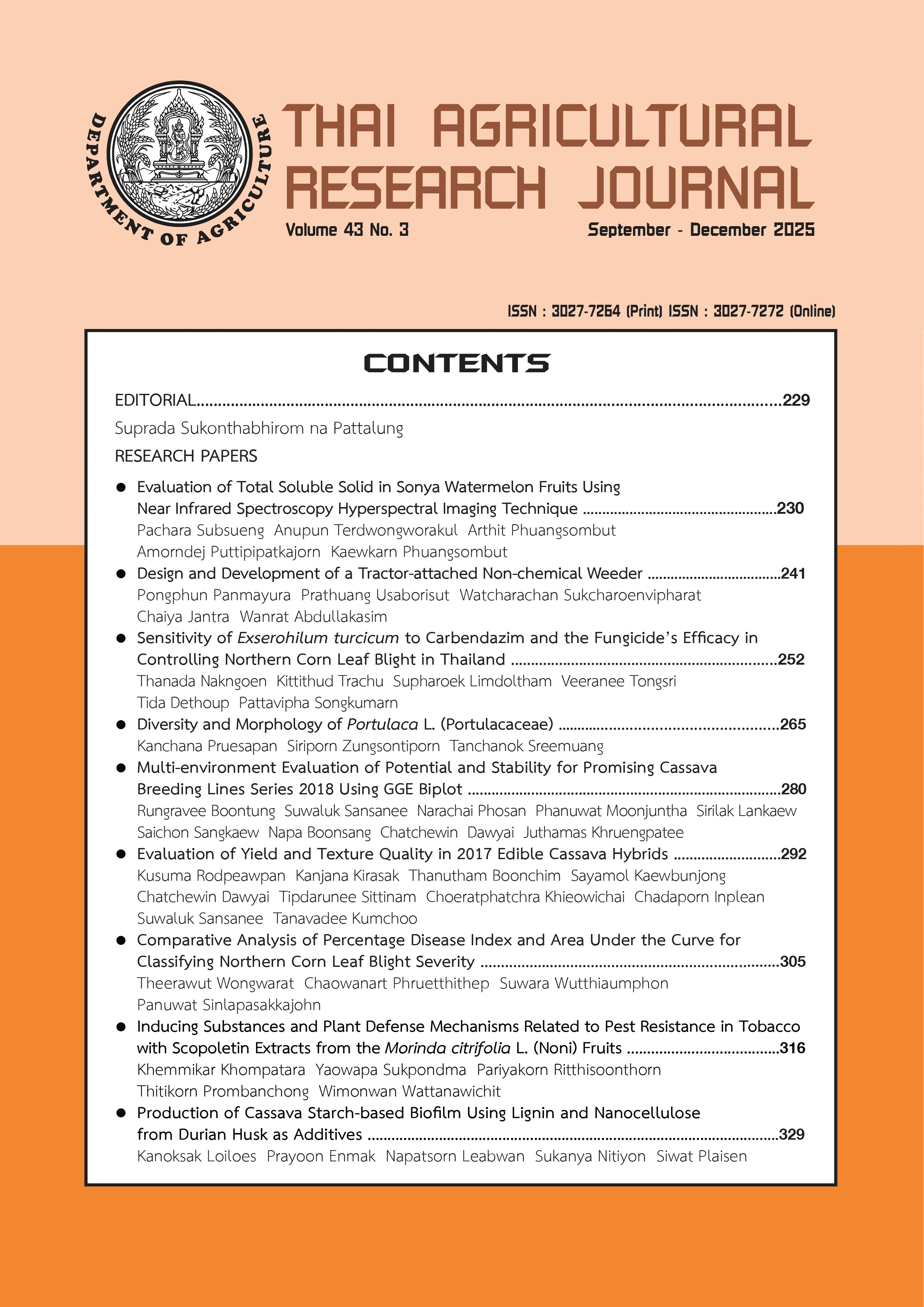
Evaluation of Yield and Texture Quality in 2017 Edible Cassava Hybrids
DOI:
https://doi.org/10.14456/thaidoa-agres.2025.23Keywords:
edible cassava, yield performance, steamed cassava, texture, GGE analysisAbstract
Evaluating the yield performance of new cassava varieties under diverse environmental conditions is a crucial step in identifying promising varieties for dissemination to farmers. The objective of this research was to evaluate the yield potential and textural quality of 2017 edible cassava hybrids across multiple environments. A randomized complete block design in three replications was conducted from May 2022 to May 2023 across six environments—Rayong, Khon Kaen, Sukhothai, Lop Buri, Kanchanaburi, and Songkhla provinces—using four edible cassava hybrids (CMRE60-03-02, CMRE60-03-13, OMRE60-01-02, and OMRE60-02-12) and two check varieties (Hanatee and DOA Rayong2). The results from combined analysis of variance indicated that the OMRE60-01-02, CMRE60-03-13, and CMRE60-03-02 lines had similar average fresh root yield of 4,794, 4,538 and 4,207 kg/rai, respectively. These three varieties showed significantly higher average fresh root yield than the two check varieties, being 70, 61 and 49% higher than Hanatee, and 57, 48 and 38% higher than DOA Rayong2, respectively. The GGE biplot analysis indicated that the OMRE60-01-02 line had the highest average fresh root yield and high yield stability, while the CMRE60-03-13 line exhibited lower yield stability but no significant difference in average fresh root yield with the OMRE60-01-02 line. Meanwhile, Hanatee exhibited the highest yield stability but the lowest yield. Steamed cassava from the CMRE60-03-13 line had a higher textural quality than that from Hanatee and OMRE60-01-02. Therefore, the hybrid cassava line CMRE60-03-13 is suitable for recommendation to farmers due to its high yield and desirable textural quality when steamed.
References
กุสุมา รอดแผ้วพาล อดิศักดิ์ สายนภา และจิณณจาร์ หาญเศรษฐสุข. 2561. การปรับปรุงพันธุ์มันสำปะหลังเพื่อบริโภค : การคัดเลือกปีที่ 2 (ลูกผสมปี 2560). แหล่งข้อมูล: https:// www.doa.go.th/plan/wpcontent/uploads/2021/05/142.3การปรับปรุงพันธุ์มันสำปะหลังเพื่อบริโภค-การคัดเลือกปีที่-2-ลูกผสม ปี-2560.pdf. สืบค้น: 11 ตุลาคม 2567.
กุสุมา รอดแผ้วพาล จิณณจาร์ หาญเศรษฐสุข และอดิศักดิ์ สายนภา. 2563ก. การปรับปรุงพันธุ์มันสำปะหลังเพื่อบริโภค : การเปรียบเทียบเบื้องต้น (ลูกผสมปี 2560) แหล่งข้อมูล: https://www.doa.go.th/plan/wp-content/uploads/2021 /05/142.4การปรับปรุงพันธุ์มันสำปะหลังเพื่อบริโภค-เปรียบเทียบเบื้องต้น-ลูกผสมปี-2560.pdf. สืบค้น: 11 ตุลาคม 2567.
กุสุมา รอดแผ้วพาล รวีวรรณ เชื้อกิตติศักดิ์ ทนุธรรม บุญฉิม วารีย์ ทองมี สุวลักษณ์ อะมะวัลย์ ธนาวดี ค้ำชู ศฐาคุปต์ เคน นากาชิมา จิณณจาร์ หาญเศรษฐสุข และอดิศักดิ์ สายนภา. 2563ข. การปรับปรุงพันธุ์มันสำปะหลังเพื่อบริโภค : การเปรียบเทียบมาตรฐาน (ลูกผสมปี 2560) แหล่งข้อมูล: https://www.doa.go.th/plan/wp-ontent/uploads/2023/ 07/152.5.pdf. สืบค้น: 11 ตุลาคม 2567.
กุสุมา รอดแผ้วพาล ชฎาพร อินเปลี่ยน สุวลักษณ์ ศันสนีย์ และธนาวดี ค้ำชู. 2567. การเปรียบเทียบสายพันธุ์/พันธุ์มันสำปะหลังบริโภค และอายุเก็บเกี่ยวที่เหมาะสมสำหรับการแปรรูปเป็นเฟรนซ์ฟรายส์. วารสารวิชาการเกษตร. 42(2): 131 -144.
จิณณจาร์ หาญเศรษฐสุข. 2552. คุณสมบัติและประโยชน์ของหัวและแป้งมันสำปะหลัง. ศูนย์วิจัยพืชไร่ระยอง กรมวิชาการเกษตร. 80 หน้า.
จำลักษณ์ ศรีปัญญา วิจารณ์ วิชชุกิจ เจริญศักดิ์ โรจนฤทธิ์พิเชษฐ์ วัชรี เลิศมงคล เอ็จ สโรบล ประภาส ช่างเหล็ก และสุภาวดี บุญมา. 2550. เสถียรภาพการให้ผลผลิตของมันสำปะหลังสายพันธุ์ดีเด่นของมหาวิทยาลัย เกษตรศาสตร์. แหล่งข้อมูล: https://agkb.lib.ku.ac.th/ ku/search_detail/ result/10151. สืบค้น: 28 เมษายน 2568.
เจริญศักดิ์ โรจนฤทธิ์พิเชษฐ์ ปิยวุฒิ พูลสงวน สมยศ พุทธเจริญ จำลอง เจียมจำนรรจา และวิทยา แสงแก้วสุข. 2530.การศึกษาฤดูปลูกมันสำปะหลัง. วารสารเกษตรศาสตร์ (วิทย.). 21(2): 119-125.
ชูศักดิ์ จอมพุก. 2562. วิธีวิเคราะห์ทางพันธุศาสตร์ปริมาณในการปรับปรุงพันธุ์พืช. มหาวิทยาลัยเกษตรศาสตร์. 507 หน้า.
ชัยวัช โซวเจริญสุข. 2566. มันสำปะหลัง. แหล่งข้อมูล: https://www.krungsri.com/th/research/industry/industry/outlook/agriculture/cassava/io/cassava-2023-2025. สืบค้น: 1 พฤษภาคม 2568.
ธัญญาภรณ์ ศิริเลิศ. 2550. การประเมินลักษณะเนื้อสัมผัสในอาหาร. วารสารเทคโนโลยีการอาหาร มหาวิทยาลัยสยาม. 3(1): 6-13.
นงนุช สิริวงศ์. 2006. การศึกษาปัจจัยที่มีผลต่อเนื้อสัมผัสของมันสำปะหลังต้มสุกในมันสำปะหลังชนิดไซยาไนด์ต่ำ. วิทยานิพนธ์ดุษฎีบัณฑิต. มหาวิทยาลัยพระจอมเกล้าพระนครเหนือ. กรุงเทพฯ.
นิรนาม. 2561. เฟรนช์ฟรายส์จากมันสำปะหลังห้านาที! อัพมูลค่าขนมขบเคี้ยวมีแคลเซียมไร้สาร. แหล่งข้อมูล:https://www.naewna.com/likesara/342432. สืบค้น: 11 ตุลาคม 2567.
สถาบันวิจัยพืชไร่และพืชทดแทนพลังงาน. 2558. แบบบันทึกข้อมูลงานวิจัยมันสำปะหลัง. หน้า 15-28. ใน: คู่มือการบันทึกข้อมูลงานวิจัยพืชไร่และพืชทดแทนพลังงาน กรมวิชาการเกษตร, กรุงเทพฯ.
สถาบันวิจัยและพัฒนาแห่งมหาวิทยาลัยเกษตรศาสตร์. 2558. มันสำปะหลัง: การใช้ประโยชน์ผลิตภัณฑ์จากมันสำปะหลัง แหล่งข้อมูล: https://www3.rdi.ku.ac. th/?p=17866. สืบค้น: 1 พฤษภาคม 2568.
สุวลักษณ์ อะมะวัลย์ จิณณจาร์ หาญเศรษฐสุข และอดิศักดิ์ สายนภา. 2560ก. การปรับปรุงพันธุ์มันสำปะหลังเพื่อบริโภค:การผสมพันธุ์ (ลูกผสมชุดปี 2560) แหล่งข้อมูล: https:// www.doa.go.th/plan/wpcontent/uploads/2021/05/182.1การปรับปรุงพันธุ์มันสำปะหลังเพื่อบริโภค-การผสมพันธุ์-ลูกผสมชุดปี-2560-.pdf. สืบค้น: 11 ตุลาคม 2567.
สุวลักษณ์ อะมะวัลย์ จิณณจาร์ หาญเศรษฐสุข กุลชาต นาคจันทึก กุสุมา รอดแผ้วพาล และวันปิติ บัวขาว. 2560ข. การปรับปรุงพันธุ์มันสำปะหลังเพื่อบริโภค: การคัดเลือกปีที่ 1 (ลูกผสมชุดปี 2560 ) รายงานผลงานเรื่องเต็มการทดลองที่สิ้นสุด. แหล่งข้อมูล: https://
www.doa.go.th/plan/wp-content/uploads/2021/05/182.2 การปรับปรุงพันธุ์มันสำปะหลังเพื่อบริโภค-การคัดเลือกปีที่-1-ลูกผสมปี-2560.pdf. สืบค้น: 11 ตุลาคม 2567.
สุวลักษณ์ อะมะวัลย์. 2564. โครงการวิจัยและพัฒนาพันธุ์มันสำปะหลังเพื่อเพิ่มประสิทธิภาพการผลิต. แหล่งข้อมูล: https://www.doa.go.th/research/research-detail. php?id=3097. สืบค้น: 11 ตุลาคม 2567.
อาทิตย์ ลมูลปลั่ง. 2561. มันสำปะหลังพันธุ์ใหม่‘พิรุณ 4’‘ปลอดกลูเตน’สู่เมนูขนมเลิศรส. แหล่งข้อมูล: https://www.posttoday.com/business/575452. สืบค้น: 11 ตุลาคม 2567.
โอภาษ บุญเส็ง. 2563. มันสำปะหลังไทย ชีววิทยา การผลิต และการแปรรูป. ม.ป.พ. 425 หน้า.
Amarullah. 2020. Evaluation of quality and variety of Indonesian cassava (Manihot esculenta Crantz). International Journal of Agricultural Research, Innovation and Technology. 10(1): 108-116.
Eberhart, S.A. and W.A. Russell. 1966. Stability parameters for comparing varieties. Crop Science. 6(1): 36-40.
Eggleston, G. and R. Asiedu. 1994. Effects of boiling on texture of cassava clones: A comparison of compressive strength, intercellular adhesion and physicochemical composition of the tuberous roots. Tropical Science. 34: 259–273.
Lawal O.O., J.O. Yusuf, O.L. Abdulrahman, I.F. Ayanda, Y.O. Ambali and U.Y. Ibrahim. 2021. On-farm phenotypic evaluation and stability analysis of provitamin A cassava (Manihot esculenta) varieties for agronomic traits, stress tolerance and tuber yield across Kwara state, Nigeria. Tropical Agriculture (Trinidad). 98:(1): 1-15.
Ndubuisi, N.D. and A.C.U. Chidiebere. 2018. Cyanide in cassava: A review. International Journal of Genomics and Data Mining. 02: 1-10.
Ngeve, J.M. 2003. Cassava root yields and culinary qualities as affected by harvest age and test environment. Journal of the Science of Food and Agriculture. 83(4): 249–257.
Noerwijati, K., Nasrullah, T. Taryono and D. Prajitno. 2014. Fresh tuber yield stability analysis of fifteen cassava genotypes across five environments in East Java (Indonesia) using GGE biplot. Energy Procedia. 47: 156-165.
Maieves, H.A., D.C.D. Oliveira, C. Bernardo, C.M.D.O. Müller and E.R. Amante. 2012. Microscopy and texture of raw and cooked cassava (Manihot Esculenta Crantz) roots. Journal of Texture Studies. 43(2): 164-173.
Mtunguja, M.K., H.S. Laswai, E. Kanju, J. Ndunguru and Y.C. Muzanila. 2016. Effect of genotype and genotype by environment interaction on total cyanide content, fresh root, and starch yield in farmer-preferred cassava landraces in Tanzania. Food Science & Nutrition. 4(6): 791-801.
Ogbonna, A.C., L.R. Braatz de Andrade, I.Y. Rabbi, L.A. Mueller, E.J. de Oliveira and G.J. Bauchet. 2021. Large-scale genome-wide association study, using historical data, identifies conserved genetic architecture of cyanogenic glucoside content in cassava (Manihot esculenta Crantz) root. The Plant Journal. 105(3): 754-770.
Sundaresan, S., B. Nambisan and A. Eswari. 1987. Bitterness in cassava in relation to cyanoglucoside content. Indian Journal Agricultural Science. 57(1): 37–40.
Williams, H.J. and T.G. Edwards. 1980. Estimation of cyanide with alkaline picrate. Journal of the Science of Food and Agriculture. 31(1): 15-22.
Yan, W., L.A. Hunt, Q. Sheng and Z. Szlavnics. 2000. Cultivar evaluation and mega environment investigation based on the GGE biplot. Crop Science. 40(3): 597-605.
Downloads
Published
How to Cite
Issue
Section
License
Copyright (c) 2025 Thai Agricultural Research Journal

This work is licensed under a Creative Commons Attribution-NonCommercial-NoDerivatives 4.0 International License.
Thai Agricultural Research Journal

