
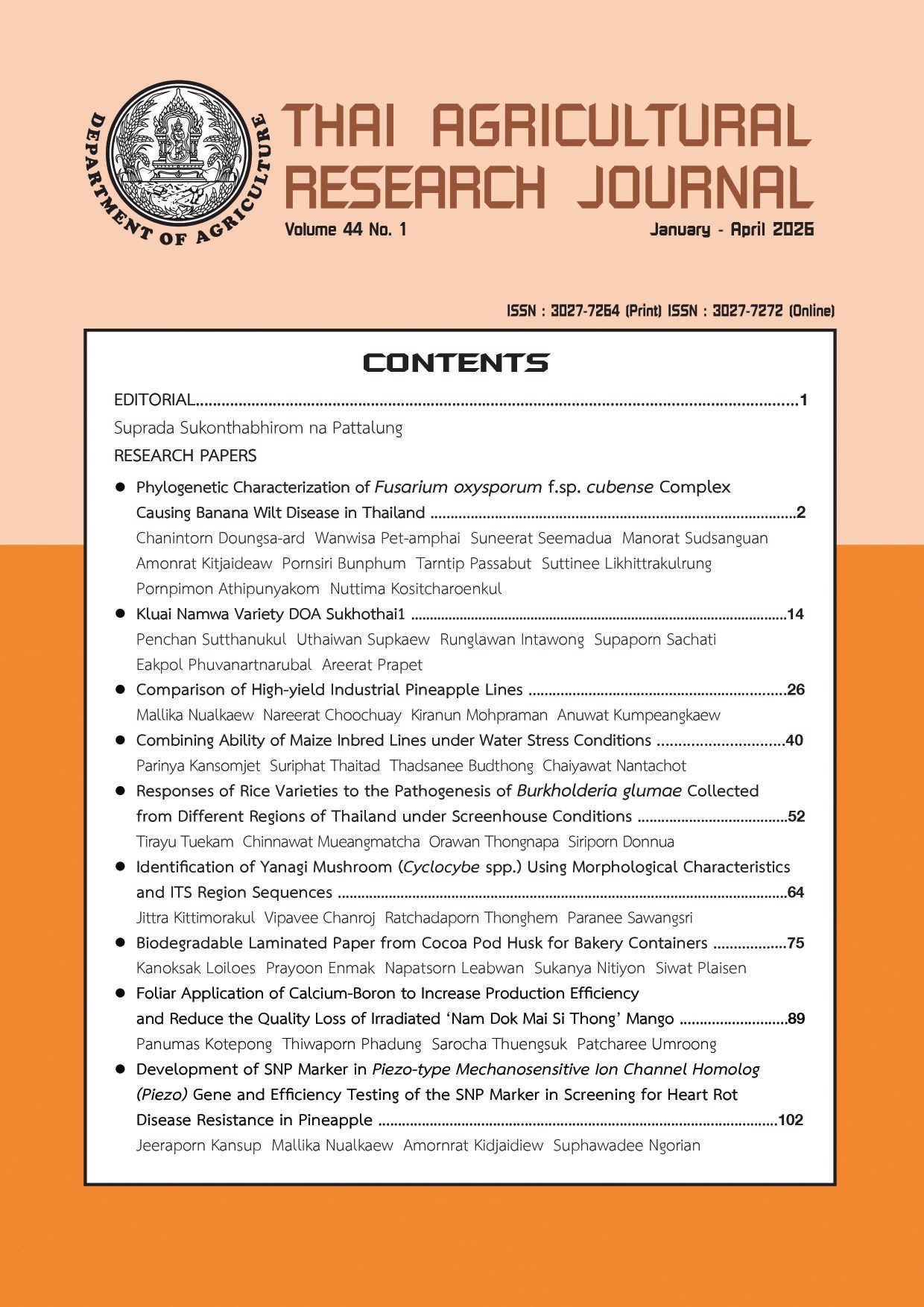
Responses of Rice Varieties to the Pathogenesis of Burkholderia glumae Collected from Different Regions of Thailand under Screenhouse Conditions
DOI:
https://doi.org/10.14456/thaidoa-agres.2026.5Keywords:
bacteria, clustering, rice, sheath rot, panicle blightAbstract
The bacterial pathogen, Burkholderia glumae, can cause severe damage in rice in many countries. The B. glumae disease causes rotting seedlings, rotting leaf sheaths, rotting seeds, burning ears, and significant yield loss. The B. glumae has multiple isolates, each responding differently to each rice line/variety. Thus, the responses of different rice lines/varieties to the bacteria can be used to classify the bacterial groups. This study aims to assess the response of rice lines/varieties to the pathogenicity of B. glumae in greenhouse conditions. The samples of B. glumae were collected from rice fields in 41 districts in 10 provinces in the central, northern, and northeastern regions of Thailand. Thirty-eight isolates of B. glumae were found. Twenty-six isolates were selected and grouped according to their ability to cause disease in 20 rice lines/varieties. The inoculation procedure was done by injecting suspended B. glumae cells (1 x 10⁸ CFU/mL, O.D.600 = 0.2) into leaf sheaths of the 45-day-old rice planted in greenhouses to assess their response to disease. The phylogenetic tree was also analyzed using the Bay-Curtis method to group the B. glumae. The results from the analysis can classify the B. glumae into a total of four groups. The B. glumae isolates from Buriram province are the most diverse and were classified into three groups, followed by the isolates from Phrae and Roi Et provinces, which were each classified into two groups.
References
กรมวิชาการเกษตร. 2550. ประกาศกระทรวงเกษตรและสหกรณ์ เรื่อง กําหนดศัตรูพืชเป็นสิ่งต้องห้ามตามพระราชบัญญัติกักพืช พ.ศ. 2507 (ฉบับที่ 6) พ.ศ. 2550. แหล่งข้อมูล: https://www.doa.go.th/ard/wp-content/uploads/2019/10/ประกาศกระทรวงเกษตรและสหกรณ์ เรื่อง กำหนดศัตรูพืชเป็นสิ่งต้องห้าม ฉบับที่ 6. สืบค้น: 13 ตุลาคม 2568.
กวินธรรพ์ บุบผา เทิดศักดิ์ สวัสดิ์สุข รัศมี ฐิติเกียรติพงศ์ ศิริพร กออินทร์ศักดิ์ และจินตนา อันอาตม์งาม. 2559. การสำรวจโรคเมล็ดด่างข้าวที่เกิดจากเชื้อราและการพัฒนาวิธีการประเมินโรคในสภาพโรงเรือน. วารสารวิทยาศาสตร์เกษตร. 47(3): 339-349.
จิตรา สุวรรณ์ เฉลิมพล ภูมิไชย์ และธานี ศรีวงศ์ชัย. 2562. ความหลากหลายของลักษณะทางสัณฐานวิทยาและการจัดกลุ่มพันธุ์ข้าวพื้นเมืองไทย. หน้า 750-760. ใน: การประชุมวิชาการเสนอผลงานวิจัยระดับบัณฑิตศึกษาแห่งชาติ ครั้งที่ 20. 15 มีนาคม 2562 อาคารพจน์ สารสิน มหาวิทยาลัยขอนแก่น.
บุณยาพร ภาคภูมิ และศิริพร ดอนเหนือ. 2562. การศึกษาเชื้อ Burkholderia glumae และ B. gladioli สาเหตุโรคของข้าวในประเทศไทย. วารสารวิทยาศาสตร์เกษตรและการจัดการ. 2(2): 48-58.
วันวิสาข์ เพ็ชรอำไพ จุฑาเทพ วัชระไชยคุปต์ สุจินต์ ภัทรภูวดล และวิชัย โฆสิตรัตน. 2560. การจำแนกเชื้อแบคทีเรียสาเหตุโรครวงไหม้ และเมล็ดด่างของข้าวโดยการวิเคราะห์ลำดับเบสของกลุ่มยีน. วารสารวิทยาศาสตร์และนวัตกรรมการเกษตร. 48(2): 297-311.
วนิดา ธรรมธุระสาร ศิริพร ดอนเหนือ ศิริพร กออินทร์ศักดิ์ และจินตนา อันอาตม์งาม. 2562. การประเมินความต้านทานต่อโรคกาบใบเน่าและโรคเมล็ดด่างข้าวที่เกิดจากเชื้อรา Sarocladium oryzae. วารสารเกษตร. 35(1): 113-123.
อริษา จิตรติกรกุล พยอม โคเบลลี่ ไอลดา ชุมแสง ศุภลักษณา สนคงนอก คนึงนิจ ศรีวิลัย อังคณา กันทาจันทร์ กิตติพงษ์ ศรีม่วง พสชนัน ชัยวิริยะพงศ์ สมศักดิ์ ลีลากุด พิกุล ลีลากุด สุนิตา ปาวะรีย์ และธีรดา หวังสมบูรณ์ดี. 2567. การสํารวจและตรวจเชื้อ Burkholderia glumae และ Burkholderia gladioli สาเหตุโรครวงไหม้ของข้าวในประเทศไทยด้วยวิธีทางชีวโมเลกุล. วารสารวิชาการข้าว. 15(1): 92-110.
Chen, Q., Y. Hu, W. Shen and A. Zhang. 2025. Evaluation of rice blast resistance and R gene analysis in japonica rice varieties tested in the Anhui region. Agronomy. 15(5): 1008.
Ham, J.H., R.A. Melanson and M.C. Rush. 2011. Burkholderia glumae: Next major pathogen of rice? Molecular Plant Pathology. 12(4): 329–339.
Jungkhun, N., A.R.G. Farias, J. Watcharachaiyakup, N. Kositcharoenkul, J.H. Ham and S. Patarapuwadol. 2022. Phylogenetic characterization and genome sequence analysis of Burkholderia glumae strains isolated in Thailand as the causal agent of rice bacterial panicle blight. Pathogens. 11(6): 676.
Maeda, Y., H. Shinohara, A. Kiba, K. Ohnishi, N. Furuya, Y. Kawamura, T. Ezaki, P. Vandamme, S. Tsushima and Y. Hikichi. 2006. Phylogenetic study and multiplex PCR-based detection of Burkholderia plantarii, Burkholderia glumae and Burkholderia gladioli using gyrB and rpoD sequences. International Journal of Systematic and Evolutionary Microbiology. 56(5): 1031-1038.
McMaugh, T. 2005. Guidelines for Surveillance for Plant Pests in Asia and the Pacific. Australian Centre for International Agricultural Research (ACIAR) Monograph No. 119. 192 p.
Mizobuchi, R., S. Fukuoka, C. Tsuiki, S. Tsushima and H. Sato. 2018. Evaluation of major Japanese rice cultivars for resistance to bacterial grain rot caused by Burkholderia glumae and identification of standard cultivars for resistance. Breeding Science. 68(4): 413–419.
Schaad, N.W., J.B. Jone and W. Chun. 2001. Laboratory Guide for Identification of Plant Pathogenic Bacteria. American Phytopathological Society, Saint Paul, Minnesota. USA. 373 p.
Yuan, X. 2004. Identification of Bacterial Pathogens Causing Panicle Blight of Rice in Louisiana. Master's thesis. Louisiana State University, USA. 97 p.
Zhu, B., M. Lou, Y. Huai, G. Xie, J. Luo and L. Xu. 2008. Isolation and identification of Burkholderia glumae from symptomless rice seeds. Rice Science. 15(2): 145-149.
Downloads
Published
How to Cite
Issue
Section
License
Copyright (c) 2026 Thai Agricultural Research Journal

This work is licensed under a Creative Commons Attribution-NonCommercial-NoDerivatives 4.0 International License.
Thai Agricultural Research Journal

