
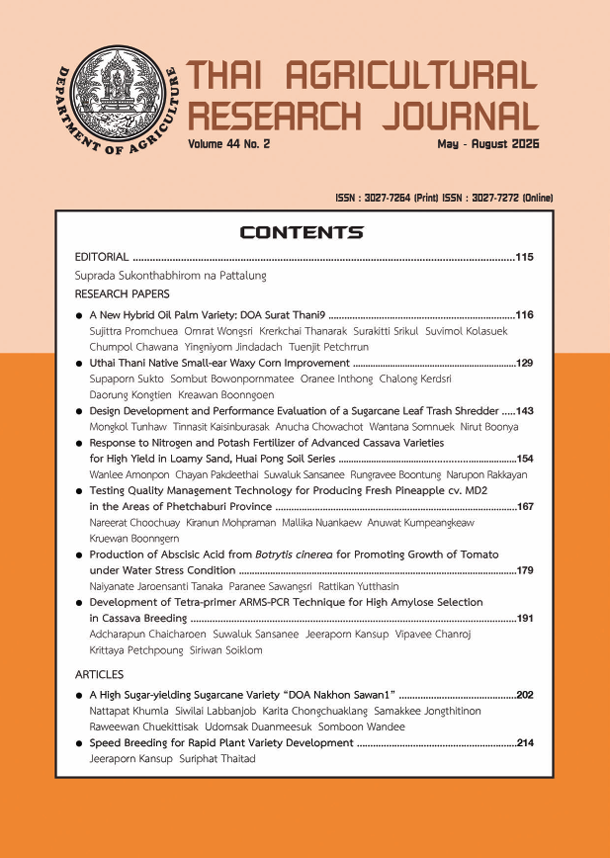
A New Hybrid Oil Palm Variety: DOA Surat Thani9
DOI:
https://doi.org/10.14456/thaidoa-agres.2026.10Keywords:
hybrid oil palm, DOA Surat Thani9, oil palm breeding, oil palm varietal developmentAbstract
The hybrid oil palm DOA Surat Thani9 was developed under the oil palm breeding program, phase 2, using the modified reciprocal recurrent selection method. The elite maternal and paternal parents were selected to generate 69 hybrid combinations. Subsequently, extensive progeny testing was done to identify crosses with fresh fruit bunch (FFB) yield, crude palm oil (CPO) yield, and bunch components exceeding the DOA’s standards at the Surat Thani Oil Palm Research Center between 2001 and 2017. Five crosses of oil palm were evaluated with DOA Surat Thani3 as the standard cross using a randomized complete block design with 4 replications. The results demonstrated that the DOA Surat Thani9, a cross between the maternal parent 68/374D (Deli Dura group) and the paternal parent 125/154T (AVROS group), was the superior performer with an average FFB yield of 3,773 kg/rai/year during the age period of 3-10 years, surpassing the standard cross by 31.4%. Specifically, the early productive phase (age of 3–4 years) gave an average FFB yield of 1,908 kg/rai/year, while the full maturity phase (age of 6–10 years) gave a higher yield of 4,634 kg/rai/year. These high yields were attributed to an average of 13.5 bunches/palm/year, an average bunch weight of 12.8 kg/bunch, and a high CPO yield averaging 817.8 kg/rai/year because of a high mesocarp content and oil-to-bunch ratio. Yield components analysis of DOA Surat Thani9 revealed that fresh mesocarp/fruit, shell/fruit, kernel/fruit, and oil-to-bunch were 86.0, 7.5, 6.6 and 25.5%, respectively. It has been determined as the recommended variety of the Department of Agriculture under the name of Surat Thani9. This variety can contribute to decreasing the country's reliance on imported oil palm seeds for planting.
References
ชัยวัช โซวเจริญสุข. 2568. แนวโน้มธุรกิจ/อุตสาหกรรม ปี 2568-2570: อุตสาหกรรมน้ำมันปาล์ม. แหล่งข้อมูล: https://www.krungsri.com/th/research/industry/industry-outlook/agriculture/palm-oil/io/plam-oil-industry-2025-2027. สืบค้น: 3 สิงหาคม 2568.
สุจิตรา พรหมเชื้อ อรรัตน์ วงศ์ศรี และวิชณีย์ ออมทรัพย์สิน. 2564. การศึกษาผลของอุณหภูมิและปริมาณน้ำฝนต่อผลผลิตปาล์มน้ำมันลูกผสมสุราษฎร์ธานี 7 8 และ 9 ในจังหวัดสุราษฎร์ธานี. หน้า 97-106. ใน: รายงานโครงการวิจัยและพัฒนาเทคโนโลยีเพิ่มประสิทธิภาพการผลิตปาล์มน้ำมัน 2564. ศูนย์วิจัยปาล์มน้ำมันสุราษฎร์ธานี กรมวิชาการเกษตร.
สำนักงานเศรษฐกิจการเกษตร. 2568. ข้อมูลการผลิตสินค้าเกษตร: ปาล์มน้ำมัน. แหล่งข้อมูล: https://oae.go.th/home/article/516. สืบค้น: 3 สิงหาคม 2568
อรรัตน์ วงศ์ศรี และศิริชัย มามีวัฒนะ. 2548. พันธุ์ปาล์มน้ำมันและการปรับปรุงพันธุ์. กรมวิชาการเกษตร กรุงเทพฯ. 317 หน้า.
อรรัตน์ วงศ์ศรี ศิริชัย มามีวัฒนะ ชุมพล เชาวนะ วราวุธ ชูธรรมธัช และชาย โฆรวิส. 2550. โครงการวิจัยปรับปรุงพันธุ์ปาล์มน้ำมันรอบที่ 2 ของกรมวิชาการเกษตร ระยะที่ 1 (2545-2548). ใน: รายงานผลงานวิจัยประจำปี 2547-2549. ศูนย์วิจัยปาล์มน้ำมันสุราษฎร์ธานี กรมวิชาการเกษตร.
อรรัตน์ วงศ์ศรี สุวิมล กลศึก ชุมพล เชาวนะ ยิ่งนิยม ริยาพันธ์ เกริกชัย ธนรักษ์ และเตือนจิตร เพ็ชรรุณ. 2559. การเปรียบเทียบคู่ผสมปาล์มน้ำมันเพื่อคัดพันธุ์ลูกผสม. หน้า 8-80. ใน: รายงานผลงานวิจัยประจำปี 2554-2558. ศูนย์วิจัยปาล์มน้ำมันสุราษฎร์ธานี กรมวิชาการเกษตร.
Corley, R.H.V. and C.J. Breure. 1988. Measurements in Oil Palm Experiments. Paper of Unipamol Malaysia Sdn. Bhd.
Corley, R.H.V. and P.B. Tinker. 2003. The Oil Palm. 4th Edition, Blackwell Science Ltd., Oxford, 562 p.
Escobar, R. and A. Blaak. 1990. Thailand Oil Palm Breeding Programme. Thailand Oil Palm Research and Development Project. 63 p.
Escobar, R., F. Sterling and F. Peralta. 1996. Oil palm planting materials by ASD de Costa Rica. ASD Oil Palm Papers (Costa Rica).14: 1-12.
Gawankar, M.S., J.P. Devmore, B.M. Jamadagni, V.V. Sagvekar and H.H. Khan. 2003. Effect of water stress on growth and yield of Tenera oil palm. Journal of Applied Horticulture. 5(1): 39-40.
Kushairi, A. and N. Rajanaidu. 2000. Breeding Populations, Seed Production and Nursery Management. pp. 711-224. In: Advances in Oil Palm Research, B. Yusof, B.S. Jalani and K.W Chan (eds.). Vol.1. Malaysian palm oil board. Ministry of Primary Industries, Malaysia.
MPOB. 2019. Current and future oil palm planting materials in Malaysia. Available at: https://mosta.org.my/wp-content/uploads/2019/10/1.4-Marhalil-Marjuni.pdf. Accessed: August 1, 2025.
Ooi, S.C. 1978. The Breeding of Oil Palm in Malaysia. pp. 169-185. In: Tropical. Agricultural Research Center No.11, Malaysia.
Ooi, S.C. 1986. Proposal for Oil Palm Research in Thailand for 1986-1990. pp. 39-40. In: Thailand Oil Palm Research and Development Project (THA/84/007). Department of Agriculture, Bangkok, Thailand.
Palm Oil Research Institute of Malaysia (PORIM). 1995. PORIM Test Methods. Ministry of Primary Industries Malaysia. 181 p.
United States Department of Agriculture. 2025. Production-palm oil. USDA Foreign Agricultural Service. Available at: https://www.fas.usda.gov/data/production/commodity/4243000. Accessed: August 3, 2025.
Downloads
Published
How to Cite
Issue
Section
License
Copyright (c) 2026 Thai Agricultural Research Journal

This work is licensed under a Creative Commons Attribution-NonCommercial-NoDerivatives 4.0 International License.
Thai Agricultural Research Journal

