
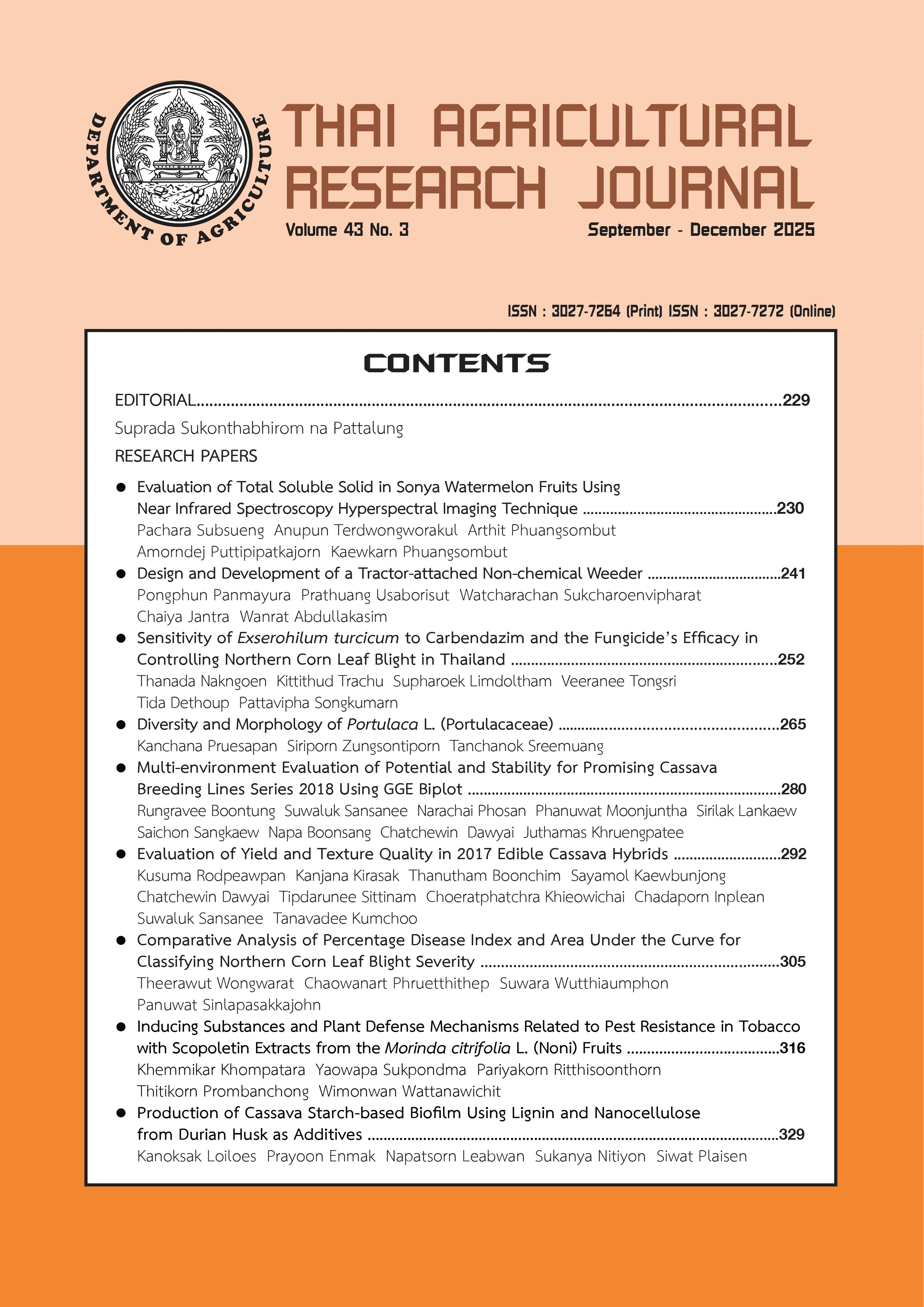
Multi-Environment Evaluation of Potential and Stability for Promising Cassava Breeding Lines Series 2018 Using GGE Biplot
DOI:
https://doi.org/10.14456/thaidoa-agres.2025.22Keywords:
GGE biplot, cassava, potential, stabilityAbstract
An ideal cassava variety should exhibit high potential and stability in key agronomic traits under diverse environmental conditions. This research aimed to assess the potential and stability of fresh root yield, starch content, and starch yield in promising cassava lines series 2018 across 14 environments under field conditions during 2023–2024. Three promising lines, CMR61-51-39, CMR61-52-113, and CMR61-52-134 with 3 check varieties, DOA Rayong5, DOA Rayong9 and Kasetsart50, were evaluated using a randomized complete block design with 4 replications. The potential and stability of genotypes were assessed using GGE biplot analysis. The results revealed that CMR61-52-134 exhibited high potential and stability in fresh root yield, starch content and starch yield, with an average fresh root yield of 5,868 kg/rai, starch content of 22.4%, and starch yield of 1,359 kg/rai. Therefore, CMR61-52-134 was selected as an elite line for further study to obtain field management practice recommendation.
References
กรมวิชาการเกษตร. 2553. คำแนะนำการใช้ปุ๋ยกับพืชเศรษฐกิจ. กลุ่มวิจัยปฐพีวิทยา สำนักวิจัยพัฒนาปัจจัยการผลิตทางการเกษตร, กรุงเทพฯ. 122 หน้า.
ปิยะ กิตติภาดากุล เจริญศักดิ์ โรจนฤทธิ์พิเชษฐ์ วิจารณ์ วิชชุกิจ ประภาส ช่างเหล็ก ชเนษฎ์ ม้าลำพอง และเกรียงไกร แก้วตระกูลพงษ์. 2547. เสถียรภาพของพันธุ์มันสำปะหลังไทย. หน้า 191-201. ใน: เรื่องเต็มการประชุมทางวิชาการของมหาวิทยาลัยเกษตรศาสตร์ ครั้งที่ 42: สาขาพืช 3-6 ก.พ. 2547 กรุงเทพฯ.
รุ่งรวี บุญทั่ง ทัศนีย์ บุตรทอง กาญจนา กิระศักดิ์ มลุลี สิทธิษา เสาวรี บำรุง ฉัตรชีวิน ดาวใหญ่ กานต์รวี แสงทอง สุวลักษณ์ ศันสนีย์ กุลชาต นาคจันทึก ศิริลักษณ์ ล้านแก้ว ภาณุวัฒน์ มูลจันทะ นราชัย โพธิ์สาร และวัลลีย์ อมรพล. 2566. การปรับปรุงพันธุ์มันสำปะหลังเพื่อผลผลิตและแป้งสูง: การเปรียบเทียบในท้องถิ่น (ลูกผสมปี 2561). หน้า 48-73. ใน: การประชุมรายงานผลงานวิจัย ปี 2565 ศูนย์วิจัยพืชไร่ระยอง. 25-26 ก.ค. 2566 ณ ห้องประชุมศูนย์วิจัยพืชไร่ระยอง.
สุวลักษณ์ อะมะวัลย์ สมศักดิ์ อิทธิพงศ์ และวันปิติ บัวขาว. 2561. การปรับปรุงพันธุ์มันสำปะหลังเพื่อผลผลิตและแป้งสูง :ผสมพันธุ์มันสำปะหลัง (ลูกผสมชุดปี 2561). แหล่งข้อมูล: www.doa.go.th/plan/wp-content/uploads/2021/05/1601.4-การผสมพันธุ์เพื่อผลผลิตและแป้งสูง-ลูกผสมชุดปี-61.pdf. สืบค้น: 10 มิถุนายน 2568.
Akinwale, M.G., B.O. Akinyele, A.C. Odiyi and A.G.O. Dixon. 2011. Genotype × environment interaction and yield performance of 43 improved cassava (Manihot esculenta Crantz) genotypes at three agro-climatic zones in Nigeria. British Biotechnology Journal. 1(3): 68–84.
Amelework, A.B., M.W. Bairu, R. Marx, M. Laing and S.L. Venter. 2023. Genotype × environment interaction and stability analysis of selected cassava cultivars in South Africa. Plants. 12(13): 2490.
Ceballos, H., C.A. Iglesias, J.C. Pérez and A.G. Dixon. 2004. Cassava breeding: opportunities and challenges. Plant Molecular Biology. 56(4): 503-516.
Chatwachirawong, P., O. Boonseng and A. Summatraya. 1999. The effect of genotypes and GE interaction on starch content of cassava. Agriculture and Natural Resources. 33(2): 171–177.
Eberhart, S.A. and W.A. Russel. 1966. Stability parameters for comparing varieties. Crop Science. 6(1): 36-40.
Egesi, C.N., P. Ilona, F.O. Ogbe, M. Akoroda and A. Dixon. 2007. Genetic variation and genotype × environment interaction for yield and other agronomic traits in cassava in Nigeria. Agronomy Journal. 99(4): 1137-1142.
Filho, J.S.S., M.D.S. Campos and E.J.D. Oliveira. 2024. Stability and genetic parameters for cassava yield attributes in the tropical humid region of Brazil. Euphytica. 220(8): 127.
Finlay, K.W. and G.N. Wilkinson. 1963. The analysis of adaptation in a plant-breeding program. Australian Journal of Agricultural Research. 14(6): 742–754.
Fox, P.N., J. Crossa and I. Romagosa. 1997. Multi-environment testing and genotype×environment interaction. pp. 117-138. In: R.A. Kempton, P.N. Fox and M. Cerezo (eds). Statistical Methods for Plant Variety Evaluation. Chapman & Hall, London, UK.
Gauch, H.G. and R.W. Zobel. 1997. Identifying mega‐environments and targeting genotypes. Crop Science. 37(2): 311-326.
Khan, M.M.H., M.Y. Rafii, S.I. Ramlee, M. Jusoh and M. Al Mamun. 2021. AMMI and GGE biplot analysis for yield performance and stability assessment of selected Bambara groundnut (Vigna subterranea L. Verdc.) genotypes under the multi-environmental trials (METs). Scientific Reports. 11(1): 22791.
Koundinya, A.V.V., B.R. Ajeesh, V. Hegde, M.N. Sheela, C. Mohan and K.I. Asha. 2021. Genetic parameters, stability and selection of cassava genotypes between rainy and water stress conditions using AMMI, WAAS, BLUP and MTSI. Scientia Horticulturae. 281. 109949.
Mullualem, D., A. Tsega, T. Mengie, D. Fentie, Z. Kassa, A. Fassil, D. Wondaferew, T.A. Gelaw and T. Astatkie. 2024. Genotype-by-environment interaction and stability analysis of grain yield of bread wheat (Triticum aestivum L.) genotypes using AMMI and GGE biplot analyses. Heliyon. 10: e32918.
Ntawuruhunga, P., G. Ssemakula, H. Ojulong, A. Bua, P. Ragama, C. Kanobe and J. Whyte. 2006. Evaluation of advanced cassava genotypes in Uganda. African Crop Science Journal. 14(1): 1-7.
Peprah, B.B., E. Parkes, J. Manu-Aduening, P. Kulakow, A. van Biljon and M. Labuschagne. 2020. Genetic variability, stability and heritability for quality and yield characteristics in provitamin A cassava varieties. Euphytica. 216(2): 31.
Uchendu, K., D.N. Njoku, U.N. Ikeogu, D. Dzidzienyo, P. Tongoona, S. Offei and C. Egesi. 2022. Genotype-by-environment interaction and stability of root mealiness and other organoleptic properties of boiled cassava roots. Scientific Reports. 12(1): 20909.
Yan, W. 2001. GGEbiplot-A Windows application for graphical analysis of multienvironment trial data and other types of two-way data. Agronomy Journal. 93(5): 1111-1118.
Yan, W. and I. Rajcan. 2002. Biplot analysis of test sites and trait relations of soybean in Ontario. Crop Science. 42: 11-20.
Yan, W. and M.S. Kang. 2003. GGE Biplot Analysis: A Graphical Tool for Breeders, Geneticists, and Agronomists. CRC Press, Boca Raton, Florida, USA. 267 p.
Yan, W., L.A. Hunt, Q. Sheng and Z. Szlavnics. 2000. Cultivar evaluation and mega-environment investigation based on the GGE biplot. Crop Science. 40(3): 597-605.
Yan, W., M.S. Kang, B. Ma, S. Woods and P.L. Cornelius. 2007. GGE biplot vs. AMMI analysis of genotype-by-environment data. Crop Science. 47(2): 643-653.
Downloads
Published
How to Cite
Issue
Section
License
Copyright (c) 2025 Thai Agricultural Research Journal

This work is licensed under a Creative Commons Attribution-NonCommercial-NoDerivatives 4.0 International License.
Thai Agricultural Research Journal

