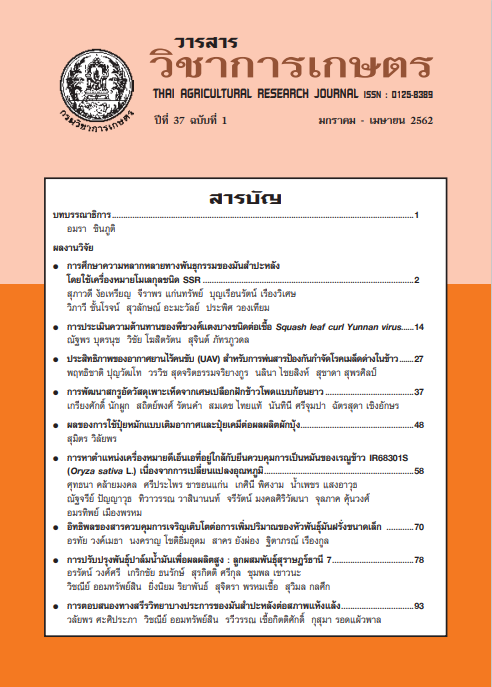
ประสิทธิภาพของอากาศยานไร้คนขับ (UAV) สำหรับการพ่นสารป้องกันกำจัดโรคเมล็ดด่างในข้าว
DOI:
https://doi.org/10.14456/thaidoa-agres.2019.4คำสำคัญ:
อากาศยานไร้คนขับ, โรคเมล็ดด่างในข้าว การตกค้างของละอองสาร, การตกค้างของละอองสาร การการปลิวของละอองสาร, การสัมผัสสารของผู้ปฏิบัติงานบทคัดย่อ
การทดสอบประสิทธิภาพของอากาศยานไร้คนขับ (Unmanned Aerial Vehicle : UAV) พ่นสารเคมี เพื่อป้องกันกำจัดโรคเมล็ดด่างข้าวใน จ.สุพรรณบุรี ระหว่างเดือนสิงหาคม-ตุลาคม พ.ศ. 2560 ด้วยวิธี colorimetric method ในข้าวระยะข้าวตั้งท้อง (74 วัน หลังหว่าน) และออกรวง (91 วัน หลังหว่าน) เพื่อเปรียบเทียบการตกค้างของละอองสารบนต้นข้าว และการปลิวบนพื้นที่นอกเป้าหมาย โดยมีกรรมวิธีการพ่นสารด้วยเครื่อง UAV อัตราพ่น 3.5 และ 5 ลิตร/ไร่ เปรียบเทียบกับกรรมวิธีการพ่นของเกษตรกรด้วยก้านพ่นแบบปรับมุมด้านท้าย ที่อัตราพ่น 40 และ 60 ลิตร /ไร่ตามลำดับ ผลการทดลองพบว่า การพ่นสารด้วย เครื่อง UAV มีการตกค้างของละอองสารบนต้นข้าวไม่แตกต่างกันทางสถิติกับกรรมวิธีการพ่นของเกษตรกรทั้ง 2 อัตรา และเมื่อพิจารณาถึงการปลิวบนพื้นที่นอกเป้าหมายจากการพ่นด้วยเครื่อง UAV ไกลกว่าการพ่นด้วยวิธีการของเกษตรกร 1 เมตร และจากการทดสอบประสิทธิภาพในการป้องกันกำจัดโรคเมล็ดด่างด้วยเครื่องดังกล่าวในแปลงทดลองที่ จ.สุพรรณบุรี และ จ.ชัยนาท โดยการพ่นสาร tebuconazole + trifloxystrobin 50% + 25% WG (Nativo 75 WG) ในขา้ วทั้ง 2 ระยะ ที่อัตรา 28 กรัมผลิตภัณฑ์/ไร่ เปรียบเทียบกับกรรมวิธีไม่พ่นสาร ผลการทดลองพบว่า การพ่นด้วยเครื่อง UAV มีประสิทธิภาพในการป้องกันกำจัดโรคเมล็ดด่างเทียบเท่ากับวิธีการพ่นของเกษตรกรผลจากการวิจัยสามารถใช้เป็นข้อมูลสำหรับงานวิจัยเกี่ยวกับเทคนิคการใช้สารกำจัดศัตรูพืชและเป็นการสร้างมาตรฐานเพื่อใช้ในการทดสอบประสิทธิภาพในการป้องกันกำจัดศัตรูพืชด้วยเครื่อง UAV
เอกสารอ้างอิง
กรมการข้าว. คู่มือการจัดการด้านการผลิต.(ระบบออนไลน์). แหล่งข้อมูล : https://www.ricethailand.go.th
/rkb/manual/index.php-file=data_012-rice_012_manul_003.html (3 พฤษภาคม 2560).
พากเพียร อรัญนารถ, นงรัตน์ นิลพานิชย์ และรัศมี ฐิติเกียรติพงศ์. 2550. การใช้เชื้อแบคทีเรียปฏิปักษ์ในการ
ควบคุมโรคเมล็ดด่างของข้าว. ว. วิชาการข้าว. 1: 21-28.
Cunningham, G.P. and J. Harden. 1999. Sprayers to reduce spray volumes in mature citrus
trees. Crop Prot. 18: 275-281.
Matthews, G.A. 2014. Pesticide Application methods. 4th Ed. Blackwell Science. 432 pp. OECD. 1997. Guidance document for the conduct of studies of occupational exposure to
pesticides during agricultural application. Environmental Health and Safety Publications Series on Testing and Assessment No 9. OCDE/GD (97) 148, OECD, Paris, France. 57 pp.
Punyawattoe, P. 2013. Rational insecticide application techniques for control of
Nilaparvata lugens Stål in paddy fields. Ph.D. Thesis, Nanjing Agricultural University.
119 pp.
Qin, W.C., Qiu, B.J., Xue, X.Y., Chen, C., Xu, Z.F. and Q.Q. Zhou. 2016. Droplet deposition and
control effect of insecticides sprayed with an unmanned aerial vehicle against plant hoppers. Crop Prot. 85: 79-88.
Qin, W.C., Xue, X.Y, Zhang, S.M., Gu, W. and B.K. Wang. 2018. Droplet deposition and efficiency of
fungicides sprayed with small UAV against wheat powdery mildew. Int. J. Agric & Biol. Eng. 11(2): 27-32.
Syamimi, I., Tengku Henidza, T.I., Puziah, A.L., 2011. Estimation of the pesticide
exposure during spraying among applicators. Health and the Environment J. 2: 18-22.
Wicke, H., G. Backer and R. Friebleben. 1999. Comparison of spray operator exposure
during orchard spraying with hand-held equipment fitted with standard and air
injector nozzles. Crop Prot. 18: 509-516.
Wongcharoen, A. 2013. Effect of fungicides on the growth of rice pathogenic fungi. Khon
Kaen Agr. J. 41(1): 527-531.
Xue, X.Y., Liang, J. and X.M. Fu. 2008. Prospect of aviation plant protection in China. Chin.
Agric. Mech. 5: 72-74.
ดาวน์โหลด
เผยแพร่แล้ว
รูปแบบการอ้างอิง
ฉบับ
ประเภทบทความ
สัญญาอนุญาต
ลิขสิทธิ์ (c) 2019 วารสารวิชาการเกษตร

อนุญาตภายใต้เงื่อนไข Creative Commons Attribution-NonCommercial-NoDerivatives 4.0 International License.
วารสารวิชาการเกษตร

