
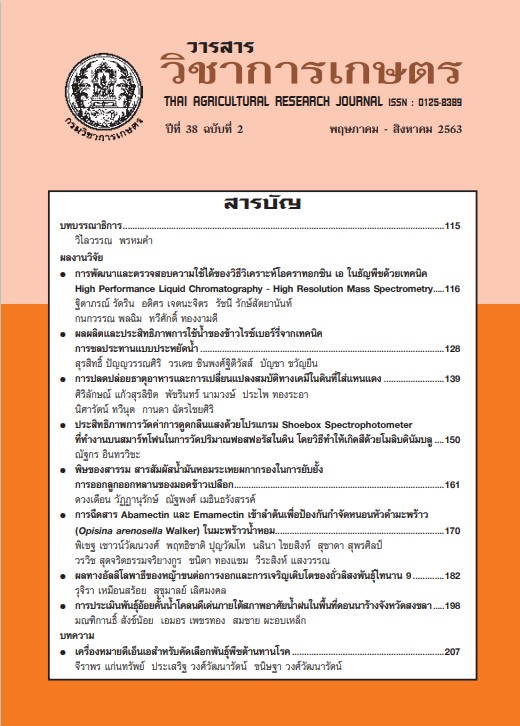
พิษของสารรม สารสัมผัสน้ำมันหอมระเหยผกากรองในการยับยั้งการออกลูกออกหลาน ของมอดข้าวเปลือก
DOI:
https://doi.org/10.14456/thaidoa-agres.2020.12คำสำคัญ:
สารรม, สารสัมผัส, การยับยั้งการออกลูกออกหลานผกากรอง, มอดข้าวเปลือกบทคัดย่อ
ทดสอบประสิทธิภาพของน้ำมันหอมระเหยจากผกากรองโดยการเป็นสารรม สารสัมผัสต่อการยับยั้งการออกลูกออกหลานของมอดข้าวเปลือก ที่ระดับความเข้มข้น 0, 20, 40, 60, 80 และ 100 ไมโครลิตร/มล. ทำการทดสอบความเข้มข้นละ 5 ซ้ำที่ห้องปฏิบัติการชีววิทยา อุณหภูมิ 25-27oซ. ความชื้นสัมพัทธ์ 75-80% พบว่า น้ำมันหอมระเหยผกากรองมีผลต่อการรม การสัมผัสและการยับยั้งการออกลูกออกหลานของมอดข้าวเปลือก ที่ความเข้มข้น 100 ไมโครลิตร/มล.มีประสิทธิภาพต่อการตายของมอดข้าวเปลือกในการเป็นสารรม คิดเป็นเปอร์เซ็นต์การตาย 70%มีค่าความเป็นพิษ (LC50) 76.45 ไมโครลิตร/มล. เวลา 24 ชม. และ มีประสิทธิภาพในการเป็นสารสัมผัสคิดเป็นเปอร์เซ็นต์การตาย 94% มีค่าความเป็นพิษ 50.00ไมโครลิตร/มล. ที่เวลา 24 ชม.ส่วนประสิทธิภาพในการเป็นสารยับยั้งการออกลูกออกหลาน ที่ความเข้มข้น 100 ไมโครลิตร/มล.มีจำนวนตัวเต็มวัย 1.80 + 0.74 ตัว (ยับยั้ง 94.11%)ใช้ระยะเวลาในการเจริญเติบโตจากระยะไข่ ถึงตัวเต็มวัย 54.40 + 1.62 วัน ในขณะที่ชุดควบคุมมีจำนวนตัวเต็มวัย 30.60 + 2.55 ตัว ใช้ระยะเวลาในการเจริญเติบโต 28.60 + 3.35 วัน
เอกสารอ้างอิง
เพ็งคุ้ม และจิราภรณ์ ทองพันธ์. 2548. แมลงศัตรูข้าวเปลือกและการป้องกันกำจัด. เอกสารวิชาการ. สำนักวิจัยและพัฒนาวิทยาการหลังการเก็บเกี่ยวและแปรรูปผลผลิตทางการเกษตร กรมวิชาการเกษตร, กรุงเทพฯ. 160 หน้า.
Abbott, W.S. 1925. Method of computing the effectiveness of an insecticide. J. Econ. Entomol.
18(2): 265-267.
Afful, E., B. Elliott, M.K. Nayak and T.W. Phillips. 2018. Phosphine resistance in North American
field populations of the lesser grain borer, Rhyzopertha dominica (Coleoptera: Bostrichidae). J. Econ. Entomol. 111(1): 463–469.
Ahmad, A., M. Ahmed, Noorullah, Q.M. Ali, M. Abbas and S. Arif. 2013. Monitoring of resistance
against phosphine in stored grain insect pests in Sindh. MEJSR. 16 (11): 1501-1507.
Arthur, F.H., G.O. Ondier and T.J. Siebenmorgen. 2012. Impact of Rhyzopertha dominica (F.) on
quality parameters of milled rice. J. Stored Prod Res. 48: 137-142.
Aulicky, R. and V. Stejskal. 2015. Efficacy and limitations of phosphine “spot-fumigation” against
five Coleoptera species of stored product pests in wheat in a grain store – short note.
Plant Protect. Sci. 51: 33–38.
Brari, F. and D.R. Thakur. 2017. Bioefficacy of four essential oils against Callosobruchus analis (F.)
(Coleoptera: Bruchidae), A seed pest of stored legumes worldwide. IJER. 2(6): 71-75.
Dey, K.R., P. Choudhury and B.K. Dutta. 2013, Impact of pesticide use on the health of farmers: A
study in Barak Valley, Assam (India). J Environ Chem Ecotoxicol, 5: 269-277.
El-Wakeil, N.E. 2013. Botanical pesticides and their mode of action. Gesunde Pflanzen. 65: 125–
149.
Guo, S., W. Zhang, J. Liang, C. You, Z. Geng, C. Wang and S. Du. 2016. Contact and repellent
activities of the essential oil from Juniperus formosana against two stored product insects. Molecules. 21: 1-11.
Isman, M.B. 2006. Botanical insecticides, detrrents, and repellents in modern agriculture and an
increasingly regulated world. Annu. Rev. 51: 45–66.
Isenring, R. 2010. Pesticides reduce biodiversity. Pesticides news. 88, 4-7.
Koul, O., S. Walia and G.S. Dhaliwai. 2008. Essential oils as green pesticides: potential and
constraints. Biopesticides Int. 4(1), 63–84.
Murugesan, S., C. Rajeshkannan, D.S. Babu, R. Sumathi and P. Manivachakam. 2012. Identification
of insecticidal properties in common weed - Lantana camara Linn by gas chromatography and mass spectrum (GC-MS-MS). Adv. Appl. Sci. Res. 3(5): 2754-2759.
Pimentel, M.A.G., L.A.D. Faroni, M.D. Batista and F.H. da Silva. 2008. Resistance of stored-product
insects to phosphine. Pesq. agropec. bras. Brasília. 43(12): 1671-1676.
Pires, E.M. and R.M. Nogueira. 2018. Damage caused by Rhyzopertha dominica (Fabricius, 1792)
(Coleoptera: Bostrichidae) in stored Brazil nuts. Sci. Elec. Arch. 11(1): 57-61.
Priyanka, N and P.K. Joshi. 2013. A review of Lantana camara studies in India. IJSRP. 3(10): 1-11.
Rajashekar, Y., K.V. Ravindra and N. Bakthavatsalam. Leaves of Lantana camara Linn.
(Verbenaceae) as a potential insecticide for the management of three species of stored grain insect pests. J Food Sci Technol. 51(11): 3494–3499.
Rani, P.U. 2012. Fumigant and contact toxic potential of essential oils from plant extracts against
stored product pests. JBiopest. 5(2): 120-128.
Relyea, R.A. 2005. The impact of insecticide and herbicide on the biodiversity and productivity
of aquatic communities. Ecol. Appl. 15(2): 618–627.
Sharma, G.P., A.S. Raghubanshi and J.S. Singh. 2005. Lantana invasion: An overview. Weed
Bio and Manage. 5: 157–165.
Srivastava, C. and S. Subramanian. 2016. Storage insect pests and their damage symptoms: an
overview. J. of Grain Storage Res. 11: 53-58.
Tripath, S. Upadhyay, M. Bhuiyan and P.R. Bhattacharya. 2009. A review on prospects of
essential oils as biopesticide in insect-pest management. Journal of Pharmacognosy
and Phytotherapy. 1(5): 1-13.
ดาวน์โหลด
เผยแพร่แล้ว
รูปแบบการอ้างอิง
ฉบับ
ประเภทบทความ
สัญญาอนุญาต
ลิขสิทธิ์ (c) 2020 วารสารวิชาการเกษตร

อนุญาตภายใต้เงื่อนไข Creative Commons Attribution-NonCommercial-NoDerivatives 4.0 International License.
วารสารวิชาการเกษตร

