
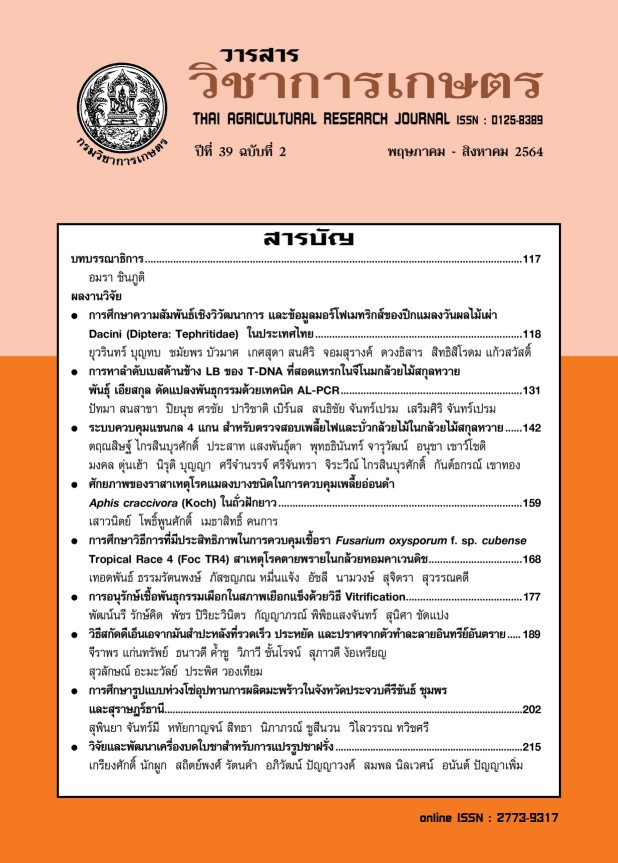
การอนุรักษ์เชื้อพันธุกรรมเผือกในสภาพเยือกแข็งด้วยวิธี Vitrification
DOI:
https://doi.org/10.14456/thaidoa-agres.2021.15คำสำคัญ:
การอนุรักษ์ในสภาพปลอดเชื้อ, การ ขยายพันธุ์ในสภาพปลอดเชื้อบทคัดย่อ
เผือก เป็นพืชหัวเขตร้อนที่มีศักยภาพทางเศรษฐกิจ กรมวิชาการเกษตรได้รวบรวมและปลูกอนุรักษ์พันธุกรรมเผือกไว้ในสภาพแปลงรวบรวมพันธุ์ ณ ศูนย์วิจัยและพัฒนาการเกษตรพิจิตร เพื่อประหยัดค่าใช้จ่าย และลดขั้นตอนในการปลูกอนุรักษ์พันธุกรรมต้นเผือกในสภาพแปลงปลูก งานวิจัยนี้มีวัตถุประสงค์เพื่อศึกษาเทคนิคการอนุรักษ์เชื้อพันธุกรรมเผือกในสภาพเยือกแข็งด้วยวิธี vitrification โดยใช้เผือกไม่หอม 2 สายพันธุ์ คือ เผือกไข่ และเผือกอ้อย และเผือกหอม 2 สายพันธุ์ คือ เผือกหอม THA-104 และเผือกหอมพะเยา ทำการทดลองเพาะเลี้ยงเนื้อเยื่อเจริญปลายยอดเผือก 4 สายพันธุ์ บนอาหาร 12 สูตร ได้แก่ อาหารสังเคราะห์ Murashige and Skoog (MS) ที่เติมกรดเบนซิลอะดีนิน (BA) 0, 3, 5 และ 7 มก./ล. ร่วมกับกรดแนพทาลีนแอซีติก (NAA) 0, 1 และ 2 มก./ล. เป็นเวลา 16 สัปดาห์ พบว่า MS ที่เติม BA 5 มก./ล. ร่วมกับ NAA 2 มก./ล. เป็นสูตรอาหารที่เหมาะสำหรับเพาะเลี้ยงเผือกไม่หอมโดยชักนำให้เกิดยอดสูงสุดเฉลี่ยที่ 10.25 และ 9.19 ยอด/ชิ้นส่วน สำหรับเผือกไข่และเผือกอ้อย ตามลำดับ และ MS ที่เติม BA 5 มก./ล. ร่วมกับ NAA 1 มก./ล. เป็นสูตรอาหารที่เหมาะสำหรับเพาะเลี้ยงเผือกหอมโดยชักนำให้เกิดยอดสูงสุดเฉลี่ย 10.04 และ 9.57 ยอด/ชิ้นส่วน สำหรับเผือกหอม THA-104 และเผือกหอมพะเยา ตามลำดับ จากนั้น นำปลายยอดเผือกทั้ง 4 สายพันธุ์ที่ได้ มาศึกษาสภาวะการอนุรักษ์ในสภาพเยือกแข็งด้วยวิธี vitrification พบว่า สภาวะที่เหมาะสมคือการแช่ปลายยอดเผือกในสาร cryoprotectant ชนิด PVS3 (plant vitrification solution 3) ที่อุณหภูมิ 25 ºซ. นาน 30 นาที ให้อัตราการรอดชีวิตของเผือกไข่ เผือกอ้อย เผือกหอม THA-104 และเผือกหอมพะเยา หลังการเพาะเลี้ยง 4 สัปดาห์ เฉลี่ย 49.5, 64.1, 52.7 และ 59.5% ตามลำดับ
เอกสารอ้างอิง
กรมส่งเสริมการเกษตร. 2564. ระบบให้บริการข้อมูลสารสนเทศการผลิตทางด้านการเกษตร กรมส่งเสริมการเกษตร กระทรวงเกษตรและสหกรณ์. แหล่งข้อมูล: http://production.doae.go.th/service/login.สืบค้น: 20 เมษายน 2564
กรมศุลกากร. 2564. รายงานสถิติ กรมศุลกากร. แหล่งข้อมูล: http://www.customs.go.th/statistic_report.php.
สืบค้น: 20 เมษายน 2564
นิรนาม. 2557. เผือก. ฐานความรู้ด้านพืช กรมวิชาการเกษตร. แหล่งข้อมูล: http://www.doa.go.th/
pl_data/TARO/STAT/st1.html. สืบค้น: 25 เมษายน 2560
พีรเดช ทองอำไพ. 2537. ฮอร์โมนพืชและสารสังเคราะห์ แนวทางการใช้ประโยชน์ในประเทศไทย, พิมพ์ครั้งที่ 4, วี.บี. บุ๊คเซนเตอร์, ภาควิชาพืชสวน คณะเกษตร มหาวิทยาลัยเกษตรศาสตร์: กรุงเทพฯ. 196 หน้า.
Acedo, V.Z., O.P. Damasco, A.C. Laurena, P.C. Sta Cruz, L.O. Namuco and A.G. Lalusin. 2018. Shoot tip splitting for rapid micropropagation of Philippine taro (Colocasia esculenta (L.) Schott). Int. J. Adv. Agri. Res. 6: 38-46.
Best, B.P. 2015. Cryoprotectant Toxicity: Facts, Tssues and Questions. Rejuvenation Res. 18(5): 422-436.
Buitink, J. and O. Leprince. 2004. Glass formation in plant anhydrobiotes: survival in the dry state. Cryobiology 48(3): 215-228.
Chung, R.C. and C.J. Goh. 1994. High frequency direct shoot regeneration from corm axillary buds and rapid clonal propagation of taro (Colocasia esculenta var. esculenta (L.) Schott (Araceae)). Plant Sci. 104: 93-100.
Cordova, L.B. and K. Thammasiri. 2016. Cryopreservation on a cryo-plate of Arundina graminifolia protocorms, dehydrated with silica gel and drying beads. Cryo Lett. 37(2): 68-76.
Engelmann, F. 2000. Development of cryopreservation techniques. pp. 8-20. In Englemann, F. and Takagi, H. (eds.) Cryopreservation of Tropical Plant Germplasm Current Research Progress and Application. IPGRI, Rome.
Hong, S., M. Yin; X. Shao, A. Wang and W. Xu. 2009. Cryopreservation of embryogenic callus of Dioscorea bulbifera by vitrification, Cryo Lett. 30(1): 64-75.
Hutami, S. and R. Purnamaningsih. 2013. Shoot multiplication of taro (Colocasia esculenta var. Antiquorum) through in vitro culture. pp. 35-40. In: Proceeding International Conference 2013 The 4th Green Technology Facculty of Science and Technology Islamic of University State Maulana Malik Ibrahim Malang. Indonesia.
Kartha, K.K., N.L. Leung and K. Pahl. 1980. Cryopreservation of plantlets. J. Am. Soc. Hortic. Sci. 105: 481-484.
Kim, H.H., J.W. Yoon, Y.E. Park, E.G. Cho, J.K. Sohn, T.S. Kim and F. Engelmann. 2006. Cryopreservation of potato cultivated varieties and wild species: critical factors in droplet vitrification. Cryo Lett. 27: 223-234.
Ko, C.Y., J.P. Kung and R. Mc Donald. 2008. In vitro micropropagation of white dasheen (Colocasia esculenta). Afr. J. Biotechnol. 7(1): 41-43.
Matsumoto, T., A. Sakai, C. Takahashi and K. Yamada. 1995. Cryopreservation of in vitro grown apical meristems of wasabi (Wasadia japonica) by encapsulation-vitrification method. Cryo Lett. 16: 189-196.
Mohanty, P., M.C. Das, S. Kumaria and P. Tandon. 2012. High-efficiency cryopreservation of the medicinal orchid Dendrobium nobile Lindl. Plant Cell Tissue Organ Cult. 109(2): 297-305.
Nath, V.S., M.S. alias Sankar, V.M. Hegde, M.L. Jeeva, R.S. Misra and S.S. Veena. 2012. A simple and efficient protocol for rapid regeneration and propagation of taro (Colocasia esculenta (L.) Schott.) in vitro from apical meristems. Int. J. Plant Dev. Biol. 6(1): 64-66.
Preetha, T.S., A.S. Hemanthakumar and P.N. Krishnan. 2013. Shoot tip Cryopreservation by Vitrification in Kaempferia galanga L. An endangered, over exploited medicinal plant in Tropical Asia. J. Pharm. Biol. Sci. 8(3): 19-23.
Reed, B.M. 2008. Plant Cryopreservation: A Practical Guide, Springer, New York. 542 p.
Sakai, A., S. Kobayashi and Oiyama, I. 1990. Cryopreservation of nucellar cells of navel organe (Citrus sinensis Osb. Var. brasiliensis Tanaka) by vitrification. Plant Cell Rep. 9(1): 30-33.
Sant, R., B. Panis, M. Taylor and A. Tyagi. 2008. Cryopreservation of shoot-tips by droplet vitrification applicable to all taro (Colocasia esculenta var. esculenta) accessions. Plant Cell Tiss Organ Cult. 92: 107-111.
Taiz, L. and E. Zeiger. 1998. Plant Physiology, in Chapter 21, 2nd Ed, Sinauer Associates, U.S.A. 792 p.
Takagi, H., N.T. Thinh, O.M. Islam and T. Senboku. 1997. Cryopreservation of in vitro-grown shoot tips of taro (Colocasia esculenta (L.) Schott) by vitrification. 1. Investigation of basic conditions of the vitrification procedure. Plant Cell Reports. 16: 594-599.
Underwood, L., J. Solocinski, E. Rosiek, Q. Osgood and N. Chakraborty. 2019. Active modulation of Hydrogen bonding by sericin enhances cryopreservation outcomes. brioRxiv. Available at: https://doi.org/10.1101/773721. Accessed: 29 August, 2019
Vaurasi, V. and R. Kant. 2016. Effects of salinity and plant growth media on in vitro growth and development of taro (Colocasia esculenta L.) varieties. Acta Horticulturae et Regiotecturae. 1: 17-20.
Wang, J.K. 1983. Taro, a review of Colocacia esculenta and its potentials. University of Hawaii Press, Hawaii. 400 pp.
Wang, Q., O. Batuman; P. Li, M.B. Joseph and R. Gafny. 2002. A simple and efficient cryopreservation of in vitro-grown shoot tips of ‘Troyer’ citrange [Poncirus trifoliata (L.) Raf. × Citrus sinensis (L.) Osbeck.] by encapsulation-vitrification. Euphytica 128: 135-142.
Yang, J., N. Cai, H. Zhai, J. Zhang, Y. Zhu and L. Zhang. 2016. Natural zwitterionic betaine enables cells to survive ultrarapia cryopreservation. Available at: www.nature.com/scientificreports. Accessed: 2 March, 2020
ดาวน์โหลด
เผยแพร่แล้ว
รูปแบบการอ้างอิง
ฉบับ
ประเภทบทความ
สัญญาอนุญาต
ลิขสิทธิ์ (c) 2021 วารสารวิชาการเกษตร

อนุญาตภายใต้เงื่อนไข Creative Commons Attribution-NonCommercial-NoDerivatives 4.0 International License.
วารสารวิชาการเกษตร

