
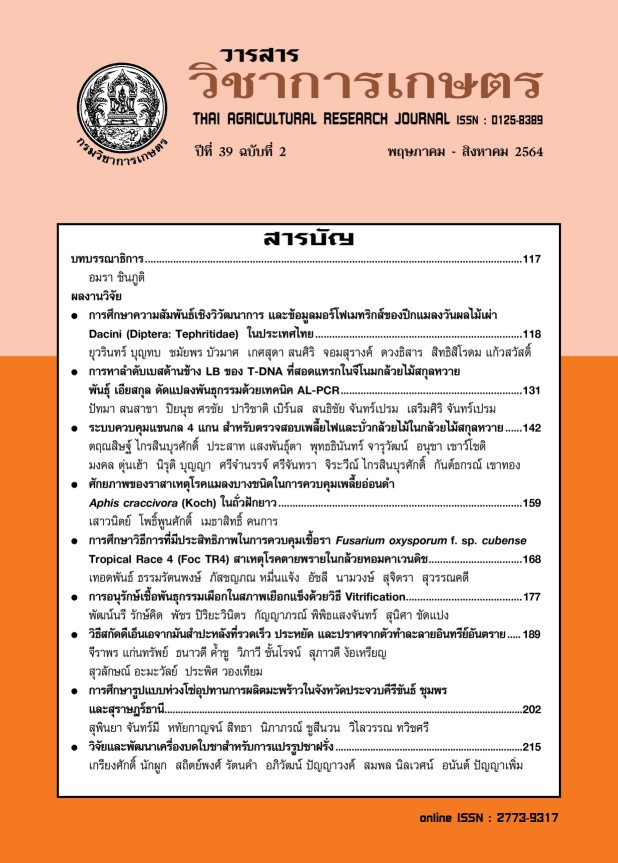
วิธีสกัดดีเอ็นเอจากมันสำปะหลังที่รวดเร็ว ประหยัด และปราศจากตัวทำละลายอินทรีย์อันตราย
DOI:
https://doi.org/10.14456/thaidoa-agres.2021.16คำสำคัญ:
การสกัดดีเอ็นเอ, มันสำปะหลัง, สาร รบกวน, โซเดียมโดเดซิลซัลเฟต(SDS), โพลิไวนิล ไพโรลิโดน (PVP)บทคัดย่อ
การสกัดดีเอ็นเอจากใบมันสำปะหลังให้ได้คุณภาพดีมีขั้นตอนที่ยุ่งยากซับซ้อนเนื่องจากมีสารรบกวน ได้แก่ โพลีฟีนอล และโพลีแซคคาไรด์ ที่ส่งผลกระทบต่อคุณภาพของดีเอ็นเอ การสกัดดีเอ็นเอด้วยวิธี hexadecyltrimethylammonium bromide หรือ CTAB ที่นิยมใช้โดยทั่วไปมีการใช้ตัวทำละลายอินทรีย์อันตรายต่างๆ เช่น ฟีนอล คลอโรฟอร์ม เพื่อกำจัดสารรบกวนและมีหลายขั้นตอนทำให้ใช้เวลานานประมาณ 130 นาที จึงไม่เหมาะกับการสกัดดีเอ็นเอจากตัวอย่างจำนวนมาก งานวิจัยนี้มีวัตถุประสงค์เพื่อพัฒนาวิธีการสกัดดีเอ็นเอจากใบมันสำปะหลังที่สะดวกรวดเร็ว ปราศจากตัวทำละลายอินทรีย์อันตราย ไม่จำเป็นต้องใช้ไนโตรเจนเหลว ประหยัดค่าใช้จ่ายและเวลา ซึ่งใช้เวลาเพียงประมาณ 48 นาที วิธีการสกัดดีเอ็นเอที่พัฒนาขึ้นจากงานวิจัยนี้มีพื้นฐานจากวิธี sodium dodecyl sulfate/sodium chloride หรือ SDS/NaCl ของ Edwards et al. (1991) และ Kotchoni and Gachomo (2009) และปรับปรุงโดยการเติมสาร polyvinylpyrrolidone (PVP) ในสารบัฟเฟอร์สกัดดีเอ็นเอ (DNA extraction buffer) ดำเนินการวิจัย ณ สำนักวิจัยพัฒนาเทคโนโลยีชีวภาพ กรมวิชาการเกษตร ระหว่างเดือนกันยายน ถึงเดือนพฤศจิกายน 2563
ปริมาณและคุณภาพของดีเอ็นเอที่สกัดได้ด้วยวิธี SDS/NaCl+PVP ที่พัฒนาขึ้นนี้ ประเมินโดยใช้เครื่องสเปกโตรโฟโตมิเตอร์วัดการดูดกลืนแสงและใช้วิธีอะกาโรสเจลอิเล็กโทรโฟรีซิส วิธี SDS/NaCl+PVP ให้ปริมาณดีเอ็นเอในช่วง 1431.4 - 1510.3 ไมโครกรัมต่อตัวอย่างใบ 1 กรัม และมีอัตราส่วนการดูดกลืนแสง A260/A280 อยู่ในช่วง 1.74 - 1.90 อะกาโรสเจลอิเล็กโทรโฟรีซิสแสดงให้เห็นแถบดีเอ็นเอที่สมบูรณ์ และคมชัดโดยมีการย่อยสลายของดีเอ็นเอเพียงเล็กน้อย ดีเอ็นเอที่สกัดได้สามารถใช้ในการวิเคราะห์กับเอนไซม์ตัดจำเพาะและใช้เป็นดีเอ็นเอต้นแบบหรือเทมเพลตในการทำปฏิกิริยาลูกโซ่พอลิเมอเรส (พีซีอาร์) โดยใช้ไพรเมอร์ ชนิดสการ์ อีเอสที และเอสเอสอาร์ ทั้งแบบไพรเมอร์คู่เดียว (single PCR) และแบบไพรเมอร์หลายคู่ในหนึ่งปฏิกิริยา (multiplex PCR) ได้ แสดงถึงดีเอ็นเอที่สกัดด้วยวิธี SDS/NaCl + PVP มีความบริสุทธิ์ คุณภาพดี และเหมาะสำหรับใช้ในการวิเคราะห์ระดับโมเลกุล เช่น การย่อยด้วยเอนไซม์ตัดจำเพาะและการเพิ่มปริมาณดีเอ็นเอด้วยเทคนิคพีซีอาร กระบวนการสกัดดีเอ็นเอนี้ใช้เวลาประมาณ 48 นาที
เอกสารอ้างอิง
จีราพร แก่นทรัพย์ สุวลักษณ์ อะมะวัลย์ ประพิศ วองเทียม อรุโณทัย ซาววา สุภาวดี ง้อเหรียญ ดนัย นาคประเสริฐ และ จิณณจาร์ หาญเศรษฐสุข. 2563. การใช้เครื่องหมายโมเลกุลในการคัดเลือกพันธุ์มันสำปะหลังต้านทานโรคใบด่าง Cassava Mosaic Disease. ว.วิชาการเกษตร. 38(1): 68-79.
Akano, A.O., A.G.O. Dixon, C. Mba, E. Barrera and M. Fregene. 2002. Genetic mapping of a dominant gene conferring resistance to cassava mosaic disease. Theor. Appl. Genetics. 105: 521-525.
Calderón-Cortés, N., M. Quesada, H. Cano-Camacho and G. Zavala-Páramo. 2010. A simple and rapid method for DNA isolation from xylophagous insects. Int. J. Mol. Sci. 11(12):5056-5064.
Carmo, C.D., M.S. Silva, G.A.F. Oliveira and E.J. Oliveira. 2015. Molecular-assisted selection for resistance to cassava mosaic disease in Manihot esculenta Crantz. Sci. Agric. 72(6): 520-527.
Dellaporta, S.L., J. Wood and J.B. Hicks. 1983. A plant DNA minipreparation: version II. Plant Mol. Biol. Rep. 1:19–21.
Devi, K.D., K. Punyarani, N.S. Singh, et al. 2013. An efficient protocol for total DNA extraction from the members of order Zingiberales- suitable for diverse PCR based downstream applications. Springer Plus. 2: 669.
Do, N. and R.P. Adams. 1991. A simple technique for removing plant polysaccharide contaminants from DNA. Biotechniques. 10(2):162-168.
Dona, F and J. Houseley. 2014. Unexpected DNA loss mediated by the DNA binding activity of ribonuclease A. PLoS One. 9(12): e115008.
Edwards, K., C. Johnstone and C. Thompson. 1991. A simple and rapid method for the preparation of plant genomic DNA for PCR analysis. Nucleic Acids Res. 19:1349.
Fregene, M., N. Morante, T. Sánchez, et al. 2006. Molecular markers for introgression of useful traits from wild Manihot relatives of cassava, marker-assisted selection (MAS) of disease and root quality traits. J. Root Crops. 32: 1-31.
Hautea, R.A. and M. Escaler. 2004. Plant biotechnology in Asia. Ag Bio Forum. 7(1):2-8.
Jadhav, K.P., R.V. Ranjani and N. Senthil. 2015. Chemistry of plant genomic DNA extraction protocol. BIOINFOLET. 12(3A): 543-548.
John, M.E. 1992. An efficient method for isolation of RNA and DNA from plants containing polyphenolics. Nucleic Acids Res. 20(9):2381.
Khanuja, S.P., A.K. Shasany, M. Darokar, et al. 1999. Rapid Isolation of DNA from dry and fresh samples of plants producing large amounts of secondary metabolites and essential oils. Plant Mol. Biol. Rep. 17: 74.
Kim, C.S., C.H. Lee, J.S. Shin, Y.S. Chung and N.I. Hyung. 1997. A simple and rapid method for isolation of high quality genomic DNA from fruit trees and conifers using PVP. Nucleic Acids Res. 25(5): 1085–1086.
Kotchoni, S.O. and E.W. Gachomo. 2009. A rapid and hazardous reagent free protocol for genomic DNA extraction suitable for genetic studies in plants. Mol. Biol. Rep. 36: 1633–1636.
Kress, W.J., D.L. Erickson, F.A. Jones, N.G. Swenson, R. Perez, O. Sanjur and E. Bermingham. 2009. Plant DNA barcodes and a community phylogeny of a tropical forest dynamics plot in Panama. PNAS. 106 (44): 18621-18626.
Levin, R.A., W.L. Wagner, P.C. Hoch, M. Nepokroeff, J.C. Pires, E.A. Zimmer and K.J. Sytsma. 2003. Family-level relationships of Onagraceae based on chloroplast rbcL and ndhF data. Am. J. Bot. 90(1):107-115.
Maniatis,T., J. Sambrook and E.F. Fritsch. 1982. Molecular cloning, pp. 76-85. In : A laboratory manual. Cold Spring Harbor Press, Cold Spring Harbor, New York.
Murray, M.G. and W.F. Thompson. 1980. Rapid isolation of high molecular weight plant DNA. Nucleic Acids Res. 19:4321–4325.
Okogbenin, E., C.N. Egesi, B. Olasanmi, et al. 2012. Molecular marker analysis and validation of resistance to cassava mosaic disease in elite cassava genotypes in Nigeria. Crop Sci. 52(6): 2576–2586.
Osena, G., E.N. Nyaboga and N. Amugune. 2017. Rapid and efficient isolation of high quality DNA from cassava (Manihot esculenta Crantz) suitable for PCR based downstream applications. Annu. Res. Rev. Biol. 12(2): 1-10.
Parvathy, V.A., V.P. Swetha, T.E. Sheeja and B. Sasikumar. 2015. Detection of plant-based adulterants in turmeric powder using DNA barcoding. Pharm. Biol. 53(12): 1774-1779.
Porebski, S., L.G. Bailey and B.R. Baum. 1997. Modification of a CTAB DNA extraction protocol for plants containing high polysaccharide and polyphenol components. Plant Mol. Biol. Rep. 15: 8–15.
Sahu, S.K., M. Thangaraj and K. Kathiresan. 2012. DNA extraction protocol for plants with high levels of secondary metabolites and polysaccharides without using liquid nitrogen and phenol. ISRN Mol. Biol. 2012:205049.
Sharma, K., A.K. Mishra and R.S. Misra. 2008. A simple and efficient method for extraction of genomic DNA from tropical tuber crops. Afr. J. Biotechnol. 7: 1018-1022.
White, T.J., T.D. Bruns, S. Lee and J. Taylor. 1990. Amplification and direct sequencing of fungal ribosomal RNA genes for phylogenetics. pp. 315-322. In: Innis, M.A., D.H. Gelfand, J.J. Sninsky, T.J. White eds. PCR protocols, a guide to methods and applications. Academic Press, San Diego, California.
Yao, H., J. Song, C. Liu, K. Luo, J. Han, Y. Li, X. Pang, H. Xu, Y. Zhu, P. Xiao and S. Chen. 2010. Use of ITS2 region as the universal DNA barcode for plants and animals. PLoS One. 5(10):e13102.
ดาวน์โหลด
เผยแพร่แล้ว
รูปแบบการอ้างอิง
ฉบับ
ประเภทบทความ
สัญญาอนุญาต
ลิขสิทธิ์ (c) 2021 วารสารวิชาการเกษตร

อนุญาตภายใต้เงื่อนไข Creative Commons Attribution-NonCommercial-NoDerivatives 4.0 International License.
วารสารวิชาการเกษตร
