
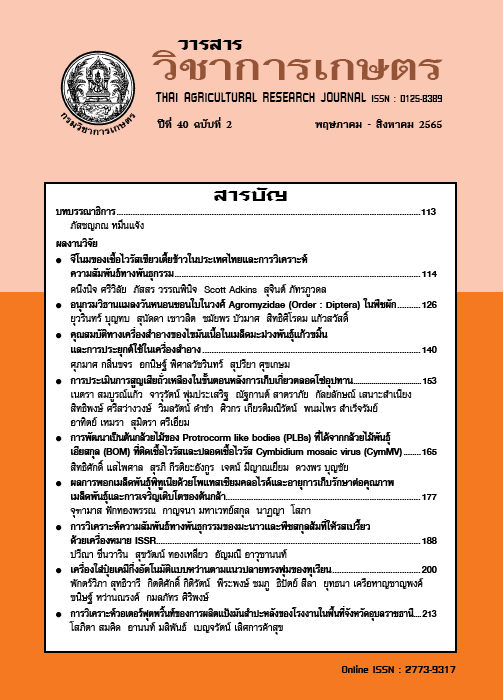
การวิเคราะห์ความสัมพันธ์ทางพันธุกรรมของมะนาวและพืชสกุลส้มที่ให้รสเปรี้ยวด้วยเครื่องหมาย ISSR
DOI:
https://doi.org/10.14456/thaidoa-agres.2022.16คำสำคัญ:
มะนาว, Citrus, เครื่องหมายดีเอ็นเอบทคัดย่อ
มะนาวพันธุ์ที่สำคัญในประเทศไทย คือ มะนาวเม็กซิกัน และมะนาวตาฮิติ แต่ยังพบว่า พันธุ์มะนาวที่นิยมปลูกยังมีความอ่อนแอต่อโรค หรือคุณภาพผลบางประการอาจยังไม่ดีพอ เพื่อพัฒนาพันธุ์มะนาวให้ดียิ่งขึ้น เชื้อพันธุกรรมมะนาวและพืชสกุลส้มที่ให้รสเปรี้ยวจึงมีความสำคัญในการที่จะเป็นแหล่งพันธุกรรมเพื่อการปรับปรุงพันธุ์มะนาว การศึกษาความสัมพันธ์ทางพันธุกรรมของมะนาวและพืชสกุลส้มที่ให้รสเปรี้ยวในเชื้อพันธุกรรม จะเป็นประโยชน์ต่อการคัดเลือกพันธุ์ที่จะนำมาใช้ในการปรับปรุงพันธุ์มะนาว งานวิจัยนี้จึงได้ศึกษาความสัมพันธ์ทางพันธุกรรมมะนาวและพืชสกุลส้มที่ให้รสเปรี้ยว ที่รวบรวมจากแหล่งเชื้อพันธุกรรมต่าง ๆ จำนวน 55 สายพันธุ์ ด้วยเครื่องหมายโมเลกุลชนิด inter simple sequence repeat (ISSR) พบว่าเครื่องหมาย ISSR ทั้ง 4 ไพรเมอร์ แสดงแถบดีเอ็นเอทั้งหมด 33 แถบ ให้เปอร์เซ็นต์พอลิมอร์ฟิซึม 87.5 % สร้างเดนโดแกรมที่สามารถจำแนกมะนาวและพืชสกุลส้มที่ให้รสเปรี้ยวออกเป็น 4 กลุ่ม คือ กลุ่มของมะนาวเม็กซิกันและมะนาวตาฮิติ กลุ่มของ citron และเลมอน กลุ่มมะกรูด และกลุ่มมะนาวนิ้วมือ ซึ่งการแบ่งกลุ่มนี้สามารถจัดกลุ่มได้ตามสปีชีส์ เมื่อพิจารณาเฉพาะกลุ่มมะนาวเม็กซิกันจำนวน 26 พันธุ์ เครื่องหมาย ISSR ไพรเมอร์ 814 สามารถจำแนกมะนาวเม็กซิกันออกเป็น 2 กลุ่ม คือ กลุ่ม A จำนวน 13 พันธุ์ มีค่าเฉลี่ยน้ำหนักผล ความหนาเปลือก และปริมาณเมล็ดน้อยกว่ามะนาวในกลุ่ม B จำนวน 13 พันธุ์
เอกสารอ้างอิง
วสรรญ ผ่องสมบูรณ์. 2558. การปรับปรุงพันธุ์และเทคโนโลยีการผลิตมะนาว. รายงานโครงการวิจัย. กรมวิชาการเกษตร. พิจิตร. 96 หน้า.
สำนักงานมาตรฐานสินค้าเกษตรและอาหารแห่งชาติ. 2560. ประกาศกระทรวงเกษตรและสหกรณ์ เรื่อง กำหนดมาตรฐานสินค้าเกษตร: มะนาว. ตามพระราชบัญญัติมาตรฐานสินค้าเกษตร พ.ศ. 2551, กรุงเทพฯ. 9 หน้า.
Amar, M.H., M.K. Biswas, Z. Zhang and W.W. Guo. 2011. Exploitation of SSR, SRAP and CAPS-SNP markers for genetic diversity of Citrus germplasm collection. Sci. Hortic. 128(3): 220-227.
Biswas, M.K., Q. Xu and X.X. Deng. 2010. Utility of RAPD, ISSR, IRAP, and REMAP markers for the genetic analysis of Citrus spp. Sci. Hortic. 124(2): 254-261.
Carvalho, R., W.S. Soares Filho, A.C. Brasileiro-Vidal and M. Guerra. 2005. The relationships among lemons, limes and citron: a chromosomal comparison. Cytogenet. Genome Res. 109(1-3): 276-282.
Cheong, M.W., Z.S. Chong, S.Q. Liu, W.B. Zhou, P. Curran and B. Yu. 2012. Characterisation of calamansi (Citrus microcarpa). Part I: volatiles, aromatic profiles and phenolic acids in the peel. Food Chem. 134(2): 686-695.
Chuenwarin, P., S. Wiphuwathinee, R. Bowonchaikittikun, R. Chuenjit, W. Srinual, S. Napa, W. Imsabai and A. Auvuchanon. 2021. Genetic and morphological diversity analysis of lime and acidic Citrus spp. from two germplasm collections in Thailand. Agri. Nat. Resour. 55(4): 589-600.
Curk, F., F. Ollitrault, A. Garcia-Lor, F. Luro, L. Navarro and P. Ollitrault. 2016. Phylogenetic origin of limes and lemons revealed by cytoplasmic and nuclear markers. Ann. Bot. 117(4): 565-583.
Doyle, J.J. and J.L. Doyle. 1987. A rapid DNA isolation procedure for small quantities of fresh leaf tissue. Phytochem. Bull. 19(1): 11-15.
Dutt, M., D. Stanton and J.W. Grosser. 2016. Ornacitrus: Development of genetically modified anthocyanin-expressing citrus with both ornamental and fresh fruit potential. J. Am. Society Hort. Sci.. 141(1): 54-61.
Johnson, J.B., R. Batley, D. Manson, S. White and M. Naiker. 2022. Volatile compounds, phenolic acid profiles and phytochemical content of five Australian finger lime (Citrus australasica) cultivars. LWT-Food Sci. and Technol. 154: 112640.
Lu, Z.H., Z.Q. Zhou and R.J. Xie. 2011. Molecular phylogeny of the True Citrus Fruit Trees group (Aurantioideae, Rutaceae) as inferred from chloroplast DNA sequence. Agricultural Sciences in China. 10(1): 49-57.
Nicolosi, E., Z.N. Deng, A. Gentile, S. La Malfa, G. Continella and E. Tribulato. 2000. Citrus phylogeny and genetic origin of important species as investigated by molecular markers. Theor. Appl. Genet. 100: 1155-1166.
Wu, G.A., J. Terol, V. Ibanez, A. López-García, E. Pérez-Román, C. Borredá, C. Domingo, F.R. Tadeo, J. Carbonell-Caballero, R. Alonso, F. Curk, D. Du, P. Ollitrault, M.L. Roose, J. Dopazo, F.G. Gmitter Jr, D.S. Rokhsar and M. Talon. 2018. Genomics of the origin and evolution of Citrus. Nature. 554(7692): 311-316.
ดาวน์โหลด
เผยแพร่แล้ว
รูปแบบการอ้างอิง
ฉบับ
ประเภทบทความ
สัญญาอนุญาต
ลิขสิทธิ์ (c) 2022 วารสารวิชาการเกษตร

อนุญาตภายใต้เงื่อนไข Creative Commons Attribution-NonCommercial-NoDerivatives 4.0 International License.
วารสารวิชาการเกษตร

