
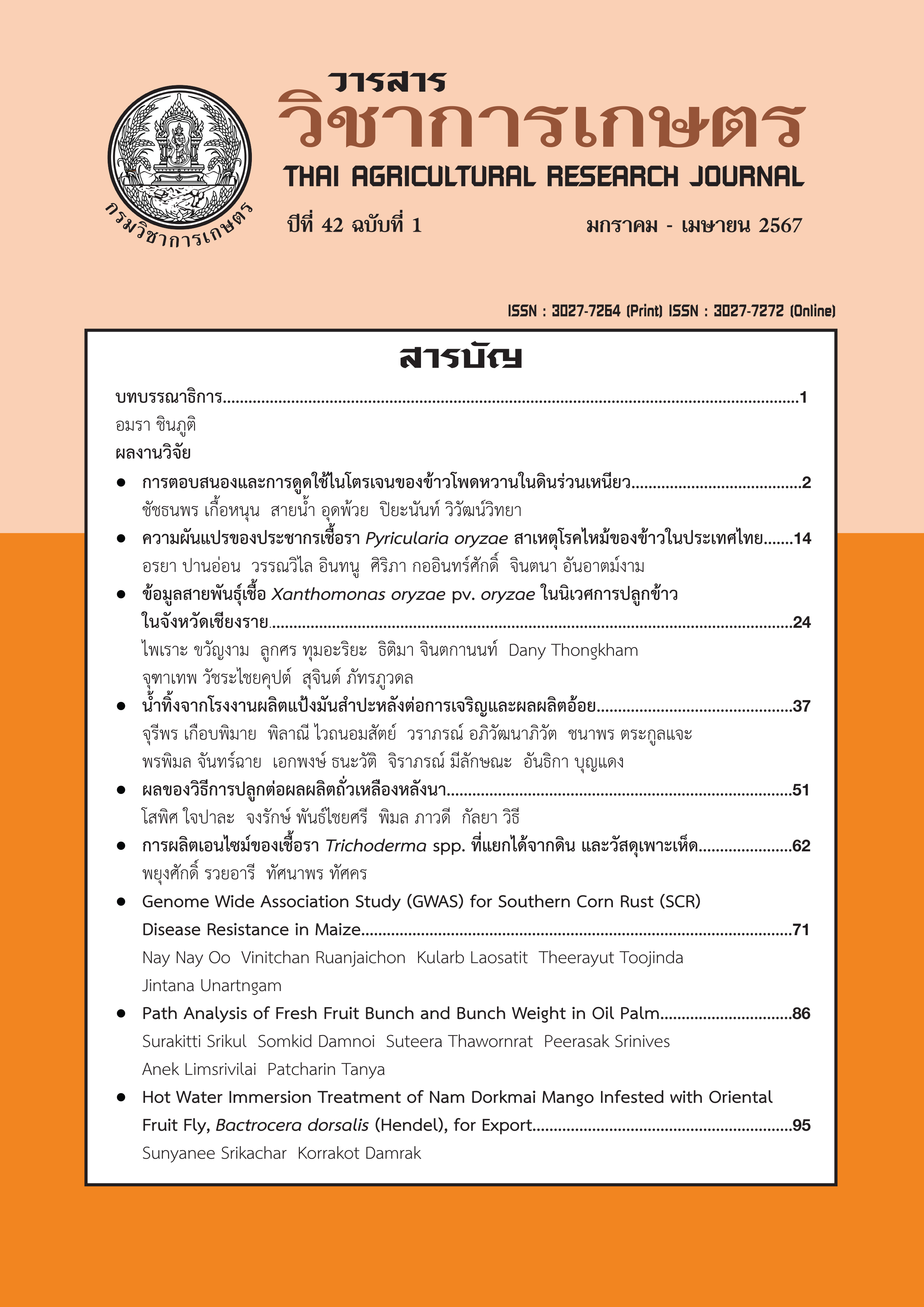
การผลิตเอนไซม์ของเชื้อรา Trichoderma spp. ที่แยกได้จากดิน และวัสดุเพาะเห็ด
DOI:
https://doi.org/10.14456/thaidoa-agres.2024.6คำสำคัญ:
Trichoderma spp, เซลลูเลส, เพคติเนส, อะไมเลสบทคัดย่อ
งานวิจัยนี้มีวัตถุประสงค์เพื่อทดสอบประสิทธิภาพการสร้างเอนไซม์ย่อยสลายของเชื้อรา Trichoderma spp. จำนวน 29 ไอโซเลท ที่แยกได้จากตัวอย่างดิน และวัสดุเพาะเห็ด ในปีพ.ศ. 2562-2564 นำเชื้อรา Trichoderma spp. ที่แยกได้มาทดสอบประสิทธิภาพการสร้างเอนไซม์ย่อยสลายบนอาหารเลี้ยงเชื้อจำเพาะ ด้วยวิธี zone clearing technique และประเมินค่า hydrolysis capacity (HC value) ผลการทดลองพบว่า เชื้อรา Trichoderma ไอโซเลท T-1, T-14 และ T-22 สามารถสร้างเอนไซม์เพคติเนส เซลลูเลส และอะไมเลสได้สูงที่สุด มีค่า HC เท่ากับ 7.73 7.13 และ 5.00 ตามลำดับ และสามารถระบุไอโซเลท T-1, T-14 และ T-22 ถึงระดับสปีซีส์ด้วยการหาลำดับเบสโดยใช้คู่ไพรเมอร์ ITS5 และ ITS4 พบว่า ไอโซเลท Trichoderma T-1, T-14 และ T-22 คือ เชื้อรา Trichoderma asperellum (Samuels) Lieckf. & Nirenberg ที่ระดับความเหมือน 100 99 และ 99% ตามลำดับ โดยเชื้อรา Trichoderma ไอโซเลท T-1 และ T-14 แยกมาได้จากตัวอย่างดินที่เก็บมาจาก อ. โพธาราม จ. ราชบุรี และ อ. ด่านมะขามเตี้ย จ. กาญจนบุรี ตามลำดับ ส่วน ไอโซเลท T-22 แยกได้จากวัสดุเพาะเห็ด อ. ดำเนินสะดวก จ. ราชบุรี
เอกสารอ้างอิง
กัญชลิกา รัตนเชิดฉาย ทวีทรัพย์ ไชยรักษ์ และณัฎฐชัย จันทชุม. 2562. การทดสอบใช้เชื้อราและสารสกัดจากเชื้อรา Trichoderma asperellum ในการต่อต้านเชื้อสาเหตุโรคเน่าดำของกล้วยไม้. วารสารเกษตรพระวรุณ. 16(1): 204-211.
จิระเดช แจ่มสว่าง และวรรณวิไล อินทนู. 2542. การใช้เชื้อราไตรโคเดอร์มาควบคุมโรคพืช. โครงการเกษตรกู้ชาติมหาวิทยาลัยเกษตรศาสตร์ ภาควิชาโรคพืช วิทยาเขตกำแพงแสน นครปฐม. 90 หน้า.
ทัศนาพร ทัศคร อภิรัชต์ สมฤทธิ์ และธารทิพย ภาสบุตร. 2550. ศึกษาผลการใช้วัสดุเพาะเห็ดร่วมกับเชื้อรา Trichoderma spp. ในการป้องกันกำจัดโรคลำต้นไหม้หน่อไม้ฝรั่ง. หน้า 366-378. ใน: รายงานผลวิจัยประจำปี 2550 เล่มที่ 1. สำนักวิจัยพัฒนาการอารักขาพืช กรมวิชาการเกษตร กระทรวงเกษตรและสหกรณ์. กรุงเทพฯ.
พิมพ์ชนา วงศ์พิศาล พรศิลป์ สีเผือก ชัยสิทธิ์ ปรีชา และวุฒิชัย สีเผือก. 2559. การคัดเลือกเชื้อราที่ผลิตเอนไซม์เซลลูเลสและไซแลนเนสจากซากใบปาล์มน้ำมัน (Elaeis guineensis Jacq.). แก่นเกษตร. 44(พิเศษ 1): 948-952.
เพชรลดา ปั้นหยา และกำไล เลาหพัฒนาเลิศ. 2556. การคัดกรองและคัดแยกจุลินทรีย์ที่สร้างเอนไซม์เซลลูเลส อะไมเลส และเพคติเนสจากกากมันสำปะหลังสด. หน้า 175-180. ใน: การประชุมวิชาการมหาวิทยาลัยรังสิตประจำปี 2556.
Adorada, D.L., C.L. Biles, C.M. Liddell, S. Fernandez-Pavia, K.O. Waugh and M.E. Waugh. 2000. Disease development and enhanced susceptibility of wounded pepper roots to Phytophthora capsici. Plant Pathology. 49: 719-726.
Bech, L., P.K. Busk and L. Lange. 2015. Cell wall degrading enzymes in Trichoderma asperellum grown on wheat bran. Fungal Genomics and Biology. 4(1):1-10.
Do Vale, L.H.F., E.X.F. Filho, R.N.G. Miller, C.A.O. Ricart, M.V. de Sousa, V.K. Gubta, M. Schmoll, A. Herrera-Estrella, R.S. Upadhyay, I. Druzhinina and M.G. Tuohy. 2014. Cellulase systems in Trichoderma: An Overview. pp. 299-244. In: Biotechnology and Biology of Trichoderma. Elsevier. Amsterdam.
Engelberth, J., E.A. Schmelz, H.T. Alborn, Y.J. Cardoza, J. Huang and J.H. Tumlinson. 2003. Simultaneous quantification of jasmonic acid and salicylic acid in plants by vapor-phase extraction and gas chromatography-chemical ionization-mass spectrometry. Analytical Biochemistry. 312: 242-250.
Gajera, H.P. and D.N. Vakharia. 2012. Production of lytic enzymes by Trichoderma isolates during in vitro antagonism with Aspergillus Niger, the causal agent of collar rot of peanut. Brazilian Journal of Microbiology. 43(1): 43-52.
Phutela, U., V. Dhuna, S. Sandhu and B.S. Chadha. 2005. Pectinase and polygalacturonase production by a thermophillic Aspergillus fumigatus isolated from decomposing orange peels. Brazilian Journal of Microbiology. 36: 63-69.
Taechapoempol, K., T. Sreethawong, P. Rangsunvigit, W. Namprohm, B. Thamprajamchit, S. Rengpipat and S. Chavadej. 2011. Cellulase-producing bacteria from Thai higher termites, Microcerotermes sp.: enzymatic activities and ionic liquid tolerance. Applied Biochemistry and Biotechnology. 164(2):204-19.
Vinale, F., K. Sivasithamparum, E.L. Ghisalbert, R. Marra, S.L. Woo and M. Lorito. 2014. Trichoderma secondary metabolites active on plants and fungal pathogens. The Open Mycology Journal. 8 (Suppl-1, M5): 127-139.
Wu, Q., R. Sun, M. Ni, J. Yu, Y. Li, C. Yu, K. Dou, J. Ren and J. Chen. 2017. Identification of a novel fungus, Trichoderma asperellum GDFS1009, and comprehensive evaluation of its biocontrol efficacy. PloS One. 12(6): e0179957.
Xu, J., and Q. Yang. 2010. Isolation and characterization of rice straw degrading Streptomyces griseorubens C5. Biodegradation. 21(1): 107-116.
ดาวน์โหลด
เผยแพร่แล้ว
รูปแบบการอ้างอิง
ฉบับ
ประเภทบทความ
สัญญาอนุญาต
ลิขสิทธิ์ (c) 2024 วารสารวิชาการเกษตร

อนุญาตภายใต้เงื่อนไข Creative Commons Attribution-NonCommercial-NoDerivatives 4.0 International License.
วารสารวิชาการเกษตร

