
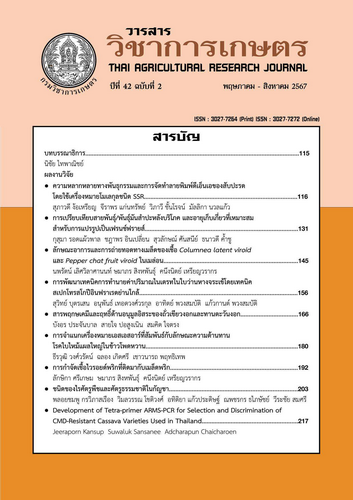
การจำแนกเครื่องหมายเอสเอสอาร์ที่สัมพันธ์กับลักษณะความต้านทาน โรคใบไหม้แผลใหญ่ในข้าวโพดหวาน
DOI:
https://doi.org/10.14456/thaidoa-agres.2024.15คำสำคัญ:
โรคใบไม้แผลใหญ่, เครื่องหมายเอสเอสอาร์, ความต้านทานโรคพืช, Exserohilum turcicumบทคัดย่อ
โรคใบไหม้แผลใหญ่ มีสาเหตุมาจากเชื้อรา Exserohilum turcicum ก่อให้เกิดความเสียหายต่อผลผลิตข้าวโพดหวาน การปลูกข้าวโพดหวานสายพันธุ์ต้านทานโรคเป็นวิธีการที่มีประสิทธิภาพสูงสุด แต่การปรับปรุงพันธุ์ด้วยวิธีมาตรฐานใช้ระยะเวลานาน และอิทธิพลของสิ่งแวดล้อมมีผลต่อการประเมินการเป็นโรคใบไหม้แผลใหญ่ งานวิจัยนี้จึงนำเทคโนโลยีชีวภาพระดับโมเลกุลทางด้านเครื่องหมายดีเอ็นเอ มาใช้ในการคัดเลือกข้าวโพดหวานต้านทานโรคใบไหม้แผลใหญ่ โดยนำเครื่องหมายเอสเอสอาร์จำนวน 16 เครื่องหมายมาทดสอบความสามารถในการแยกความแตกต่างของการเป็นโรคใบไหม้แผลใหญ่ในข้าวโพดหวาน 26 พันธุ์/พันธุ์ลูกผสม ผลการทดสอบ พบว่า เครื่องหมาย bnlg182 บนโครโมโซมที่ 1 ตำแหน่ง 1.03 ปรากฎอัลลีลที่สามารถแยกความแตกต่างกันระหว่างข้าวโพดหวานที่มีระดับต้านทานปานกลางต่อโรคกับข้าวโพดหวานที่มีระดับอ่อนแอปานกลางต่อโรคได้ เมื่อนำ bnlg182 มาใช้เพิ่มปริมาณดีเอ็นเอข้าวโพดหวานลูกผสมรุ่นชั่วที่ 6 จำนวน 158 สายพันธุ์ พบอัลลีลที่สัมพันธ์กับความต้านทานโรคปานกลางในข้าวโพดหวานลูกผสมจำนวน 10 สายพันธุ์ เมื่อนำไปปลูกเพื่อประเมินการเป็นโรคใบไหม้แผลใหญ่ พบว่า ข้าวโพดหวานทั้ง 10 สายพันธุ์นี้มีระดับต้านทานปานกลางต่อโรค (19 – 30%) การประยุกต์ใช้เครื่องหมาย bnlg182 มาเป็นเครื่องมือในการช่วยคัดเลือกข้าวโพดหวานต้านทานใบไหม้แผลใหญ่ในการปรับปรุงพันธุ์ข้าวโพดหวานทำให้การปฏิบัติงานง่าย และรวดเร็วขึ้น
เอกสารอ้างอิง
พีระวรรณ พัฒนวิภาส. 2551. โรคข้าวโพดฝักสด. เอกสารวิชาการ สำนักวิจัยพัฒนาการอารักขาพืช กรมวิชาการเกษตร. แหล่งข้อมูล: http://lib.doa.go.th/multim/e-book/EB00572.pdf. สืบค้น: 15 สิงหาคม 2566.
องอาจ กิตติคุณชัย. 2567. สถานการณ์ปัจจุบันของอุตสาหกรรมข้าวโพดหวานไทย. แหล่งข้อมูล: https://thaifood.org/main/revealed-the-current-situation-of-thai-sweet-corn. สืบค้น: 23 พฤษภาคม 2567.
Hao, Z.F., X.H. Li, C.X. Xie, M.S. Li, D.G. Zhang, L. Bai and S.H. Zhang. 2008. Two consensus quantitative trait loci clusters controlling anthesis-silking interval, ear setting and grain yield might be related with drought tolerance in maize. Annals of Applied Biology. 153: 73-83.
Kumar, B., M. Choudhary, P. Kumar, K. Kumar, S. Kumar, B.K. Singh, C. Lahkar, Meenakshi, P. Kumar, Z.A. Dar, R. Devlash, K.S. Hooda, S.K. Guleria and S. Rakshit. 2022. Population structure analysis and association mapping for turcicum leaf blight resistance in tropical maize using SSR markers. Genes. 13(4): 618.
Liu, X., X. Zhu, X. Wei, C. Lu, F. Shen, X. Zhang and Z. Zhang. 2020. The wheat LLM domain-containing transcription factor TaGATA1 positively modulates host immune response to Rhizoctonia cerealis. Journal of Experimental Botany. 71(1): 344-355.
Min, J., Z. Chunyu, H. Khalid, W. Suwen and L. Feng. 2012. Pyramiding resistance genes to northern leaf blight and head smut in maize. International Journal of Agriculture & Biology. 14: 430-434.
Osman, H.T., M.G. Balbaa, A.E. Khalied and N.R. Abdelsalam. 2015. Marker assisted selection for leaf blight in maize (Zea mays L.). Middle East Journal of Agricultural Research. 4(3): 417-426.
Puttarach, J., P. Puddhanon, S. Siripin, S. Sangtong and S. Songchantuek. 2016. Marker assisted selection for resistance to northern corn leaf blight in sweet corn. SABRAO Journal of Breeding and Genetics. 48(1): 72-79.
Rajeshwar, R.P., R. Narayan, P. Ranga and S.R. Sokka. 2014. Cultural and morphological variability among Exserohilum turcicum isolates. International Journal of Scientific Research and Publication. 3: 54-59.
Raymundo, A.D. and A.L. Hooker. 1981. Measuring the relationship between northern corn blight and yield losses. Plant Disease. 65: 325-327.
Teakle, G.R., I.W. Manfield, J.F. Graham and P.M. Gilmartin. 2002. Arabidopsis thaliana GATA factors: organization, expression and DNA-binding characteristics. Plant Molecular Biology. 50(1): 43-57.
Tuberosa, S., M.C. Sanguinet, P. Landi, M.M. Giulini, S. Salvi and M. Conti. 2002. Identification of QTLs for root characteristics in maize grown in hydroponics and analysis of their overlap with QTLs for gran yield in the field at two water regimes. Plant Molecular Biology. 48: 697-712
Wende, A., H. Shimelis and E.T. Gwata. 2018. Genetic variability for resistance to leaf blight and diversity among selected maize inbred lines. pp. 39-56. In: M.A. El-Esawi, Maize Germplasm-Characterization and Genetic Approaches for Crop Improvement. London, U.K. IntechOpen.
Yu, Y.H., L. Bian, K.K. Yu, S.D. Yang, G.H. Zhang and D.L. Guo. 2020. Grape (Vitis davidii) VdGATA2 functions as a transcription activator and enhances powdery mildew resistance via the active oxygen species pathway. Scientia Horticulturae. 267: 109327.
Zhang, K., X. Wang, W. Zhu, X. Qin, J. Xu, C. Cheng, Q. Lou, J. Li and J. Chen. 2018. Complete resistance to powdery mildew and partial resistant to downy mildew in a Cucumis hystrix, introgression line of cucumber were controlled by a co-localized locus. Theoretical and Applied Genetics. 131: 2229-2243.
ดาวน์โหลด
เผยแพร่แล้ว
รูปแบบการอ้างอิง
ฉบับ
ประเภทบทความ
สัญญาอนุญาต
ลิขสิทธิ์ (c) 2024 วารสารวิชาการเกษตร

อนุญาตภายใต้เงื่อนไข Creative Commons Attribution-NonCommercial-NoDerivatives 4.0 International License.
วารสารวิชาการเกษตร

