
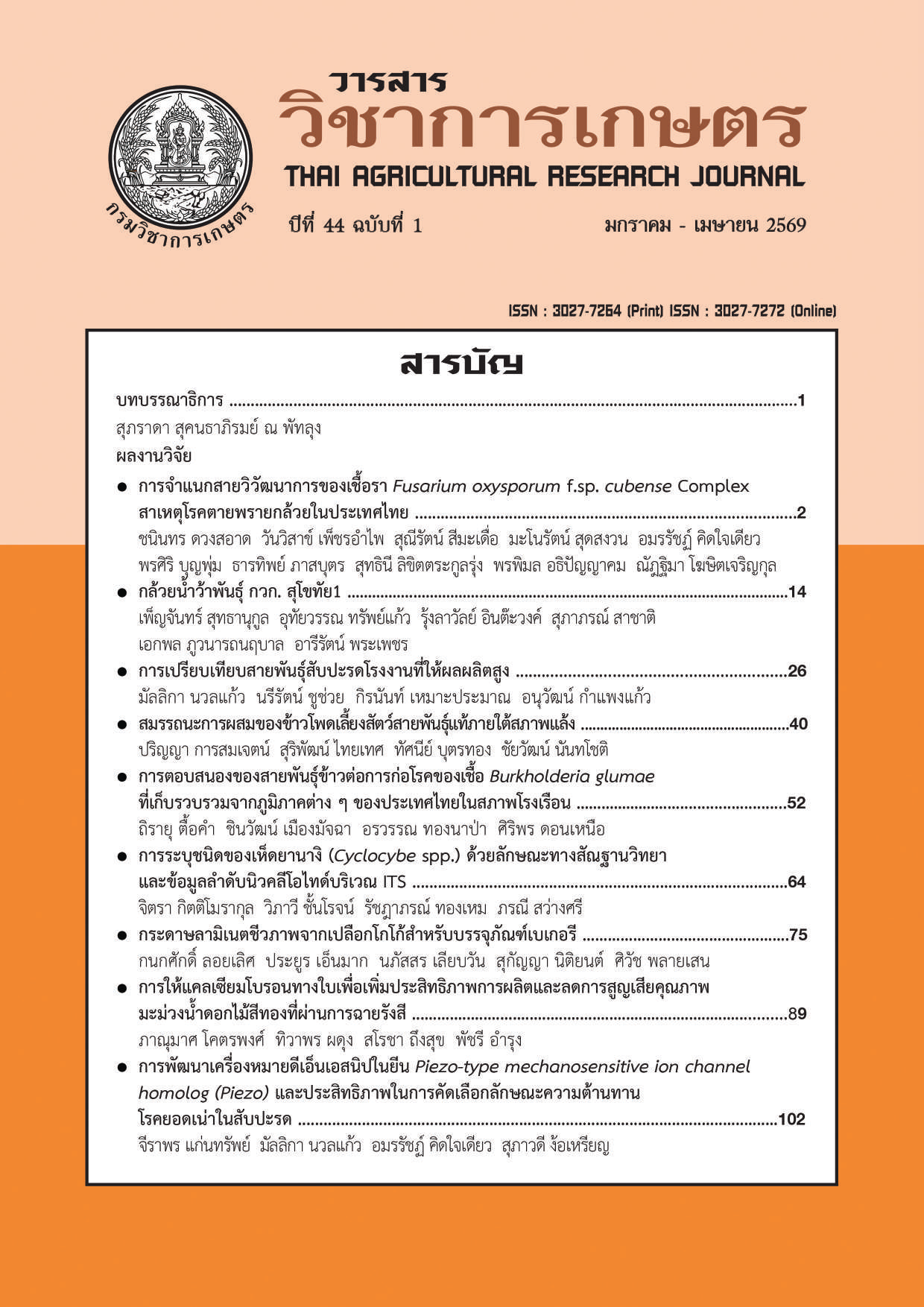
กระดาษลามิเนตชีวภาพจากเปลือกโกโก้สำหรับบรรจุภัณฑ์เบเกอรี
DOI:
https://doi.org/10.14456/thaidoa-agres.2026.7คำสำคัญ:
ผลิตภัณฑ์เบเกอรี, เปลือกโกโก้, กระดาษ, บรรจุภัณฑ์, พอลิบิวทิลีนอะดิเพท-โค-เทเรฟทาเลทบทคัดย่อ
กระดาษเปลือกโกโก้มีข้อจำกัดเรื่องความทนทานด้านเชิงกล จึงศึกษาการใช้เปลือกโกโก้ที่เป็นวัสดุเหลือใช้เพื่อผลิตภาชนะกระดาษซึ่งลามิเนตด้วยพลาสติกชีวภาพพอลิบิวทิลีนอะดิเพท-โค-เทเรฟทาเลท (PBAT) สำหรับผลิตภัณฑ์เบเกอรี โดยต้มเยื่อเปลือกโกโก้ด้วยวิธีการทางเคมีซึ่งใช้โซเดียมไฮดรอกไซด์-แอนทราควิโนน (SAQ) แล้วทดสอบสมบัติทางกายภาพและเคมี พบว่า การต้มเยื่อเปลือกโกโก้สูตร SAQ5 (โซเดียมไฮดรอกไซด์ 20 (%โดยน้ำหนัก/ปริมาตร) แอนทราควิโนน 0.1 (%โดยน้ำหนัก/น้ำหนัก) ที่อุณหภูมิ 140°ซ. ใช้เวลา 60 นาที ได้ปริมาณเยื่อสูงสุด 77.87±2.57% คัปปานัมเบอร์ 26.0±0.1 ลิกนิน 3.38±0.01% และสภาพการระบายน้ำ 802.67±63.79 ซีเอสเอฟ การขึ้นรูปกระดาษโดยใช้สตาร์ชดัดแปรเป็นตัวประสานพบว่า เยื่อเปลือกโกโก้ 10 ก. สตาร์ชดัดแปร 0.25 ก. มีความต้านทานการไหลของอากาศ 12.6±3.3 ปาสคาล.วินาที/ม. และน้ำหนักมาตรฐาน 67.33±12.92 ก./ตร.ม. เมื่อใช้พลาสติก PBAT ลามิเนตเพื่อต้านทานน้ำและไขมัน พบว่า PBAT 4 ชั้น/กระดาษ/ PBAT 4 ชั้น ให้สมบัติดีที่สุด มีน้ำหนักมาตรฐาน 119.70±7.94 ก./ตร.ม. มีความหนาแน่น 1.40±0.20 ก./ลบ.ซม แตกต่างอย่างมีนัยสำคัญกับชุดควบคุม เมื่อขึ้นรูปแล้วนำมาใช้เป็นภาชนะบรรจุผลิตภัณฑ์เบเกอรีชนิดขนมปังไส้กรอกมายองเนส บัตเตอร์เค้ก คุกกี้เนยผสมอัลมอนด์ แลครัวซองท์รสนม แสดงแนวโน้มการเพิ่มคุณสมบัติไม่ชอบน้ำ/น้ำมันจากค่ามุมสัมผัสและผลการทดสอบต้านทานไขมันและน้ำมันเชิงคุณภาพได้ทุกผลิตภัณฑ์เมื่อเวลาผ่านไป 180 นาที
เอกสารอ้างอิง
ธัญญารัตน์ จิญกาญจน์. 2557. การทดสอบกระดาษและบรรจุภัณฑ์กระดาษ. พิมพ์ครั้งที่ 1. บริษัท Asia digital การพิมพ์ จำกัด, กรุงเทพฯ. 130 หน้า.
รมณีย์ หวังดีธรรม กิตติภณ เจริญพรพิทักษ์ ไพศักดิ์ อนันท์นุกูล และยุทธนันท์ สิงค์คำมา. 2554. การศึกษากระบวนการผลิตเยื่อกระดาษจากสบู่ดำ. สถาบันวิจัยวิทยาศาสตร์และเทคโนโลยีแห่งประเทศไทย. 84 หน้า.
รุ่งนภา พงศ์สวัสดิ์มานิต. 2562. การประเมินและการเพิ่มอายุการเก็บผลิตภัณฑ์อาหาร. พิมพ์ครั้งที่ 2. บริษัท โอ. เอส. พริ้นติ้ง เฮ้าส์ จำกัด, กรุงเทพฯ. 397 หน้า.
โสรญา เรืองดิษฐ์. 2560. การดัดแปลงเมมเบรนพอลิซัลโฟนสำหรับการแยกแก๊ส CO2/CH4 โดยเทคนิคพลาสมากระแสตรง. วิทยานิพนธ์ปริญญาโท, มหาวิทยาลัย สงขลานครินทร์. 92 หน้า.
Akpabio, U.D., I.E. Effiong and A.E. Akpakpan. 2012. Preparation of Pulp and Cellulose Acetate from Nypa Palm Leaves. International Journal of Environment and Bioenergy 1(3): 179-194.
Choi, H.J., M.S. Kim, D. Ahn, S.Y. Yeo and S. Lee. 2019. Electrical percolation threshold of carbon black in a polymer matrix and its application to antistatic fibre. Scientific Reports 9(1): 6338.
Córdova, B.M., J.P.S. Cruz, T.V. Ocampo, R.G.H. Palomino and A.M.B. Moncada. 2020. Simultaneous adsorption of a ternary mixture of brilliant green, rhodamine B and methyl orange as artificial wastewater onto biochar from cocoa pod husk waste. Quantification of dyes using the derivative spectrophotometry method. New Journal of Chemistry. 44: 8303-8316.
Daud, Z., H. Awang, A.S.M. Kassim, M.Z.M. Hatta and A.M. Aripin. 2014. Cocoa Pod Husk and Corn Stalk: Alternative Paper Fibres. Advanced Materials Research. 911: 331–335.
Guiné, R.P.F. 2022. Textural properties of bakery products: A review of instrumental and sensory evaluation studies. Applied Sciences. 12(17): 8628.
Li, G., S. Shankar, J.W. Rhim and B.Y. Oh. 2015. Effects of preparation method on properties of poly (butylene adipate-co-terephthalate) films. Food Science and Biotechnology. 24(5): 1679-1685.
Lu, F., J.R. Garcia, I.V. Damme, N.J. Westwood, L. Shaw, J.S. Robinson, G. Warren, A. Chatzifragkou, S.M. Mason, L. Gomez, L. Faas, K. Balcombe, C. Srinivasan, F. Picchioni, P. Hdley and D. Charalampopoulos. 2018. Valorisation strategies for cocoa pod husk and its fractions. Current Opinion in Green and Sustainable Chemistry 14: 80-88.
Mannai, F., M. Aammar, J.G. Yanez, E. Elaloui and Y. Moussaoui. 2017. Alkaline delignification of cactus fibres for pulp and papermaking applications. Journal of Polymers and the Environment. 26(2): 798–806.
Murray, R., S. Bachu, C. Pemberton and R. Birch. 2021. Investigation of the impact of aging upon the mechanical properties of cocoa pod husk. Pelita Perkebunan. 37(2): 146-165.
Nabels, S.M., O. Platnieks, L. Grase and S. Gaidukovs. 2022. Lamination of cast hemp paper with bio-based plastics for sustainable packaging: Structure-thermomechanical properties relationship and biodegradation studies. Journal of Composites Science. 6(9): 246.
Oddoye, E.O.K., C.K.A. Badu and E.G. Akoto. 2012. Cocoa and Its By-Products: Identification and Utilization. pp. 23-37. In: Chocolate in Health and Nutrition, R.W. Ronald, V.R. Preedy and S. Zibadi (eds.). Humana Press, Totowa, NJ.
Riley, A. 2012. Plastics Manufacturing Processes for Packaging Materials. pp. 310-360. In: Packaging Technology Fundamentals, Materials and Processes, A. Emblem and H. Emblem (eds). Woodhead Publishing Limited.
Tayeb, A.H., M. Tajvidi and D. Bousfield. 2020. Paper-based oil barrier packaging using lignin-containing cellulose nanofibrils. Molecules. 25(6): 1344.
Vandenberghe, L.P.S., K.K.V. Diestra, G.A. Bittencourt, A.F.M. Mello, Z.S. Vásquez, P.Z. Oliveira, G.V.M. Pereira and C.R. Soccol. 2022. Added-value biomolecules’ production from cocoa pod husks: A review. Bioresource Technology. 344: 126252.
Wongphan, P., E. Canellas, C. Nerín, C. Estremera, N. Harnkarnsujarit and P. Vera. 2025. Screening and Relative Quantification of Migration from Novel Thermoplastic Starch and PBAT Blend Packaging. Foods. 14: 1-16.
Zubiaguirre, L.B., I. Zabaleta, A. Prieto, M. Olivares, O. Zuloaga and M.P. Elizalde. 2021. Migration of photoinitiators, phthalates and plasticizers from paper and cardboard materials into different simulants and foodstuffs. Food Chemistry. 344: 1-8.
ดาวน์โหลด
เผยแพร่แล้ว
รูปแบบการอ้างอิง
ฉบับ
ประเภทบทความ
สัญญาอนุญาต
ลิขสิทธิ์ (c) 2026 วารสารวิชาการเกษตร

อนุญาตภายใต้เงื่อนไข Creative Commons Attribution-NonCommercial-NoDerivatives 4.0 International License.
วารสารวิชาการเกษตร

