
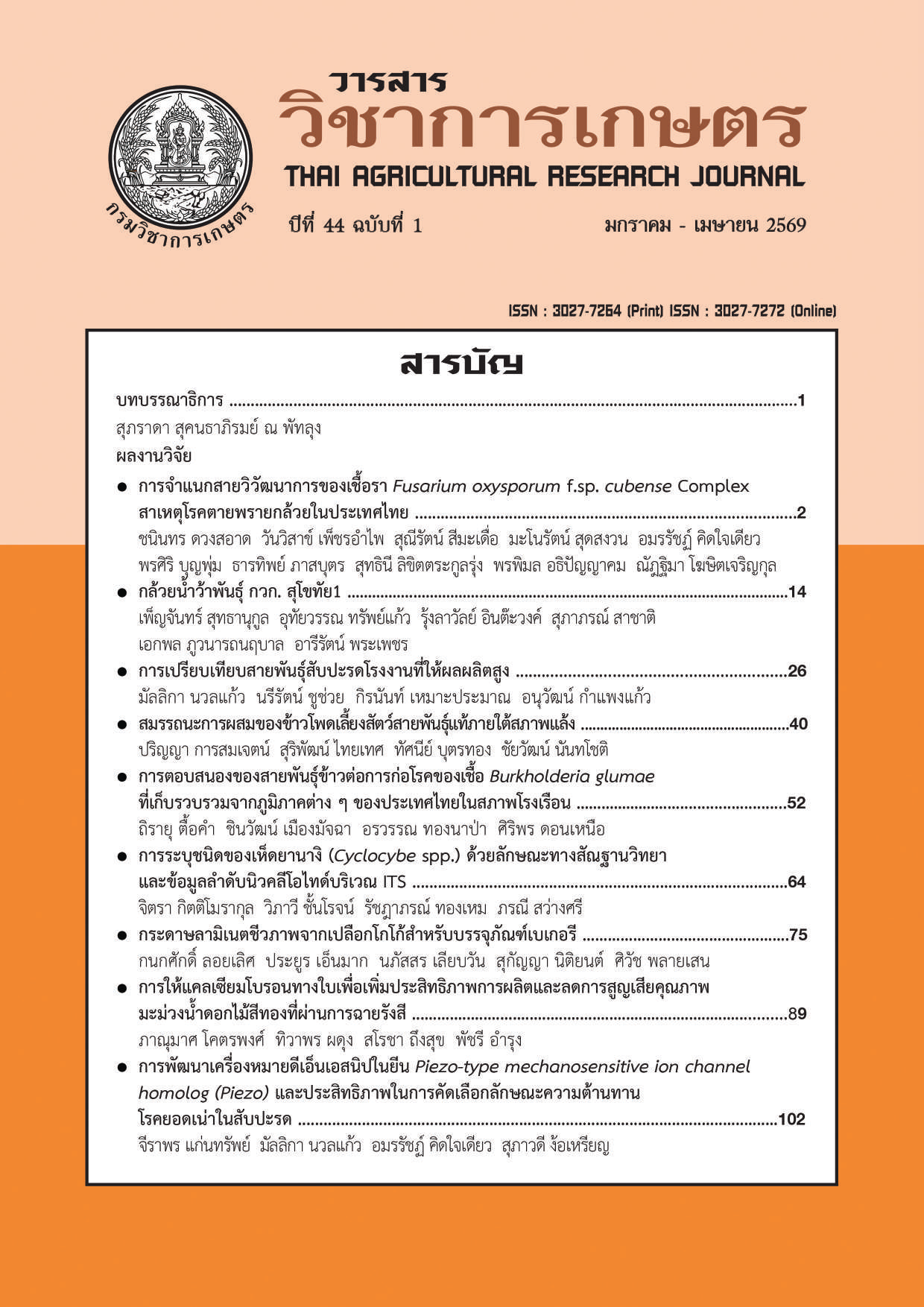
การจำแนกสายวิวัฒนาการของเชื้อรา Fusarium oxysporum f.sp. cubense Complex สาเหตุโรคตายพรายกล้วยในประเทศไทย
DOI:
https://doi.org/10.14456/thaidoa-agres.2026.1คำสำคัญ:
ชนิดที่ซับซ้อน, Fusarium oxysporum f. sp. cubense, อนุกรมวิธานบทคัดย่อ
โรคตายพรายในกล้วยเกิดจากเชื้อรา Fusarium oxysporum f. sp. cubense (Foc) ซึ่งทำลายท่อลำเลียง ทำให้ต้นกล้วยเหี่ยวและตายเป็นภัยร้ายแรงต่อการปลูกกล้วยทั่วโลก ในประเทศไทยเชื้อรา Foc race 1 มีระบาดนานแล้ว ในขณะที่เชื้อรา Foc tropical race 4 (TR4) ซึ่งเป็นศัตรูพืชร้ายแรงอุบัติใหม่ในกล้วยคาเวนดิชและตรวจพบจากการเฝ้าระวังเชื้ออาการเหี่ยวจากเชื้อรา Fusarium ที่ยังไม่ทราบชนิดที่แน่ชัด จำเป็นต้องจำแนกชนิดให้ถูกต้อง เพื่อกำหนดมาตรการที่เหมาะสมในการควบคุมโรค งานวิจัยนี้มีวัตถุประสงค์ เพื่อจำแนกชนิดของเชื้อรา Foc ที่พบในกล้วยซึ่งแสดงอาการเหี่ยว จากแหล่งปลูกที่สำคัญของจังหวัดต่าง ๆ โดยใช้ข้อมูลและวิธีการทางชีวโมเลกุล รวมทั้งตรวจสอบชนิดของเชื้อรา Fusarium ที่เคยพบในกล้วยคาเวนดิชจากเขตควบคุมศัตรูพืชซึ่งได้ดำเนินควบคุมกำจัดศัตรูพืชและปัจจุบันไม่ปรากฏในประเทศไทย โดยได้นำเชื้อรา มาเก็บรักษาไว้ที่กรมวิชาการเกษตรซึ่งทำหน้าที่องค์กรอารักขาพืชแห่งชาติ (NPPO) ของประเทศไทย ภายใต้อนุสัญญาอารักขาพืชระหว่างประเทศ (IPPC) นำมาแยกเชื้อ สกัด และเพิ่มปริมาณ DNA ตำแหน่ง tef1 และ rpb2 ด้วยเทคนิค PCR วิเคราะห์ลำดับนิวคลิโอไทด์ และความสัมพันธ์เชิงวิวัฒนาการเพื่อจำแนกชนิด พบว่า Foc race 1 ในประเทศไทยมีความหลากหลายทางพันธุกรรม สามารถจำแนกได้เป็น F. tardichlamydosporum F. duoseptatum และ F. grosmichelii นอกจากนี้ยังพบในกลุ่ม non-race คือ F. kalimantanense โดยเชื้อราจากกล้วยคาเวนดิช คือ F. odoratissimum (syn. TR4) ซึ่งปัจจุบันเชื้อราชนิดนี้มีสถานะไม่ปรากฏในประเทศไทย เชื้อราทุกชนิดมีความสัมพันธ์เชิงวิวัฒนาการที่ใกล้ชิดกันมาก การระบุชนิดจำแนกชนิดในกลุ่มที่เป็น species complex ต้องใช้การวินิจฉัยระดับห้องปฏิบัติการด้วยข้อมูลชีวโมเลกุลมาช่วยในการศึกษา
เอกสารอ้างอิง
Booth, C. 1971. The Genus Fusarium. Commonwealth Mycological Institute, Kew, Surrey, 237p.
Brayford, D. 1992. IMI Descriptions of Fungi and Bacteria No. 1112. Fusarium oxysporum f. sp. Batatas. Mycopathologia. 118(1): 41-42.
Correll, J.C., C.J.R. Klittich and J.F. Leslie. 1987. Nitrate non-utilizing mutants of Fusarium oxysporum and their use in vegetative compatibility tests. Phytopathology. 77(12): 1640-1646.
Cove, D.J. 1976. Chlorate toxicity in Aspergillus nidulans: the selection and characterisation of chlorate resistant mutants. Heredity. 36(2): 191-203.
Dita, M.A., C. Waalwijk, I.W. Buddenhagen, M.T. Jr Souza and G.H.J. Kema. 2010. A molecular diagnostic for tropical race 4 of the banana fusarium wilt pathogen. Plant Patholology. 59(2): 348–357.
Dita, M.A., C. Waalwijk, I.W. Buddenhagen, M.T. Jr Souza and G.H.J. Kema. 2011. Corrigendum. Plant Pathology. 60: 384.
Doungsa-ard, C., A.R. McTaggart, A.D. Geering, T.U. Dalisay, J. Ray and R.G. Shivas. 2015. Uromycladium falcatarium sp. nov., the cause of gall rust on Paraserianthes falcataria in south-east Asia. Australasian Plant Pathology. 44(1): 25-30.
Food and Agriculture Organization of the United Nations (FAO). 2014. Prevention and diagnostic of fusarium wilt (Panama disease) of banana caused by Fusarium oxysporum f. sp. cubense Tropical Race 4 (TR4). Available at: https://openknowledge.fao.org/handle/20.500.14283/br126e. Accessed: December 20, 2023.
FAO. 2021. ISPM 8: Determination of pest status in an area. Available at: https://openknowledge.fao.org/handle/20.500.14283/x2968e. Accessed: December 20, 2023.
FAO. 2022a. FAOSTAT Database. Rome, Italy: FAO. Available at: http://www.fao.org/faostat/en/# data/QC. Accessed: January 8, 2024.
FAO. 2022b. Detection of Fusarium oxysporum f. sp. cubense tropical race 4 in Thailand. Available at: https://www.ippc.int/en/countries/thailand/ pestreports/2019/11/detection-of-fusarium-oxysporum-f-sp-cubense-tropical-race-4-in-thailand/. Accessed: December 20, 2023.
Fraser-Smith, S., E. Czislowski, R.A. Meldrum, M. Zander, W. O'neill, G.R. Balali and E.A.B. Aitken. 2014. Sequence variation in the putative effector gene SIX8 facilitates molecular differentiation of Fusarium oxysporum f. sp. cubense. Plant Patholology. 63(5): 1044 –1052.
Katoh, K. and H. Toh. 2008. Recent developments in the MAFFT multiple sequence alignment program. Briefings in Bioinformatics. 9(4): 286-298.
Kearse, M., R. Moir, A. Wilson, S. Stones-Havas, M. Cheung, S. Sturrock, S. Buxton, A. Cooper, S. Markowitz, C. Duran, T. Thierer, B. Ashton, P. Mentjies and A. Drummond. 2012. Geneious Basic: An integrated and extendable desktop software platform for the organization and analysis of sequence data. Bioinformatics. 28(12): 1647-1649.
Kumar, S., G. Stecher and K. Tamura. 2016. MEGA7: Molecular Evolutionary Genetics Analysis Version 7.0 for Bigger Datasets. Molecular Biology and Evolution. 33(7): 1870-1874.
Michielse, C.B. and M. Rep. 2009. Pathogen profile update: Fusarium oxysporum. Molecular Plant Pathology. 10(3): 311-324.
Maryani, N., L. Lombard, Y.S. Poerba, S. Subandiyah, P.W. Crous and G.H.J. Kema. 2019. Phylogeny and genetic diversity of the banana Fusarium wilt pathogen Fusarium oxysporum f. sp. cubense in the Indonesian centre of origin. Studies in Mycology. 92(1): 155–194.
O'Donnell, K., C. Gueidan, S. Sink, P.R. Johnston, P.W. Crous, A. Glenn, R. Riley, N.C. Zitomer, P. Colyer, C. Waalwijk, Tv. Lee, A. Moretti, S. Kang, H.S. Kim, D.M. Geiser, J.H. Juba, R.P. Baayen, M.G. Cromey, S. Bithell, D.A. Sutton, K. Skovgaard, R. Ploetz, K.H. Corby, M. Elliott, M. Davis and B.A. Sarver. 2009. A two-locus DNA sequence database for typing plant and human pathogens within the Fusarium oxysporum species complex. Fungal Genetics and Biology. 46(12): 936-948.
O'Donnell, K., D.A. Sutton, M.G. Rinaldi, B.A Sarver, S.A. Balajee, H.J. Schroers, R.C. Summerbell, V.A. Robert, P.W. Crous, N. Zhang, T. Aoki, K. Jung, J. Park, Y.H. Lee, S. Kang, B. Park and D.M. Geiser. 2010. Internet-accessible DNA sequence database for identifying fusaria from human and animal infections. Journal of Clinical Microbiology. 48(10): 3708-3718.
O’Donnell, K., H.C. Kistler, E. Cigelnik and R.C. Ploetz. 1998. Multiple evolutionary origins of the fungus causing Panama disease of banana: concordant evidence from nuclear and mitochondrial gene genealogies. Proceedings of the National Academy of Sciences of the United States of America. 95(5): 2044–2049.
Ploetz, R.C. 2005. Panama disease: An old nemesis rears its ugly head Part 2. The Cavendish era and beyond. Online APS Publications. The American Phytopathological Society (APS). Minnesota, USA. Available at: https://apsjournals.apsnet.org/doi/10.1094/PHP-2006-0308-01-RV. Accessed: January 8, 2022.
Ploetz, R.C. 2015. Fusarium wilt of banana. Phytopathology. 105(12): 1512–1521.
Ploetz, R.C., G.H. Kema and L.J. Ma. 2015. Impact of diseases on export and smallholder production of banana. Annual Review of Phytopathology. 53(1): 269-288.
Puhalla, J.E. 1985. Classification of strains of Fusarium oxysporum on the basis of vegetative compatibility. Canadian Journal of Botany. 63(2): 179–183.
Stamatakis, A. 2014. RAxML version 8: A tool for phylogenetic analysis and post-analysis of large phylogenies. Bioinformatics. 30(9): 1312-1313.
Stover, R. H. 1962. Fusarial wilt (Panama Disease) of bananas and other Musa species. Commonwealth Mycological Institute. Phytopathological Paper No. 4. Kew, Surrey, England. 117 p.
Stover, R.H. and I.W. Buddenhagen. 1986. Banana breeding: Polyploidy, disease resistance and productivity. Fruits. 41(3): 175-191.
Stover, R.H. and N.W. Simmonds. 1987. Bananas, 3rd ed. Longman, London, UK. 468p.
Talavera, G. and J. Castresana. 2007. Improvement of phylogenies after removing divergent and ambiguously aligned blocks from protein sequence alignments. Systematic Biology. 56(4): 564-5
ดาวน์โหลด
เผยแพร่แล้ว
รูปแบบการอ้างอิง
ฉบับ
ประเภทบทความ
สัญญาอนุญาต
ลิขสิทธิ์ (c) 2026 วารสารวิชาการเกษตร

อนุญาตภายใต้เงื่อนไข Creative Commons Attribution-NonCommercial-NoDerivatives 4.0 International License.
วารสารวิชาการเกษตร

