
Molecular Food Web of Lepidopteran Hosts and Their Parasitoids in a Tropical Secondary Forest in Thailand
DOI:
https://doi.org/10.58837/tnh.25.1.262564Keywords:
DNA barcoding, Braconidae, Ichneumonidae, Tachinidae, dissection, quantitative food webAbstract
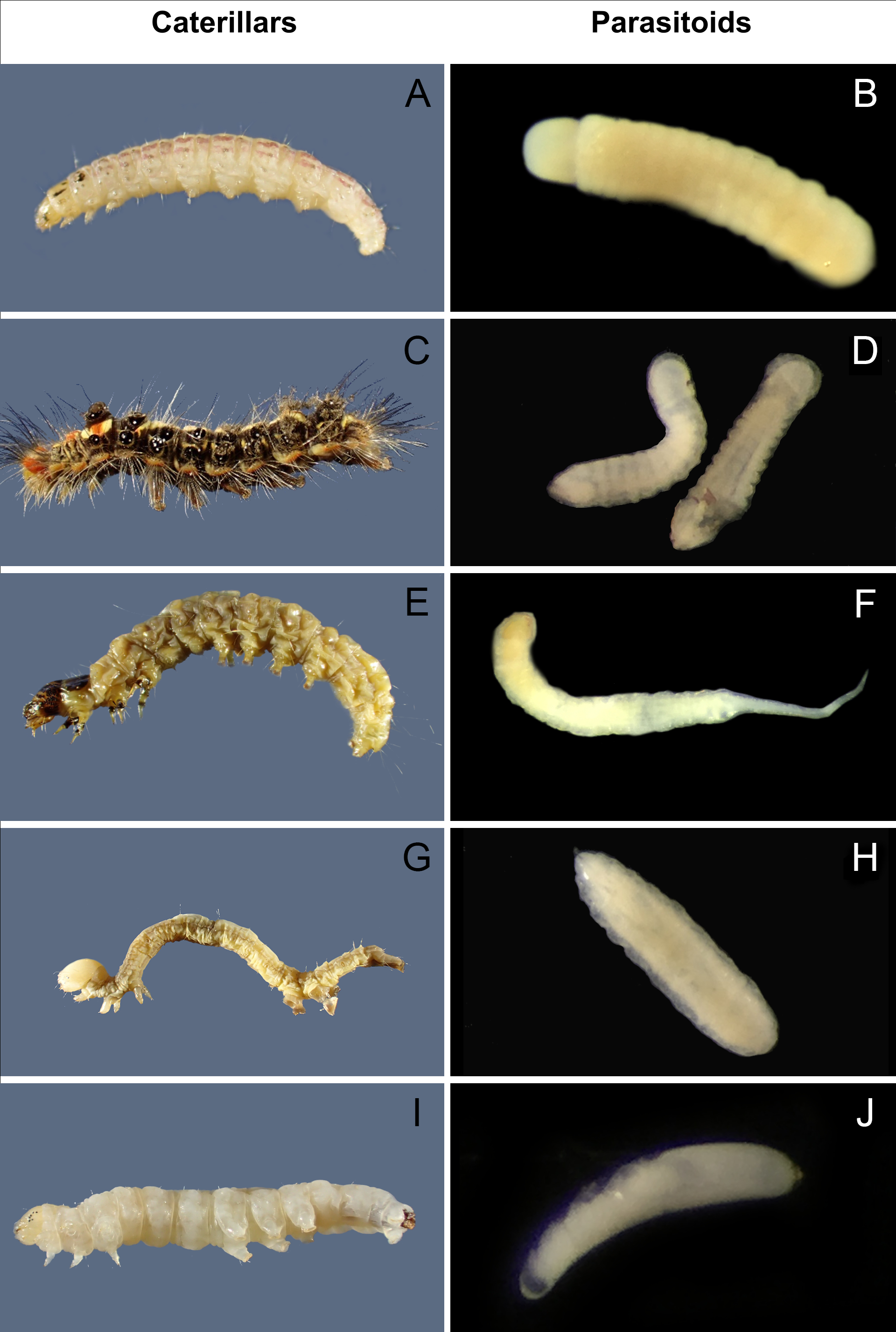
A semi-quantitative molecular food web was constructed for caterpillars (Lepidoptera) and juvenile insect parasitoids dissected from them, using the barcoding region of the mitochondrial cytochrome oxidase c subunit 1 gene. Sample collection was carried out in a secondary forest in Saraburi province of Thailand. A total of 5,673 caterpillars were collected between November 2015 and November 2016. Overall, 6%. of these were found to be parasitised. DNA barcoding revealed 118 provisional host species and 119 species of parasitoids. The most abundant caterpillar hosts were Haritalodes derogate (Lepidoptera, Crambidae) and the most abundant parasitoid was a tachinid fly, Peribaea sp. (Diptera, Tachinidae). Apparently, specialist parasitoids constituted 80% of the species, however, this seems likely to be an overestimate because of the large number of singletons. Compared with a number of other comparable food web studies the connectedness of our web was extremely low whereas generality, vulnerability and linkage density were very high. This might reflect the heterogeneous nature of the recently disturbed study area. Understanding the relationship and the unique attributes of secondary forests is essential for enhancing biodiversity and maintaining ecosystem stability in these fragile environments.
References
Agusti, N., Bourguet, D., Spataro, T., Delos, M., Eychenne, N., Folcher, L. and Arditi, R. 2005. Detection, identification and geographical distribution of European corn borer larval parasitoids using molecular markers. Molecular Ecology, 14: 3267–3274.
Ahmed, J., Khalap, R., Cathrine, C., Mohan, K. and Jadhav, B. 2021. A new, exotic larval host plant record for the Nygmiine Tussock Moth Orvasca cf. subnotata Walker, 1865, from the Mumbai region (Erebidae: Lymantriinae: Nygmiini). Ela Journal of Forestry and Wildlife, 10: 867–873.
Ashfaq, M., Akhtar, S., Akhtar, S. and Masood, M. 2017. PCR-Based Detection of a hHyperparasitoid in cCotton mMealybug, Phenacoccus solenopsis Tinsley (Hemiptera: Pseudococcidae). Pakistan Journal of Zoology, 49, 1–4.
Ashton, L., Sharp, A., Boyle, M., Bonebrake, T., Guo, Y., Kitching, R., Stork,N. and Zeng, X. 2024. Elevated ENSO extremes are reducing tropical forest invertebrate diversity and function. URL https://doi.org/10.21203/rs.3.rs-5081932/v1, (accessed 30 January 2025).
Bajwa, G.A., Gul, H. and Panhwar, G.M. 1998. Biology of leaf stitcher Piesmopoda obliquifasceilla Hamps (Lepidoptera) Pyralidae in the laboratory. Pakistan Journal of Forestry, 48: 39–46.
Barrion, A.T., and Litsinger, J.A. 1994. Taxonomy of rice insect pests and their arthropod parasites and predators. In: Heinrichs, E.A. (Ed.). Biology and Management of Rice Insects, Wiley Eastern, New Delhi, pp 13–362.
Basappa, H. 2011. Biodiversity of bBiocontrol aAgents in sSunflower eEcosystem. Journal of Biological Control, 25: 182–187.
Basset, Y., Jorge, L.R., Butterill, P.T., Lamarre, G.P.A., Dahl, C., Ctvrtecka, R., Gripenberg, S., Lewis, O.T., Barrios, H., Brown, J.W., Bunyavejchewin, S., Butcher, B.A., Cognato, A.I., Davies, S.J., Kaman, O., Klimes, P., Knížek, M., Miller, S.E., Morse, G.E., Novotny, V., Pongpattananurak, N., Pramual, P., Quicke, D.L.J., Sakchoowong, W., Umari, R., Vesterinen, E.J., Weiblen, G., Wright, S.J. and Segar, S.T. 2021. Host specificity and interaction networks of insects feeding on seeds and fruits in tropical rainforests. Oikos, 130: 1462–1476.
Beaver, R.A., Sittichaya, W. and Liu, L.Y. 2011. A review of the powder-post beetles of Thailand (Coleoptera: Bostrichidae). Tropical Natural History, 11: 135–158.
Berry, J.A. and Walker, G.P. 2004. Meteorus pulchricornis (Wesmael) (Hymenoptera: Braconidae: Euphorinae): an exotic polyphagous parasitoid in New Zealand. New Zealand Journal of Zoology, 31: 33–44
Bersier, L.F., Banasĕk-Richter, C. and Cattin, M.F. 2002. Quantitative descriptors of food-web matrices. Ecology, 83: 2394–2407.
Bhumannavar, B.S., Monhanraj, P., Ranganath, H.R., Jacob, T.K. and Bandyopadyay, A.K. 1991. Insects of agricultural importance in Andaman and Nicobar Islands. Research Bulletin of the Central Agricultural Research Institute, Port Blair, 649 pp.
Browne, F.G. 1968. Pests and diseases of forest plantation trees. Clarendon Press, Oxford, 1330 pp.
Butcher, B.A., Smith, M.A., Sharkey, M.J. and Quicke, D.L.J. 2012. A turbo-taxonomic study of Thai Aleiodes (Aleiodes) and Aleiodes (Arcaleiodes) (Hymenoptera: Braconidae: Rogadinae) based largely on COI bar-coded specimens, with rapid descriptions of 179 new species. Zootaxa, 3457: 1–232.
CABI. 2023. Crop Pest Compendium. URL https://www.cabidigitallibrary.org/product/qc, (accessed 27 January 2025).
Calizza, E., Costantini, M.L. and Rossi, L. 2015. Effect of multiple disturbances on food web vulnerability to biodiversity loss in detritus‐based systems. Ecosphere, 6: 1–20.
Calizza, E., Rossi, L., Careddu, G., Sporta Caputi, S. and Costantini, M.L. 2019. Species richness and vulnerability to disturbance propagation in real food webs. Scientific Reports, 9: 19331.
Campos-Moreno, D.F., Dyer, L.A., Salcido, D., Massad, T.J., Pérez-Lachaud, G., Tepe, E.J., Whitfield, J.B. and Pozo, C. 2021. Importance of interaction rewiring in determining spatial and temporal turnover of tritrophic (Piper-caterpillarparasitoid)
Chaudhry, G.U., Chaudhry, M.I. and Malik, N.K., 1970. Survey of Insect Fauna of Forests of Pakistan, 11. Pakistan Forst Institute, Peshwar, 205 pp.
Chen, X. and Kunshan, Y. 1987. Pest fauna of tea plant in China and its integrated management In: Sakata, K. and Ina, K. (Eeds). Proceedings of the International Tea Quality Human health Symposium, Hangzhou, China, pp 154–159.
Danthanarayana, W. and Kathiravetpillai, A. 1969. The bionomics of tea looper (Biston suppressaria Guen.) (Lepidoptera: Geometridae). Tea Quarterly, 40:71–83.
Das, S., Mukhopadhyay, A. and Roy, S. 2010. Morphological diversity, developmental traits and seasonal occurrence of looper pests (Lepidoptera: Geometridae) of tea crop. Journal of Biopesticides, 3:16–19
Davidson, J., Bell, T.R. and Aitken, E.H. 1896. The butterflies of the North Canara district of the Bombay Presidency. Part I. Journal of the Bombay Natural History Society, 10: 237–259.
Dawah, H.A., Hawkins, B.A. and Claridge, M.F. 1995. Structure of the parasitoid communities of grass-feeding chalcid wasps. Journal of Animal Ecology, 64: 708–720.
Day, W. 1994. Estimating mortality caused by parasites and diseases of insects: comparisons of the dissection and rearing methods. Environmental Entomology, 23: 543–550.
deWaard, J.R., Ivanova, N.V., Hajibabaei, M. and Hebert, P.D.N. 2008. Assembling DNA barcodes: analytical protocols. In: Martin, C.C. (Ed.). Environmental Genomics, Humana Press, Totowa, pp 275–293.
Dormann, C.F., Fründ, J., Blüthgen, N. and Gruber, B. 2009. Indices, graphs and null models: analyzing bipartite ecological networks. The Open Ecology Journal, 2: 7–24.
Edmunds, M. 1976. Larval mortality and population regulation in the butterfly Danaus chrysippus in Ghana. Zoological Journal of the Linnean Society, 58: 129–145.
Ek-Amnuay, P. 2012. Butterflies of Thailand 2nd Edition. Amarin Printing and Publishing, Bangkok, Thailand, 943 pp.
Feener Jr, D.H. and Brown, B.V. 1997. Diptera as parasitoids. Annual Review of Entomology, 42: 73–97.
Ferguson, D.C. 2008. The Moths of America North of Mexico, Fascicle 17.2: Geometroidea, Geometridae, Ennominae (Part: Abraxini, Cassymini, Macariini). The Wedge Entomological Research Foundation, Washington, D.C., 431 pp.
Fernandez-Triana, J., Shaw, M.R., Boudreault, C., Beaudin, M. and Broad, G.R. 2020. Annotated and illustrated world checklist of Microgastrinae parasitoid wasps (Hymenoptera, Braconidae). ZooKeys, 920: 1–1089
Fernandez-Triana, J.L. 2022. Turbo taxonomy approaches: Lessons from the past and recommendations for the future based on the experience with Braconidae (Hymenoptera) parasitoid wasps. ZooKeys, 1087: 199.
Fernandez-Triana, J.L., Beaudin, M., van Achterberg, K., Agbodzavu, M.K., Othim, S.T., Nyamu, F.W. and Fiaboe, K.K. 2017. DNA barcodes, expanded distribution, and redescription of Apanteles hemara Nixon, 1965 (Hymenoptera, Braconidae, Microgastrinae), a potential biocontrol species against amaranth leaf-webbers in Africa. Journal of Hymenoptera Research, 58: 1–15.
Gagic, V., Hanke, S., Thies, C., Scherber, C., Tomanovic, Z. and Tscharntke, T. 2012. Agricultural intensification and cereal aphid–parasitoid–hyperparasitoid food webs: network complexity, temporal variability and parasitism rates. Oecologia, 170: 1099–1109.
Gahramanova, G., Mamay, M. and Mammadov, Z. 2020. Biological characteristics and efficacy of Bacillus thuringiensis var. thuringiensis against the cotton leaf roller, Syllepte derogata (Fabricius, 1775) (Lepidoptera: Crambidae). Egyptian Journal of Biological Pest Control, 30: 85.
Gariepy, T., Kuhlmann, U., Gillott, C. and Erlandson, M. 2008. A large‐scale comparison of conventional and molecular methods for the evaluation of host‐parasitoid associations in non‐target risk‐assessment studies. Journal of Applied Ecology, 45: 708–715.
Ghazali, S.Z., Md-Zain, B.M., Maideen, H., Maimon, A. and Yaakop, S. 2014. A first record of gregarious moth pest, Herpetogramma platycapna (Meyrick) of fern species, Angiopteris evecta (G. Forst.) Hoffm from Malaysia. Malaysian Applied Biology, 43: 105–109.
Gilbert, A.J. 2009. Connectance indicates the robustness of food webs when subjected to species loss. Ecological Indicators, 9: 72–80.
Gilligan, T.M., Goldstein, P.Z., Timm, A.E., Farris, R., Ledezma, L. and Cunningham, A.P. 2019. Identification of Heliothine (Lepidoptera: Noctuidae) larvae intercepted at US ports of entry from the New World. Journal of Economic Entomology, 112: 603–615.
Godfray, H.C.J. 1994. Parasitoids: Behavioral and Evolutionary Ecology. Princeton University Press, New Jersey, USA, 473 pp.
Goff, R. 2019. African Moths: An Online Database of African Lepidoptera. URL https://africanmoths.com/pages/CRAMBIDAE/SPILOMELINAE/notarcha%20obrinusalis.html (accessed 31 March 2025)
Greenstone, M. 2006. Molecular methods for assessing insect parasitism. Bulletin of Entomological Research, 96: 1–13.
Gupta, A., Achterberg, C.V. and Chitrala, M. 2016. A new species of Crinibracon Quicke (Hymenoptera: Braconidae) parasitic on pupae of Hasora chromus (Cramer) (Lepidoptera: Hesperiidae) from India. Zootaxa, 4158: 281–291.
Gupta, A., Saji, K. and Manoj, P. 2016. Parasitoids of butterflies: reassignment of Dolichogenidea hasorae (Wilkinson, 1928) as a new combination along with new host-parasitoid linkages and notes on host specificity from Kerala, India. Journal of Biological Control, 1: 61–67.
Hampson, G. F. 1918. Descriptions of new Pyralidae of the subfamily Pyraustinae. Annals and Magazine of Natural History, including Zoology, Botany and Geology, 9: 125–136.
Harinath, P., Prasanna Kumar, V. and Venkata Ramana, S.P. 2012. Eco-biology of the cCommon pPierrot Castalius rosimon (Fabricius) (Lepidoptera: Rhopalocera: Lycaenidae). World Journal of Zoology, 7: 216–220.
Heath, B.D., Butcher, R.D., Whitfield, W.G. and Hubbard, S.F. 1999. Horizontal transfer of Wolbachia between phylogenetically distant insect species by a naturally occurring mechanism. Current Biology, 9: 313–316.
Hebert, P.D.N., deWaard, J.R., Zakharov, E.V., Prosser, S.W.J., Sones, J.E., McKeown, J.T.A., Mantle, B. and LaSalle, J. 2013. A DNA ‘barcode blitz’: rapid digitization and sequencing of a natural history collection. PLoS One, 8: e68535.
Hebert, P.D.N., Stoeckle, M.Y., Zemlak, T.S., and Francis, C.M. 2004. Identification of birds through DNA barcodes. PLoS Biology, 2: e312.
Heijboer, A., Ruess, L., Traugott, M., Jousset, A. and De Ruiter, P. 2017. Empirical methods of identifying and quantifying trophic interactions for constructing soil food web models. In: Moore, J., De Ruiter, P., McCann, K. and Wolters, V. (Eds.). Adaptive Food Webs: Stability and Transitions of Real and Model Ecosystems, Cambridge University Press, cambridge, UK, pp 257–286.
Hirao, T. and Murakami, M. 2007. Quantitative food webs of lepidopteran leafminers and their parasitoids in a Japanese deciduous forest. Ecological Research, 23: 159–168.
Horstmann, K., Floren, A. and Linsenmair, K. E. 2005. Ichneumonidae (Hymenoptera) from the canopy of tropical forests in Sabah, Malaysia: a comparison between primary and secondary forests. Ecotropica, 11: 41–52.
Hrček, J. and Godfray, H.C.J. 2015. What do molecular methods bring to host–parasitoid food webs?. Trends in Parasitology, 31: 30–35.
Hrček, J., Miller, S.E., Quicke, D.L.J. and Smith, M.A. 2011. Molecular detection of trophic links in a complex insect host‐parasitoid food web. Molecular Ecology Resources, 11: 786–794.
Huddleston, T., and Walker, A.K. 1994. A revision of the Chelonus scrobiculatus species-group of Cheloninae (Insecta: Hymenoptera: Braconidae). Annalen des Naturhistorischen Museums in Wien. Serie B für Botanik und Zoologie, 1: 153–168.
iNaturalist. (2023.) Moths of Thailand Project. URL https://www.inaturalist.org/projects/moths-of-thailand, (accessed 27 January 20252 December 2023).
Ivanova, N.V., deWaard, J.R. and Hebert, P.D.N. 2006. An inexpensive, automation-friendly protocol for recovering high-quality DNA. Molecular Ecology Notes, 6: 998–1002.
Janzen, D.H. and Hallwachs, W. 2011. Joining inventory by parataxonomists with DNA barcoding of a large complex tropical conserved wildland in northwestern Costa Rica. PloS one, 6: e18123.
Janzen, D.H., Hajibabaei, M., Burns, J.M., Hallwachs, W., Remigio, E. and Hebert, P.D.N. 2005. Wedding biodiversity inventory of a large and complex Lepidoptera fauna with DNA barcoding. Philosophical Transactions of the Royal Society of London B: Biological Sciences, 360: 1835–1845.
Janzen, D.H., Hallwachs, W., Blandin, P., Burns, J.M., Cadiou, J.M., Chacon, I., Dapkey, T., Deans, A.R., Epstein, M.E., Espinoza, B., Franclemont, J.G., Haber, W.A., Hajibabaei, M., Hall, J.P., Hebert, P.D., Gauld, I.D., Harvey, D.J., Hausmann, A., Kitching, I.J., Lafontaine, D., Landry, J.F., Lemaire, C., Miller, J.Y., Miller, J.S., Miller, L., Miller, S.E., Montero, J., Munroe, E., Green, S.R., Ratnasingham, S., Rawlins, J.E., Robbins, R.K., Rodriguez, J.J., Rougerie, R., Sharkey, M.J., Smith, M.A., Solis, M.A., Sullivan, J.B., Thiaucourt, P., Wahl, D.B., Weller, S.J., Whitfield, J.B., Willmott, K.R., Wood, D.M., Woodley, N.E. and Wilson, J.J. 2009. Integration of DNA barcoding into an ongoing inventory of complex tropical biodiversity. Molecular Ecology Resources, 9: 1–26.
Khan, D. and Sahito, Z. A. 2012. Eurema hecabe (Linnaeus, 1758) [Lepidoptera: Pieridae], a serious seedling pest of Acacia stenophylla A. Cunn. Ex. Benth., in Karachi. International Journal of Biology and Biotechnology, 9: 307–312.
Kim, K.C. and Lee, T.S. 1986. Identification of larval host plants, range and damage of the fruit sucking moth to the major fruits in Cheonaram Province. Korean Journal of Plant Protection, 24: 18–190.
Kitson, J.J., Hahn, C., Sands, R.J., Straw, N.A., Evans, D.M. and Lunt, D.H. 2019. Detecting host‐parasitoid interactions in an invasive Lepidopteran using nested tagging DNA metabarcoding. Molecular Ecology, 28: 471–483.
Kumar, R., Mittal, V., Kumar, N. and Ramamurthy, V.V. 2013. Taxonomic aid to major crambid vegetable pests from North India (Lepidoptera: Crambidae). Munis Entomology & Zoology, 8: 858–875.
Kushawaha, M. and Agrawal, R.C. 2012. Biological activity of medicinal plant Cassia fistula-a review. Journal of Research in Pharmacy Practice, 1: 7–11.
Leppänen, S.A., Altenhofer, E., Liston, A.D. and Nyman, T. 2013. Ecological versus phylogenetic determinants of trophic associations in a plant–leafminer–parasitoid food web. Evolution, 67: 1493–1502
Lewis, O.T., Memmott, J., Lasalle, J., Lyal, C.H., Whitefoord, C. and Godfray, H.C.J. 2002. Structure of a diverse tropical forest insect–parasitoid community. Journal of Animal Ecology, 71: 855–873.
Macfadyen, S., Gibson, R., Polaszek, A., Morris, R., Craze, P., Planqué, R., Symondson, C. and Memmott, J. 2009. Differences in food web structure between organic and conventional farms affect the ecosystem service of pest control? Ecology Letters, 12: 229–238.
Maeto, K., Noerdjito, W.A., Belokobylskij, S.A. and Fukuyama, K. 2009. Recovery of species diversity and composition of braconid parasitic wasps after reforestation of degraded grasslands in lowland East Kalimantan. Journal of Insect Conservation, 13: 245–257.
Matthews, D.L. 2008. Plume Moths (Lepidoptera: Pterophoridae). In: Capinera, J.L. (Ed.). Encyclopedia of Entomology, 2nd ed. Springer, London, UK, pp 2953–2959.
Meena, A. K., Nagar, R. and Swaminathan, R. 2016. Occurrence of genus Amyna (Noctuidae: Bagisarinae) among the semilooper complex infesting soybean at Udaipur. Journal of Entomology and Zoology Studies, 5: 949–953.
Meier, R., Blaimer, B.B., Buenaventura, E., Hartop, E., von Rintelen, T., Srivathsan, A. and Yeo, D. 2021. A re-analysis of the data in Sharkey et al.’s 2021. minimalist revision reveals that BINs do not deserve names, but BOLD Systems needs a stronger commitment to open science. Cladistics, 38: 264–275.
Méndez-Abarca, F., Mundaca, E.A. and Vargas, H.A. 2012. First remarks on the nesting biology of Hypodynerus andeus (Packard) (Hymenoptera, Vespidae, Eumeninae) in the Azapa valley, northern Chile. Revista Brasileira de Entomologia, 56: 240–243.
Morris, R.J., Sinclair, F.H. and Burwell, C.J. 2015. Food web structure changes with elevation but not rainforest stratum. Ecography, 38: 792–802.
Murakami, M., Hirao, T. and Kasei, A. 2008. Effects of habitat configuration on host‐parasitoid food web structure. Ecological Research, 23: 1039–1049.
Nafus, D. 1991. Biological control of Penicillaria jocosatrix (Lepidoptera: Noctuidae) on mango on Guam with notes on the biology of its parasitoids. Environmental Entomology, 20: 1725–1731.
Narita, S., Kageyama, D., Nomura, M. and Fukatsu, T. 2007. Unexpected mechanism of symbiont-induced reversal of insect sex: feminizing Wolbachia continuously acts on the butterfly Eurema hecabe during larval development. Applied and Environmental Microbiology, 73: 4332–4341.
National Center for Biotechnology Information [NCBI]. 2023. Bethesda (MD): National Library of Medicine (US), National Center for Biotechnology Information. https://www.ncbi.nlm.nih.gov (accessed 27 January 202514 September 2023).
Nether, M.C., Dudek, J. and Buschini, M.L.T. 2019. Trophic interaction and diversity of cavity-nesting bees and wasps (Hymenoptera: Aculeata) in Atlantic forest fragments and in adjacent matrices. Apidologie, 50: 104–115.
Novotny, V., Miller, S.E., Baje, L., Balagawi, S., Basset, Y., Cizek, L., Craft, K.J., Dem, F., Drew, R.A.I., Hulcr, J., Leps, J., Lewis, O.T., Pokon, R., Stewart, A.J.A., Samuelson, G.A. and Weiblen, G.D. 2010. Guild-specific patterns of species richness and host specialization in plant-herbivore food webs from a tropical forest. Journal of Animal Ecology, 79: 1193–1203.
Novotny, V., Miller, S.E., Leps, J., Basset, Y., Bito, D., Janda, M., Hulcr, J., Damas, K. and Weiblen, G.D. 2004. No tree an island: the plant-–caterpillar food web of a secondary rain forest in New Guinea. Ecology Letters, 7: 1090–1100.
Oanh, N. T. and Duc, H.D. 2020. An initial investigation of pest species on Dai Loan mango planting in Cao Lanh city, Dong Thap province, Vietnam. Dong Thap University Journal of Science, 9: 68–76.
Odebiyi, J.A. 1982. Parasites of the cotton leafroller, Sylepta derogata (F.) (Lepidoptera: Pyralidae), in south-western Nigeria. Bulletin of Entomological Research, 72: 329333.
Paine, R.T. 1980. Food webs: linkage, interation strength and community infrastructure. Journal of Animal Ecology, 49: 667–685.
Paniagua, M.R., Medianero, E. and Lewis, O.T. 2009. Structure and vertical stratification of plant galler–parasitoid food webs in two tropical forests. Ecological Entomology, 34: 310–320.
Pardede, D. 1986. Integrated control of cocoa tussock moth (Orgyia postica Wlk.) in North Sumatra (Indonesia). Buletin Perkebunan, 17: 131–138.
Perera, D.R., Armstrong, G., Naylor, R.E.L. and Senanayake, N. 2000. Response of Chrysodeixis eriosoma (Doubleday), Plutella xylostella L. and the parasitoid, Cotesia plutellae (Kurdjumov) to feeding deterrents. Tropical Agricultural Research, 12: 186–198.
Pschorn-Walcher, H., and E. Altenhofer. 1989. The parasitoid community of leaf-mining sawflies (Fenusini and Heterarthrini): a comparative analysis. Zoologischer Anzeiger, 222: 37–56.
Puillandre, N., Lambert, A., Brouillet, S. and Achaz, G.J.M.E. 2012. ABGD, Automatic Barcode Gap Discovery for primary species delimitation. Molecular Ecology, 21: 1864–1877.
Punia, A., Chauhan, N.S., Singh, D., Kesavan, A.K., Kaur, S. and Sohal, S.K. 2021. Effect of gallic acid on the larvae of Spodoptera litura and its parasitoid Bracon hebetor. Scientific Reports, 11: 531.
Qin, Y.G., Zhou, Q.S., Yu, F., Wang, X.B., Wei, J.F., Zhu, C.D., Zhang, Y.Z. and Vogler, A.P. 2018. Host specificity of parasitoids (Encyrtidae) toward armored scale insects (Diaspididae): untangling the effect of cryptic species on quantitative food webs. Ecology and Evolution, 8: 7879–7893.
Quicke, D.L.J. 2015. The Braconid and Ichneumonid Parasitic Wasps: Biology, Systematics, Evolution and Ecology. Wiley Blackwell, Oxford, UK, 704 pp.
Quicke, D.L.J., Hebert, P.D.N., Pentinsaari, M. and Butcher, B.A. 2023. Barcoding Hymenoptera: 11 Malaise traps in three Thai forests: the first 68 trap weeks and 15,338 parasitoid wasp sequences. Forests, 14: 1991.
Quicke, D.L.J., Janzen, D.H., Hallwachs, W., Sharkey, M.J., Hebert, P.D. and Butcher, B.A. 2024. Forty-five years of caterpillar rearing in Area de Conservación Guanacaste (ACG) Northwestern Costa Rica: DNA barcodes, BINs, and a first description of plant–caterpillar–ichneumonoid interactions detected. Diversity, 16(11): 683.
R Development Core Team. 2017. R: A Language and Environment for Statistical Computing. R Foundation for Statistical Computing, Vienna, Austria. URL https://www.R-project.org/, (accessed 30 January 2025).
Ranga Rao, G.V., Wightman, J.A. and Ranga Rao, D.V. 1993. World review of the natural enemies and diseases of Spodoptera litura (F.) (Lepidoptera: Noctuidae). International Journal of Tropical Insect Science, 14: 273–284.
Ratnasingham, S. and Hebert, P.D.N. 2007. BOLD: The Barcode of Life Data System (http://www. barcodinglife. org). Molecular Ecology Notes, 7: 355–364.
Ratnasingham, S. and Hebert, P.D.N. 2013. A DNA-based registry for all animal species: The Barcode Index Number (BIN) system. PLoS ONE, 8, e66213.
Ravindrakumar, B.M. (2021). Inventory of moth fauna (Lepidoptera) of Western Ghats region of Karnataka (Chikamanglur and Shivamogga districts). Journal of Entomology and Zoology Studies, 9: 203–217.
Robinson, G.S., Ackery, P.R., Kitching, I.J., Beccaloni, G.W. and Hernández, L.M. 2010. HOSTS-a Database of the World’s Lepidopteran Hostplants. Natural History Museum, London, 11: 2017.
Rodríguez, L.A. and Medianero, E. 2022. The composition of braconid wasp communities in three forest fragments in a tropical lowland forest of Panama. BMC Ecology and Evolution, 22: 98.
Roychoudhury, N. 2016. Search for natural enemies of defoliator, Hyblaea puera Cramer and leaf skeltonizer, Eutectona machaearlis (Walker), in teak forests of Madhya Pradesh. Journal of Tropical Forestry, 32: 51–83.
Sääksjärvi, I.E., Ruokolainen, K., Tuomisto, H., Haataja, S., Fine, P.V., Cárdenas, G., Mesones, I. and Vargas, V. 2006. Comparing composition and diversity of parasitoid wasps and plants in an Amazonian rain-forest mosaic. Journal of Tropical Ecology, 22: 167–176.
Sajap, A.S., Wahab, Y.A. and Marsidi, A. 1997. Biology of Spirama retorta (Lepidoptera: Noctuidae), a new pest of Acacia mangium in Peninsular Malaysia. Journal of Tropical Forest Science, 10: 167–175.
Sajap, A.S., Yaaqob, A.W. and Aida, M. 1997. Biology of Spirama retorta (Lepidoptera: Noctuidae), a nNew pPest of Acacia mangium in pPeninsular Malaysia. Journal of Tropical Forest Science, 10: 167–175.
Sambath, S., Avinash Jain, A.J., Roychoudhury, N., Kulkarni, N. and Joshi, K.C. 2012. Effect of host plants on the growth and development of Spirama retorta Clerck (Lepidoptera: Noctuidae). Indian Journal of Forestry, 35:213–217.
Sarkar, A., Dutt, N.K., Saha, A.K. and Howlader, M.T.H. 2023. First Record of Citrus Leaf Roller Archips machlopis (Meyrick) on Sweet Orange in Bangladesh. Journal of Insect Science, 23: 1–7.
Sarkar, S., Babu, A., Chakraborty, K. and Deka, B. 2020. Biology and life history of Cotesia ruficrus (Hymenoptera: Braconidae) a potential parasitoid of Hyposidra talaca (Lepidoptera: Geometridae) larvae, a major tea pest. Journal of Biopesticides, 13: 79–84.
Sharkey, M. J., Janzen, D.H., Hallwachs, W., Chapman, E.G., Smith, M.A., Dapkey, T., Brown, A., Ratnasingham, S., Naik, S., Manjunath, R., Perez, K., Milton, M., Hebert, P., Shaw, S.R., Kittel, R.N., Solis, M.A., Metz, M.A., Goldstein, P.Z., Brown, J.W., Quicke, D.L.J., Achterberg, C. van., Brown, B.V. and Burns, J.M. 2021a. Minimalist revision and description of 403 new species in 11 subfamilies of Costa Rican braconid parasitoid wasps, including host records for 219 species. ZooKeys, 1013: 1–665.
Sharkey, M.J., Brown, B., Baker, A. and Mutanen, M. 2021b. Response to Zamani et al. 2020: The omission of critical data in the pursuit of “revolutionary” methods to accelerate the description of species. ZooKeys, 1033: 191–201.
Shima, H. and Tachi, T. 2023. Systematic study of the genus Senometopia Macquart (Diptera: Tachinidae) from the eastern Palaearctic and Oriental regions. Oriental Insects, 57: 139–420.
Shivakumara, K.T., Keerthi, M.C., Shashank, P.R., Komal, J., Polaiah, A.C., Ramya, R.S., Venkatesan, T., Sagar, D., Casini,R., Moussa, I.M., Elansary, H.O. and El-Sabrout, A.M. 2023. Detection and molecular characterization of Copamyntis obliquifasciella (Hampson, 1896) infesting medicinal plant, Cassia fistula L from India. Journal of Applied Research on Medicinal and Aromatic Plants, 37: 100517.
Shokralla, S., Gibson, J.F., Nikbakht, H., Janzen, D.H., Hallwachs, W. and Hajibabaei, M. 2014. Next‐generation DNA barcoding: using next‐generation sequencing to enhance and accelerate DNA barcode capture from single specimens. Molecular Ecology Resources, 14: 892–901.
Šigut, M., Šigutová, H., Šipoš, J., Pyszko, P., Kotásková, N. and Drozd, P. 2018. Vertical canopy gradient shaping the stratification of leaf‐chewer–parasitoid interactions in a temperate forest. Ecology and Evolution, 8: 7297–7311.
Smith, M.A., Bertrand, C., Crosby, K., Eveleigh, E.S., Fernandez-Triana, J., Fisher, B.L., Gibbs, J., Hajibabaei, M., Hallwachs, W., Hind, K., Hrcek, J., Huang, D.W., Janda, M., Janzen, D.H., Li, Y., Miller, S.E., Packer, L., Quicke, D.L.J., Ratnasingham, S., Rodriguez, J., Rougerie, R., Shaw, M.R., Sheffield, C., Stahlhut, J.K., Steinke, D., Whitfield, J., Wood, M. and Zhou, X. 2012. Wolbachia and DNA barcoding insects: patterns, potential, and problems. PLoS One, 7: e36514.
Smith, M.A., Eveleigh, E.S., McCann, K.S., Merilo, M.T., McCarthy, P.C. and Van Rooyen, K.I. 2011. Barcoding a quantified food web: crypsis, concepts, ecology and hypotheses. PLoS ONE 6: e14424.
Smith, M.A., Rodriguez, J.J., Whitfield, J.B., Deans, A.R., Janzen, D.H., Hallwachs, W. and Hebert, P.D. 2008. Extreme diversity of tropical parasitoid wasps exposed by iterative integration of natural history, DNA barcoding, morphology, and collections. Proceedings of the National Academy of Sciences of the United States of America, 105: 12359–12364.
Smith, M.A., Wood, D.M., Janzen, D.H., Hallwachs, W. and Hebert, P.D.N. 2007. DNA barcodes affirm that 16 species of apparently generalist tropical parasitoid flies (Diptera, Tachinidae) are not all generalists. Proceedings of the National Academy of Sciences of the United States of America, 104: 4967–4972.
Smith, M.A., Woodley, N.E., Janzen, D.H., Hallwachs, W. and Hebert, P.D.N. 2006. DNA barcodes reveal cryptic host-specificity within the presumed polyphagous members of a genus of parasitoid flies (Diptera: Tachinidae). Proceedings of the National Academy of Sciences of the United States of America, 103: 3657–3662.
Soumia, P.S., Dilipsundar, N., Karuppaiah, V., Pandi, G. and Singh, M. 2019. Archips machlopis (Meyrick) (Tortricidae: Lepidoptera)-occurrence on garlic. Indian Journal of Entomology, 81: 269–270.
Sow, A., Brévault, T., Benoit, L., Chapuis, M.-P., Galan, M., Coeur d'acier, A., Delvare, G., Sembène, M. and Haran, J. 2019. Deciphering host-parasitoid interactions and parasitism rates of crop pests using DNA metabarcoding. Scientific Reports, 9: 3646.
Stanaway, M.A., Zalucki, M.P., Gillespie, P.S., Rodriguez, C.M. and Maynard, G.V. 2001. Pest risk assessment of insects in sea cargo containers. Australian journal of Entomology, 40: 180–192.
Stireman III, J.O. 2016. Community ecology of the ‘other’parasitoids. Current Opinion in Insect Science, 14: 87–93.
Stireman III, J.O., Dyer, L.A. and Greeney III, H.F. 2017. Specialised generalists? Food web structure of a tropical tachinid-caterpillar community. Insect Conservation and Diversity, 10: 367–384.
Sudheendrakumar, V.V. 2002. Bioecology of Sympiesis hyblaeae Surekha (Hymenoptera: Eulophidae) a parasitoid of the teak defoliator, Hyblaea puera Cramer (Lepidoptera: Hyblaeidae). Journal of Biological Control, 1: 97–101.
Symondson, W. and Hemingway, J. 1997. Biochemical and molecular techniques. In: Dent, D.R. and Walton, M.P. (Eeds). Methods in Ecological and Agricultural Entomology, CAB International, Wallingford, UK, pp. 293–350.
Tabesh, B.H., Alipanah, H. and Sahragard, A. 2015. First record of Haritalodes derogata (Fabricius) (Lepidoptera: Crambidae: Spilomelinae) from Iran. Journal of Crop Protection, 4: 167–171.
Timms, L.L., Walker, S.C. and Smith, S.M. 2012. Establishment and dominance of an introduced herbivore has limited impact on native host-parasitoid food webs. Biology of Invasions, 14: 229–244.
Tylianakis, J.M., Tscharntke, T. and Klein, A.M. 2006. Diversity, ecosystem function, and stability of parasitoid–host interactions across a tropical habitat gradient. Ecology, 87: 3047–3057.
Valentine, E.W. and Walker, A.K. 1991. Annotated catalogue of New Zealand Hymenoptera. DSIR Plant Protection, 4: 1–84.
Valladares, G., Cagnolo, L. and Salvo, A. 2012. Forest fragmentation leads to food web contraction. Oikos, 121: 299–305.
Van Veen, F.J.F., Müller, C.B., Pell, J.K. and Godfray, H.C.J. 2008. Food web structure of three guilds of natural enemies: predators, parasitoids and pathogens of aphids. Journal of Animal Ecology 77: 191–200.
Vavre, F., Fleury, F., Lepetit, D., Fouillet, P. and Boulétreau, M. 1999. Phylogenetic evidence for horizontal transmission of Wolbachia in host-parasitoid associations. Molecular Biology and Evolution, 16: 1711–1723.
Warren, P.H. 1994. Making connections in food webs. Trends in Ecology & Evolution, 9: 136–141.
Wirta, H.K., Hebert, P.D.N., Kaartinen, R., Prosser, S.W., Várkonyic, G. and Roslin, T. 2014. Complementary molecular information changes our perception of food web structure. Proceedings of the National Academy of Sciences of the United States of America, 111: 1885–1890.
Wynter-Blyth, M.A. 1957. Butterflies of the Indian region. Bombay Natural History Society, Bombay. 523 pp.
Yan, Z., Yue, J.J., Zhang, C.H., Lu, B.Q., Xie, Y.L., Zhang, L.X. and Peng, Z.Q. 2018. Parasitism of Spodoptera litura (Lepidoptera: Noctuidae) by Microplitis prodeniae (Hymenoptera: Braconidae). Neotropical Entomology, 47: 139–144.
Zamani, A., Vahtera, V., Sääksjärvi, I.E. and Scherz, M.D. 2021. The omission of critical data in the pursuit of “revolutionary” methods to accelerate the description of species. Systematic Entomology, 46: 1–4.
Downloads
Additional Files
Published
How to Cite
Issue
Section
Categories
License
Chulalongkorn University. All rights reserved. No part of this publication may be reproduced, translated, stored in a retrieval system, or transmitted in any form or by any means, electronic, mechanical, photocopying, recording or otherwise, without prior written permission of the publisher