
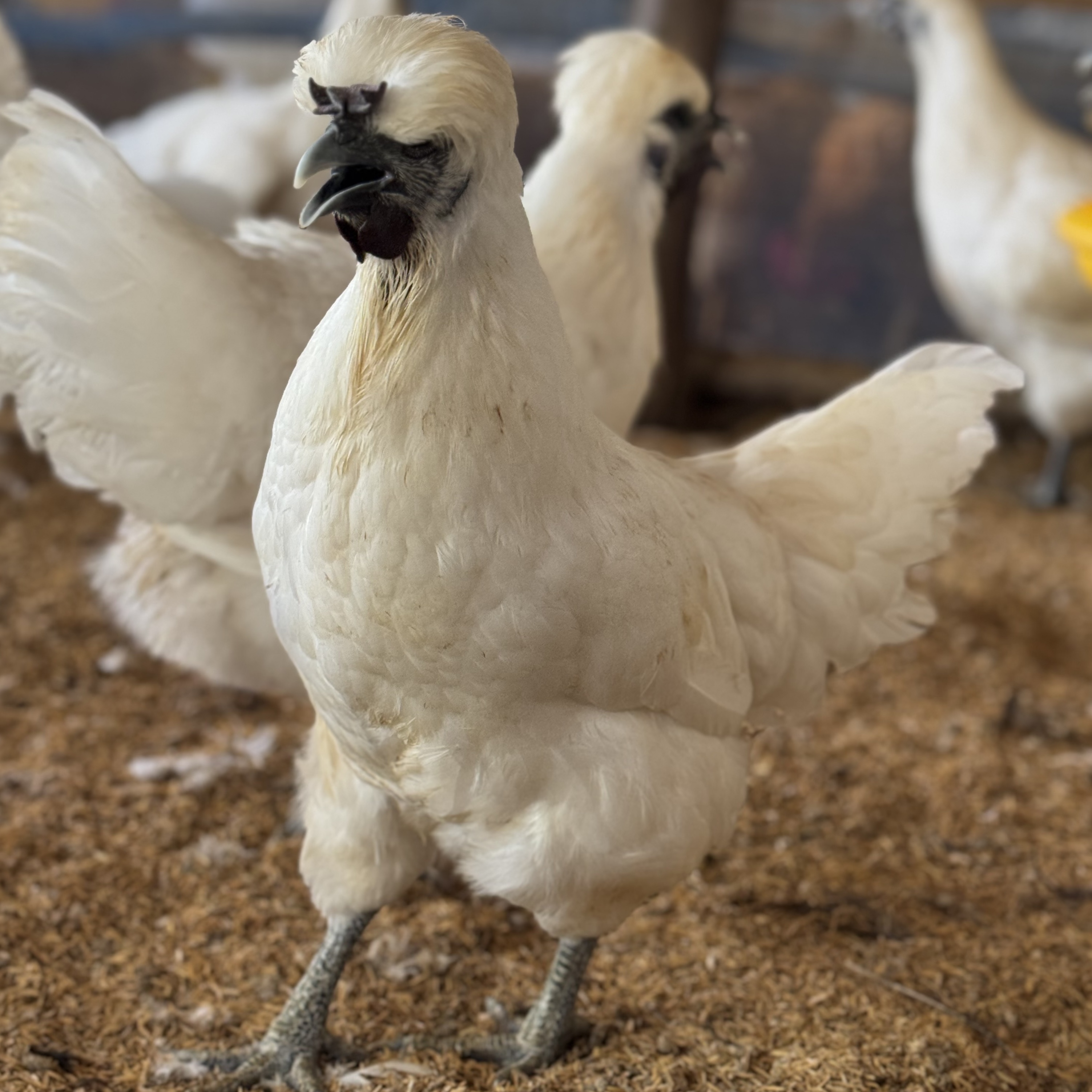
รูปแบบการเจริญเติบโตของไก่พื้นเมืองไทย: กรณีศึกษาของไก่ดำนิลเกษตร (ศาสตร์) และไก่เบตง (สายพันธุ์เคยู) ที่อายุ 1–16 สัปดาห์
Article Sidebar
Main Article Content
บทคัดย่อ
ความเป็นมาและวัตถุประสงค์: ความเข้าใจในรูปแบบการเจริญเติบโตของไก่ช่วยสนับสนุนการวางแผนและจัดการผลิตได้อย่างมีประสิทธิภาพ การศึกษานี้มีวัตถุประสงค์เพื่อพิจารณาแบบจำลองที่อธิบายรูปแบบการเจริญเติบโตของไก่ดำนิลเกษตร (ศาสตร์; NK) และไก่เบตง (สายพันธุ์เคยู; BT) ที่อายุ 1–16 สัปดาห์ ได้ดีที่สุด
วิธีดำเนินการวิจัย: ข้อมูลน้ำหนักตัวรายสัปดาห์ที่อายุ 1–16 สัปดาห์ ของ NK (53 ตัว) และ BT (40 ตัว) ถูกนำมาประมาณค่าโดยใช้แบบจำลอง Gomperzt nonlinear, การถดถอยพหุนามระดับที่สอง และการถดถอยพหุนามระดับที่สาม ความแตกต่างระหว่างน้ำหนักจริงและที่ประมาณค่าถูกนำมาพิจารณาร่วมกับค่า Akaike information criterion, corrected Akaike information criterion, Schwarz Bayesian information criterion และ -2log likelihood ที่น้อยที่สุดและสัมประสิทธิ์การตัดสินใจที่มีค่ามากที่สุดถูกใช้ในการสรุปความเหมาะสมของแบบจำลอง
ผลการวิจัย: NK เจริญเติบโตเร็วกว่า BT ในสัปดาห์แรกถึงสัปดาห์ที่ 14 ในขณะที่ BT กลับมามีน้ำหนักตัวสูงกว่าเมื่อมีอายุ 15–16 สัปดาห์ อย่างไรก็ตาม รูปแบบการเจริญเติบโตของไก่ทั้งสองกลุ่มไม่แตกต่างกันทางสถิติ (P > 0.05) ความคลาดเคลื่อนเฉลี่ยของทั้งสามแบบจำลองอยู่ในช่วง -72.40 ± 4.24 ถึง 99.77 ± 89.45 กรัม ทั้งนี้ แบบจำลองการถดถอยพหุนามระดับที่สองมีความเหมาะสมที่สุดในการอธิบายรูปแบบการเจริญเติบโตของไก่ทั้งสองพันธุ์ในช่วงอายุ 1–16 สัปดาห์
สรุป: ไก่ NK และ BT มีรูปแบบการเจริญเติบโตที่อายุ 1–16 สัปดาห์ ไม่แตกต่างกัน ข้อมูลเหล่านี้เป็นประโยชน์ต่อการกำหนดกลยุทธ์การให้อาหารที่เหมาะสมตามช่วงอายุ การเพิ่มประสิทธิภาพการผลิต และการพัฒนาเครื่องมือในการประมาณน้ำหนักตัวที่แม่นยำ
Article Details

อนุญาตภายใต้เงื่อนไข Creative Commons Attribution-NonCommercial-NoDerivatives 4.0 International License.
เอกสารอ้างอิง
Abbas, A.A., A.A. Yosif, A.M. Shukur and F.H. Ali. 2014. Effect of genotypes, storage periods and feed additives in broiler breeder diets on embryonic and hatching indicators and chicks blood parameters. Glob. J. Sci. Res. 2(4): 105–110.
Akaike, H. 1974. A new look at the statistical model identification. IEEE Trans. Autom. Contr. 19(6): 716–723. https://doi.org/10.1109/TAC.1974.1100705.
Attah, S., A.O. Okubanjo, A.B. Omojola and A.O.K. Adesehinwa. 2004. Body and carcass linear measurements of goats slaughtered at different weights. Livest. Res. Rural Dev. 16(8): 62.
Boonmee, C., P. Yimget and C. Janthasorn. 2020. Growth performance, economic return and reproductive performance of Nakhonthai black chicken. BAHGI e-Journal. 2: 29–39. (in Thai)
Buakeeree, K., M. Mongkol and T. Thepparat. 2018. The development of Betong chicken production for commerce in Klong Hoi Kong district, Songkhla province. Prawarun Agr. J. 15(1): 130–137. (in Thai)
Bungsrisawat, P., S. Tumwasorn, W. Loongyai, S. Nakthong and P. Sopannarath. 2018. Genetic parameters of some carcass and meat quality traits in Betong chicken (KU line). Agr. Nat. Resour. 52(3): 274–279. https://doi.org/10.1016/j.anres.2018.09.010.
Burnham, K.P. and D.R. Anderson. 2002. Model Selection and Multimodel Inference: A Practical Information-Theoretic Approach. Springer, New York, USA. 488 pp.
Chankong, J. and N. Chuaychu-noo. 2021. Production potential and economic, society and environmental impacts of Khaolak black bone chicken, Trang province. Prawarun Agric. J. 18(1): 80–87. https://doi.org/10.14456/paj.2021.10. (in Thai)
Das, C., B.C. Roy, I. Oshima, H. Miyachi, S. Nishimura, H. Iwamoto and S. Tabata. 2010. Collagen content and architecture of the pectoralis muscle in male chicks and broilers reared under various nutritional conditions. Anim. Sci. J. 81(2): 252–263. https://doi.org/10.1111/j.1740-0929.2009.00730.x.
Gompertz, B. 1833. On the nature of the function expressive of the law of human mortality, and on a new mode of determining the value of life contingencies. In a letter to Francis Baily, Esq. F.R.S. & c. By Benjamin Gompertz, Esq. F.R.S. Proc. R. Soc. Lond. 2: 252–253. http://doi.org/10.1098/rspl.1815.0271.
Kong, H.S., J.D. Oh, J.H. Lee, K.J. Jo, B.D. Sang, C.H. Choi, S.D. Kim, S.J. Lee, S.H. Yeon, G.J. Jeon and H.K. Lee. 2006. Genetic variation and relationships of Korean native chickens and foreign breeds using 15 microsatellite markers. Asian-Australas. J. Anim. Sci. 19(11): 1546–1550. https://doi.org/10.5713/ajas.2006.1546.
Laird, A.K. 1965. Dynamics of relative growth. Growth. 29(3): 249–263.
Magothe, T.M., W.B. Muhuyi and A.K. Kahi. 2010. Influence of major genes for crested-head, frizzle-feather and naked-neck on body weights and growth patterns of indigenous chickens reared intensively in Kenya. Trop. Anim. Health Prod. 42(2): 173–183. https://doi.org/10.1007/s11250-009-9403-y.
Makchumpon, S., C. Bunchasak, T. Poeikampha, K. Poonthawee and C. Rakangthong. 2015. Comparison of meat quality between broiler and KU Betong chickens. In Proc. the 53rd Kasetsart University Annual Conference, February 3–6, 2015. p. 836–843. (in Thai)
Mancinelli, A.C., L. Menchetti, M. Birolo, G. Bittante, D. Chiattelli and C. Castellini. 2023. Crossbreeding to improve local chicken breeds: Predicting growth performance of the crosses using the Gompertz model and estimated heterosis. Poult. Sci. 102(8): 102783. https://doi.org/10.1016/j.psj.2023.102783.
Molee, A., P. Kuadsantia and P. Kaewnakian. 2018. Gene effects on body weight, carcass yield, and meat quality of Thai indigenous chicken. J. Poult. Sci. 55(2): 94–102. https://doi.org/10.2141/jpsa.0160159.
Norris, D., J.W. Ngambi, K. Benyi, M.L. Makgahlele, H.A. Shimelis and E.A. Nesamvuni. 2007. Analysis of growth curves of indigenous male Venda and naked neck chickens. S. Afr. J. Anim. Sci. 37(1): 21–26. https://doi.org/10.4314/sajas.v37i1.4021.
Olawoyin, O.O. 2007. Evaluation of the growth parameters of four strains of cockerels. Afri. J. Anim. Biomed. Sci. 2(2): 17–25.
Osei-Amponsah, R., B.B. Kayang, A. Naazie, I.M. Barchia and P.F. Arthur. 2014. Evaluation of models to describe temporal growth in local chickens of Ghana. Iran. J. Appl. Anim. Sci. 4(4): 855–861.
Padhi, M.K. 2016. Importance of indigenous breeds of chicken for rural economy and their improvements for higher production performance. Scientifica. 2016: 2604685. https://doi.org/10.1155/2016/2604685.
Plaengkaew, S., P. Khumpeerawat and K.J. Stalder. 2021. Using non-linear models to describe growth curves for Thai black-bone chickens. Agr. Nat. Resour. 55(6): 1049–1056. https://doi.org/10.34044/j.anres.2021.55.6.15.
Putsakul, A., C. Bunchasak, B. Chomtee, S. Kao-ian and P. Sopannarath. 2010. Effect of dietary protein and metabolizable energy levels on growth and carcass yields in Betong chicken (KU line). In Proc. the 48th Kasetsart University Annual Conference, February 3–5, 2010. p. 158–166. (in Thai)
Riansut, W. 2023. A study of the effectiveness of model selection criteria for multiple regression model. RMUTSV Research Journal. 15(1): 198–212. (in Thai)
Rizzi, C., B. Contiero and M. Cassandro. 2013. Growth patterns of Italian local chicken populations. Poult. Sci. 92(8): 2226–2235. https://doi.org/10.3382/ps.2012-02825.
Sangjong, S., T. Suwanasopee, S. Koonawootrittriron and D. Jattawa. 2022. Variation of live weight, carcass weight and retail cut weight of Nin Kaset black meat chickens. In Proc. the 60th Kasetsart University Annual Conference, February 21–23, 2022. p. 42. (in Thai)
Sangthong, M. 2019. A study of the effectiveness of model selection criteria for multilevel analysis. BUU Sci. J. 24(1): 156–169. (in Thai)
Schwarz, G. 1978. Estimating the dimension of a model. Ann. Stat. 6(2): 461–464.
Sehrawat, R., R. Sharma, S. Ahlawat, V. Sharma, M.S. Thakur, M. Kaur and M.S. Tantia. 2021. First report on better functional property of black chicken meat from India. Indian J. Anim. Res. 55(6): 727–733. https://doi.org/10.18805/IJAR.B-4014.
Sharma, R., R. Sehrawat, S. Ahlawat, V. Sharma, A. Parmar, M.S. Thakur, A.K. Mishra and M.S. Tantia. 2022. An attempt to valorize the only black meat chicken breed of India by delineating superior functional attributes of its meat. Sci. Rep. 12: 3555. https://doi.org/10.1038/s41598-022-07575-9.
Siriwadee, P., L. Wirot, P. Thanapol and N. Wirawan. 2023. Genetic diversity among five native Thai chickens and Khiew-Phalee chickens in lower-northern Thailand using mitochondrial DNA barcodes. Biodiversitas. 24(4): 1962–1970. https://doi.org/10.13057/biodiv/d240404.
Sopannarath, P. and C. Bunchasak. 2015. Betong chicken (KU Line) or KU Betong chicken. Kasetsart Extension Journal. 61(1): 13–21. (in Thai)
Sosa-Madrid, B.S., G. Maniatis, N. Ibáñez-Escriche, S. Avendaño and A. Kranis. 2023. Genetic variance estimation over time in broiler breeding programmes for growth and reproductive traits. Animals. 13(21): 3306. https://doi.org/10.3390/ani13213306.
Sowande, O.S. and O.S. Sobola. 2008. Body measurements of West African Dwarf sheep as parameters for estimation of live weight. Trop. Anim. Health Prod. 40(6): 433–439. https://doi.org/10.1007/s11250-007-9116-z.
Suwanasopee, T., S. Koonawootrittriron, T. Suwonsichon, A. Kayan and S. Hongsakornprasert. 2019. Development of Thai Native Chicken for Meat Consumption. Research Report submitted to Kasetsart University Research and Development Institute, Kasetsart University, Bangkok, Thailand. (in Thai)
Suyatno, S., S. Sujono, A. Winaya, L. Zalizar and M. Pangestu. 2023. Characterization of qualitative and quantitative traits of four types of Indonesian native chickens as ancestor of new strains of local super laying hens. Jordan J. Biol. Sci. 16(2): 171–179. https://doi.org/10.54319/jjbs/160201.
Teleken, J.T., A.C. Galvão and W. da Silva Robazza. 2017. Comparing non-linear mathematical models to describe growth of different animals. Acta Sci. 39(1): 73–81. https://doi.org/10.4025/actascianimsci.v39i1.31366.
Tompić, T., J. Dobša, S. Legen, N. Tompić and H. Medić. 2011. Modeling the growth pattern of in-season and off-season Ross 308 broiler breeder flocks. Poult. Sci. 90(12): 2879–2887. https://doi.org/10.3382/ps.2010-01301.
Tongsiri, S., G.M. Jeyaruban, S. Hermesch, J.H.J. van der Werf, L. Li and T. Chormai. 2019. Genetic parameters and inbreeding effects for production traits of Thai native chickens. Asian-Australas J. Anim. Sci. 32(7): 930–938. https://doi.org/10.5713/ajas.18.0690.
van der Werf, J.H.J. 2022. Sustainable animal genetic improvement. E3S Web Conf. 335: 00001. https://doi.org/10.1051/e3sconf/202233500001.
Wangtaweesukkamol, N., W. Loongyai, B. Chomtee and P. Sopannarath. 2013. Genetic parameters for body weights in Betong chicken (KU Line). Agric. Sci. J. 44(Suppl. 1): 167–170. (in Thai)
Wattanachant, S., S. Benjakul and D.A. Ledward. 2004. Composition, color, and texture of Thai indigenous and broiler chicken muscles. Poult. Sci. 83(1): 123–128. https://doi.org/10.1093/ps/83.1.123.
Zhang, S., J. Zhang, C. Cao, Y. Cai, Y. Li, Y. Song, X. Bao and J. Zhang. 2022. Effects of different rearing systems on Lueyang black-bone chickens: Meat quality, amino acid composition, and breast muscle transcriptome. Genes. 13(10): 1898. https://doi.org/10.3390/genes13101898.
Zubair, A.K. and S. Leeson. 1996. Compensatory growth in the broiler chicken: A review. Worlds Poult. Sci. J. 52(2): 189–201. https://doi.org/10.1079/WPS19960015.
