
การยืดอายุการเก็บรักษาฝรั่งตัดแต่งด้วยสารเคลือบผิวไคโตซานชนิดบริโภคได้
Article Sidebar
Main Article Content
บทคัดย่อ
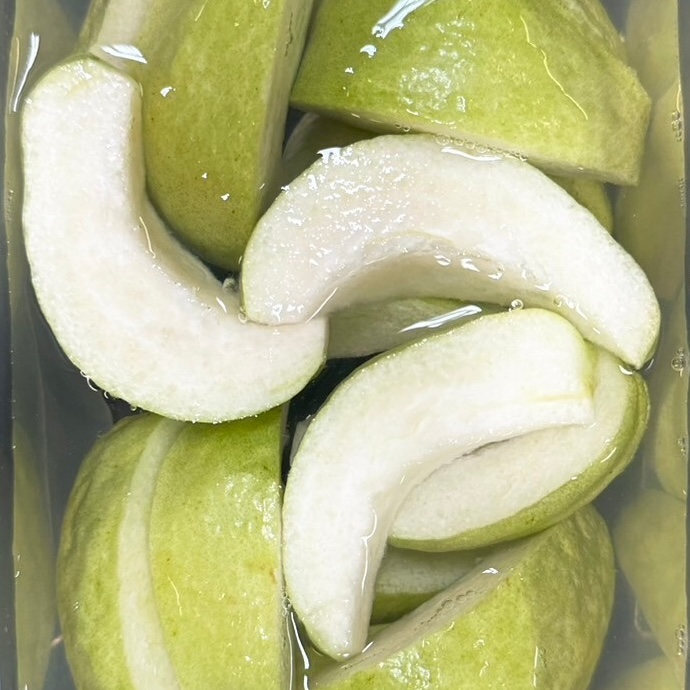
ความเป็นมาและวัตถุประสงค์: ฝรั่งสดตัดแต่งช่วยให้ความสะดวกและพร้อมสำหรับการบริโภค แต่โดยปกติมีอายุการเก็บรักษาสั้น งานวิจัยนี้ศึกษาผลของการเคลือบผิวด้วยไคโตซาน เพื่อรักษาคุณภาพและยืดอายุการเก็บรักษา
วิธีดำเนินการวิจัย: วางแผนการทดลองแบบสุ่มสมบูรณ์ มี 4 ทรีตเมนต์ ทรีตเมนต์ละ 3 ซ้ำ ได้แก่ ไคโตซานความเข้มข้น 1, 2 และ 3% w/v โดยฝรั่งที่ไม่ได้เคลือบเป็นชุดควบคุม เก็บรักษาที่ 4 ±1 องศาเซลเซียส เป็นเวลา 15 วัน บันทึกปริมาณออกซิเจน (O2) และคาร์บอนไดออกไซด์ (CO2) ในบรรจุภัณฑ์ การสูญเสียน้ำหนัก ค่าสี ความแน่นเนื้อ ปริมาณวิตามินซี ปริมาณของแข็งที่ละลายน้ำได้ทั้งหมด ปริมาณกรดที่ไทเทรตได้ และประเมินคุณภาพทางประสาทสัมผัส
ผลการวิจัย: การเคลือบไคโตซานช่วยลดการสูญเสียน้ำหนักได้ดี (0.01 ± 0.01% ถึง 0.06 ± 0.11%) เมื่อเทียบกับชุดควบคุม (0.18 ± 0.16%) โดยไคโตซานความเข้มข้น 3% w/v รักษาปริมาณของแข็งที่ละลายน้ำได้ทั้งหมด (7.70 ± 0.00 °Brix) และวิตามินซี (88.69 ± 0.68 mg/100g FW) ได้ดีที่สุด (P < 0.05) และช่วยรักษาค่าสีเหลืองและความเข้มสีของเนื้อ แต่ไม่มีผลต่อความแน่นเนื้อ (P > 0.05) จากการประเมินทางประสาทสัมผัสพบว่าชุดควบคุมมีคะแนนสูงกว่า แต่ฝรั่งตัดแต่งที่เคลือบด้วยไคโตซานยังมีคะแนนอยู่ในเกณฑ์ที่ยอมรับได้ (คะแนน ≥ 3) ตลอดการเก็บรักษา 15 วัน
สรุป: การเคลือบผิวฝรั่งตัดแต่งด้วยไคโตซานความเข้มข้น 3% w/v ช่วยลดการสูญเสียน้ำหนัก ชะลอการเปลี่ยนแปลงสี รักษาปริมาณของแข็งที่ละลายน้ำได้ทั้งหมด ปริมาณกรดที่ไทเทรตได้ และปริมาณวิตามินซี ทุกทรีตเมนต์มีคะแนนคุณภาพทางประสาทสัมผัสอยู่ในเกณฑ์ที่ยอมรับได้เป็นเวลา 15 วัน
Article Details

อนุญาตภายใต้เงื่อนไข Creative Commons Attribution-NonCommercial-NoDerivatives 4.0 International License.
เอกสารอ้างอิง
Amal, S.H.A., M.M. El-Mogy, H.E. Aboul-Anean and B.W. Alsanius. 2010. Improving strawberry fruit storability by edible coating as a carrier of thymol or calcium chloride. J. Hort. Sci. & Ornamen. Plants. 2(3): 88–97.
Association of Official Agricultural Chemists (AOAC). 1990. Official Methods of Analysis of the Association of Official Analytical Chemists. 15th edition. Association of Official Analytical Chemists, Arlington, Virginia, USA.
Chien, P.J., F. Sheu and F.H. Yang. 2007. Effects of edible chitosan coating on quality and shelf life of sliced mango fruit. J. Food Eng. 78(1): 225–229. https://doi.org/10.1016/j.jfoodeng.2005.09.022.
Demircan, B. and Y.S. Velioglu. 2024. Control of browning, enzyme activity, and quality in stored fresh-cut fruit salads through chitosan coating enriched with bergamot juice powder. Foods. 13(1): 147. https://doi.org/10.3390/foods13010147.
Dong, H., L. Cheng, J. Tan, K. Zheng and Y. Jiang. 2004. Effects of chitosan coating on quality and shelf life of peeled litchi fruit. J. Food Eng. 64(3): 355–358. https://doi.org/10.1016/j.jfoodeng.2003.11.003.
Eissa, H.A.A. 2007. Effect of chitosan coating on shelf life and quality of fresh-cut mushroom. J. Food Qual. 30(5): 623–645. https://doi.org/10.1111/j.1745-4557.2007.00147.x.
El Ghaouth, A., J. Arul, R. Ponnampalam and M. Boulet. 1991. Chitosan coating effect on storability and quality of fresh strawberries. J. Food Sci. 56(6): 1618–1620. https://doi.org/10.1111/j.1365-2621.1991.tb08655.x.
El Ghaouth, A., R. Ponnampalam, F. Castaigne and J. Arul. 1992. Chitosan coating to extend the storage life of tomatoes. HortScience. 27(9): 1016–1018. https://doi.org/10.21273/HORTSCI.27.9.1016.
Gil, M.I., M.V. Selma, T. Suslow, L. Jacxsens, M. Uyttendaele and A. Allende. 2015. Pre-and postharvest preventive measures and intervention strategies to control microbial food safety hazards of fresh leafy vegetables. Crit. Rev. Food Sci. Nutr. 55(4): 453–468. https://doi.org/10.1080/10408398.2012.657808.
González-Aguilar, G.A., E. Valenzuela-Soto, J. Lizardi-Mendoza, F. Goycoolea, M.A. Martínez-Téllez, M.A. Villegas-Ochoa, I.N. Monroy-García and J.F. Ayala-Zavala. 2009. Effect of chitosan coating in preventing deterioration and preserving the quality of fresh-cut papaya ‘Maradol’. J. Sci. Food Agric. 89(1): 15–23. https://doi.org/10.1002/jsfa.3405.
Hanani, Z.A.N., K.L. Soo, W.I.W. Zunairah and S. Radhiah. 2023. Prolonging the shelf life of fresh-cut guava (Psidium guajava L.) by coating with chitosan and cinnamon essential oil. Heliyon. 9(12): e22419. https://doi.org/10.1016/j.heliyon.2023.e22419.
Hong, K., J. Xie, L. Zhang, D. Sun and D. Gong. 2012. Effects of chitosan coating on postharvest life and quality of guava (Psidium guajava L.) fruit during cold storage. Sci. Hortic. 144: 172–178. https://doi.org/10.1016/j.scienta.2012.07.002.
Huang, W., Y. Shi, H. Yan, H. Wang, D. Wu, D. Grierson and K. Chen. 2023. The calcium-mediated homogalacturonan pectin complexation in cell walls contributes the firmness increase in loquat fruit during postharvest storage. J. Adv. Res. 49: 47–62. https://doi.org/10.1016/j.jare.2022.09.009.
Jain, N., K. Dhawan, S. Malhotra and R. Singh. 2003. Biochemistry of fruit ripening of guava (Psidium guajava L.): Compositional and enzymatic changes. Plant Foods Hum. Nutr. 58: 309–315. https://doi.org/10.1023/B:QUAL.0000040285.50062.4b.
Jirapaet, J., T. Jaidee and S. Poonthep. 2021. Temperature and rainfall on growth and development of ‘Kimju’ guava (Psidium guajava). PNUJR. 13(2): 386–399. (in Thai)
Kader, A.A., D. Zagory, E.L. Kerbel and C.Y. Wang. 1989. Modified atmosphere packaging of fruits and vegetables. Crit. Rev. Food Sci. Nutr. 28(1): 1–30. https://doi.org/10.1080/10408398909527490.
Khalifa, I., H. Barakat, H.A. El-Mansy and S.A. Soliman. 2016. Enhancing the keeping quality of fresh strawberry using chitosan-incorporated olive processing wastes. Food Biosci. 13: 69–75. https://doi.org/10.1016/j.fbio.2015.12.008.
Mahajan, B.V.C., S.R. Sharma and R.K. Dhall. 2009. Optimization of storage temperature for maintaining quality of guava. J. Food Sci. Technol. 46(6): 604–605.
Mungmuang, N., T. Senphan and W. Daengprok. 2023. Use of edible coating agents on ready-to-eat fresh-cut pineapple. BUU Sci. J. 28(1): 384–402. (in Thai)
Olivas, G.I. and G.V. Barbosa-Cánovas. 2005. Edible coatings for fresh-cut fruits. Crit. Rev. Food Sci. Nutr. 45(7–8): 657–670. https://doi.org/10.1080/10408690490911837.
Pornjalean, R. and A. Jaidee. 2021. Development of carboxymethyl cellulose coating combined with galanga extract on postharvest guava preservation, pp. 874–881. In Proc. the 1st Kamphang Phet Rajabhat University Annual Conference, February 22, 2021. (in Thai)
Poubol, J., C. Techavuthiporn and S. Kanlayanarat. 2018. Guava fruit treated with hot water on microbiological quality of fresh-cut ‘Kimju’ and ‘Pan Srithong’ guava. Int. Food Res. J. 25(3): 903–907.
Sapna, C. Sharma, P. Pathak and S. Gautam. 2025. Chitosan edible coatings loaded with bioactive components for fruits and vegetables: A step toward sustainable development goals. Food Bioproc. Tech. 18: 4975–5009. https://doi.org/10.1007/s11947-025-03770-4.
Sharma, M. and C.S. Saini. 2021. Postharvest shelf-life extension of fresh-cut guavas (Psidium guajava) using flaxseed protein-based composite coatings. Food Hydrocoll. Health. 1: 100015. https://doi.org/10.1016/j.fhfh.2021.100015.
Shiekh, R.A., M.A. Malik, S.A. Al-Thabaiti and M.A. Shiekh. 2013. Chitosan as a novel edible coating for fresh fruits. Food Sci. Technol. Res. 19(2): 139–155. https://doi.org/10.3136/fstr.19.139.
Shyu, Y.S., G.W. Chen, S.C. Chiang and W.C. Sung. 2019. Effect of chitosan and fish gelatin coatings on preventing the deterioration and preserving the quality of fresh-cut apples. Molecules. 24(10): 2008. https://doi.org/10.3390/molecules24102008.
Silva, W.B., G.M.C. Silva, D.B. Santana, A.R. Salvador, D.B. Medeiros, I. Belghith, N.M. da Silva, M.H.M. Cordeiro and G.P. Misobutsi. 2018. Chitosan delays ripening and ROS production in guava (Psidium guajava L.) fruit. Food Chem. 242: 232–238. https://doi.org/10.1016/j.foodchem.2017.09.052.
Suseno, N., E. Savitri, L. Sapei and K.S. Padmawijaya. 2014. Improving shelf-life of cavendish banana using chitosan edible coating. Procedia Chem. 9: 113–120. https://doi.org/10.1016/j.proche.2014.05.014.
Waimaleongora-Ek, P., A.J.H. Corredor, H.K. No, W. Prinyawiwatkul, J.M. King, M.E. Janes and S. Sathivel. 2008. Selected quality characteristics of fresh-cut sweet potatoes coated with chitosan during 17-day refrigerated storage. J. Food Sci. 73(8): S418–S423. https://doi.org/10.1111/j.1750-3841.2008.00921.x.
