
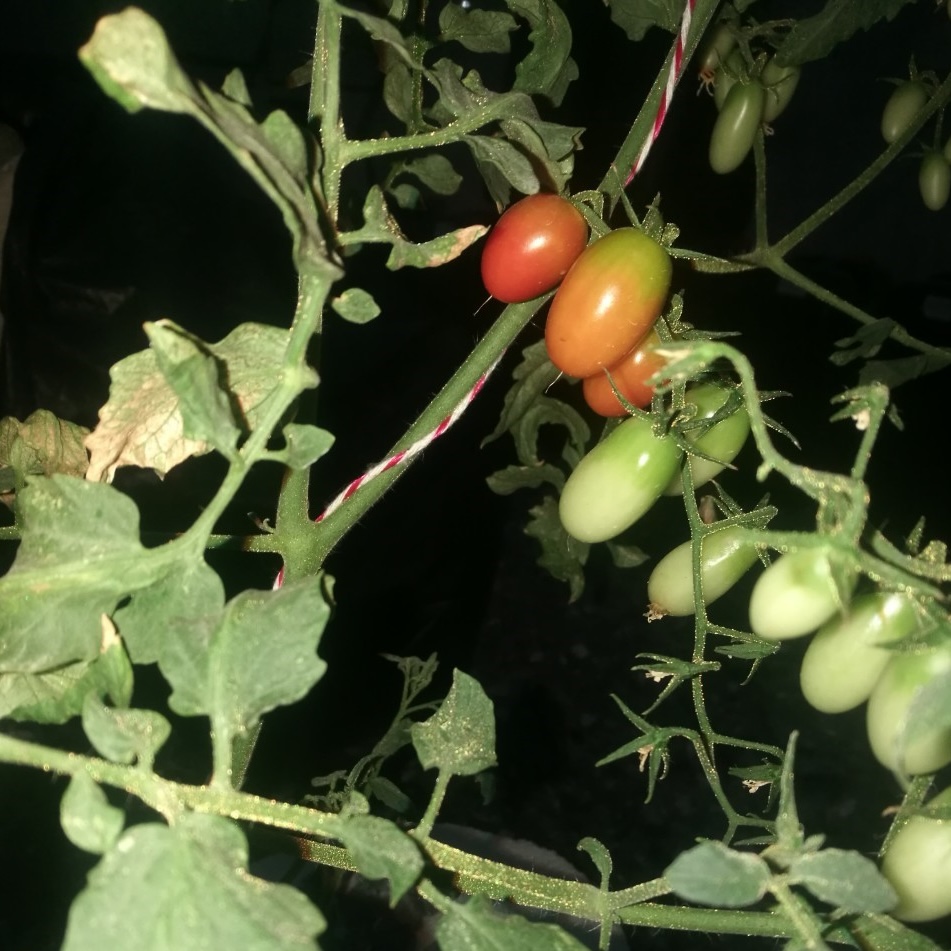
Effects of zinc fertilizers on growth and yield of cherry tomato ‘CH154’
Article Sidebar
Main Article Content
Abstract
Background and Objective: Cherry tomatoes, commonly grown in soilless systems, often face micronutrient deficiencies, which can lead to a reduction in both the quantity and quality of the yield. This study aimed to compare types of zinc fertilizer and ways to apply to the growth and yield of cherry tomato.
Methodology: The experiment was conducted on cherry tomatoes grown using a hydroponics system consisting of 6 treatments: control grown in nutrient solution containing zinc, control grown in nutrient solution without zinc, nutrient solution fertilized with Zn-EDTA or ZnSO4 by foliar spray at a concentration of 250 ppm or root at a concentration of 50 ppm application twice when the tomatoes were 40 and 47 days old after sowing. Data were recorded weekly when the cherry tomato plants were 40 days old after sowing, and yield data were recorded after harvest.
Main Results: The application of both types of zinc fertilizers via foliar spray or root application tended to increase the number of flowers. Zn-EDTA fertilizers increased fruit number per plant and fruit weight per plant more than ZnSO4 fertilizers by 12–89% and 11–55%, respectively. Both zinc fertilizers helped to recover tomato plants from zinc deficiency. Root application of zinc fertilizers resulted in lower zinc accumulation in the leaves compared to foliar application, which helps reduce the risk of zinc toxicity from excessive accumulation. However, both types of Zn fertilizers did not affect stem height, leaf greenness index, total soluble solids in fruit, and dry weight of shoot and root.
Conclusions: Foliar or root application of zinc fertilizers Zn-EDTA or ZnSO4 can increase the yield of cherry tomatoes grown under zinc deficiency conditions. However,the root application is recommended to minimize zinc accumulation and the risk of toxicity in plants.
Article Details

This work is licensed under a Creative Commons Attribution-NonCommercial-NoDerivatives 4.0 International License.
References
Asaduzzaman, M., M. Saifullah, A.S.R. Mollick, M.M. Hossain, G. Halim and T. Asao. 2015. Influence of soilless culture substrate on improvement of yield and produce quality of horticultural crops, pp. 1–32. In M. Asaduzzaman, ed. Soilless Culture - Use of Substrates for the Production of Quality Horticultural Crops, London, UK.
Behura, A.K., M. Mohapatra and B.K. Mohanty. 2018. Ecophysiological studies of a cereal crop Oryza sativa L. with zinc stress. J. Environ. Sci. Pollut. Res. 4(4): 311–313. https://doi.org/10.30799/JESPR.147.18040402.
Cakmak, I., H. Marschner and F. Bangerth. 1989. Effect of zinc nutritional status on growth, protein metabolism and levels of indole-3-acetic acid and other phytohormones in bean (Phaseolus vulgaris L.). J. Exp. Bot. 40(3): 405–412. https://doi.org/10.1093/jxb/40.3.405.
Carillo, P., M.C. Kyriacou, C. El-Nakhel, A. Pannico, E. dell’Aversana, L. D’Amelia, G. Colla, G. Caruso, S. De Pascal and Y. Rouphael. 2019. Sensory and functional quality characterization of protected designation of origin ‘Piennolo del Vesuvio’ cherry tomato landraces from Campania-Italy. Food Chem. 292: 166–175. https://doi.org/10.1016/j.foodchem.2019.04.056.
Choi, S.H., H.R. Kim, H.J. Kim, I.S. Lee, N. Kozukue, C.E. Levin and M. Friedman. 2011. Free amino acid and phenolic contents and antioxidative and cancer cell-inhibiting activities of extracts of 11 greenhouse-grown tomato varieties and 13 tomato-based foods. J. Agric. Food Chem. 59(24): 12801–12814. https://doi.org/10.1021/jf202791j.
Doolette, C.L., T.L. Read, C. Li, K.G. Scheckel, E. Donner, P.M. Kopittke, J.K. Schjoerring and E. Lombi. 2018. Foliar application of zinc sulphate and zinc EDTA to wheat leaves: Differences in mobility, distribution, and speciation. J. Exp. Bot. 69(18): 4469–4481. https://doi.org/10.1093/jxb/ery236.
Ebbs, S. and S. Uchil. 2008. Cadmium and zinc induced chlorosis in Indian mustard [Brassica juncea (L.) Czern] involves preferential loss of chlorophyll b. Photosynthetica. 46: 49–55. https://doi.org/10.1007/s11099-008-0010-3.
Gupton, C.L. and J.M. Spiers. 1996. High zinc concentrations in the growing medium contribute to chlorosis in blueberry. HortScience. 31(6): 955–956. https://doi.org/10.21273/HORTSCI.31.6.955.
Hänsch, R. and R.R. Mendel. 2009. Physiological functions of mineral micronutrients (Cu, Zn, Mn, Fe, Ni, Mo, B, Cl). Curr. Opin. Plant Biol. 12(3): 259–266. https://doi.org/10.1016/j.pbi.2009.05.006.
Haque, M.E., M.A. Islam and S.T. Ahmed. 2011. Effect of nitrogen and boron on the growth and yield of tomato (Lycopersicon esculentum MILL.). J. Sher-e-Bangla Agric. Univ. 5(2): 1–9.
Jiang, C., M. Johkan, M. Hohjo, S. Tsukagoshi and T. Maruo. 2017. A correlation analysis on chlorophyll content and SPAD value in tomato leaves. HortResearch. 71: 37–42. http://doi.org/10.20776/S18808824-71-P37.
Jitpong, P., J. Jannoi, W. Sastawittaya, R. Mega, P. Chulaka and J. Thussagunpanit. 2025. Impact of greenhouse height on growth, physiological changes, and yield of two cherry tomatoes (Solanum lycopersicum) cultivars. Thai J. Agric. Sci. 58(1): 1−16.
Kavitha, L., M.N. Nakhon and S. Suwanwong. 2009. Plant Physiology. 2th edition. Kasetsart University, Faculty of Science, Department of Botany, Bangkok, Thailand. 259 pp. (in Thai)
Khan, H.R., G.K. McDonald and Z. Rengel. 1998. Chickpea genotypes differ in their sensitivity to Zn deficiency. Plant Soil. 198: 11–18. https://doi.org/10.1023/A:1004241826907.
Khettala, S. 2015. Tomato Production Technology. Research Project, Department of Agriculture, Bangkok, Thailand. (in Thai)
Lakchaikun, A. 2013. Tomato. Bureau of Agricultural Commodities Promotion and Management, Bangkok, Thailand. (in Thai)
Ljung, K. 2002. Auxin Biosynthesis and Homeostasis in Arabidopsis thaliana in Relation to Plant Growth and Development. PhD Thesis, Swedish University of Agricultural Sciences.
Matsuda, R., K. Suzuki, Y. Nakano, H. Sasaki and M. Takaichi. 2011. Nutrient supply and fruit yields in tomato rockwool hydroponics under daily quantitative nutrient management: Analysis and evaluation based on leaf area index. J. Agric. Meteorol. 67(3): 117–126. https://doi.org/10.2480/agrmet.67.3.6.
Meng, Y., C. Xiang, J. Huo, S. Shen, Y. Tang and L. Wu. 2023. Toxicity effects of zinc supply on growth revealed by physiological and transcriptomic evidences in sweet potato (Ipomoea batatas (L.) Lam). Sci. Rep. 13: 19203. https://doi.org/10.1038/s41598-023-46504-2.
Ngennoy, S. 2014. Effect of Humic Acid Extracted from Leonardite on Growth and Development, Yield and Plant Nutrition of Maize (Zea mays L.). MS Thesis, Kasetsart University, Bangkok. (in Thai)
Nielsen, F.H. 2012. History of zinc in agriculture. Adv. Nutr. 3(6): 783–789. https://doi.org/10.3945/an.112.002881.
Osman, I.M., M.H. Hussein, M.T. Ali, S.S. Mohamed, M.A. Kabir and B.C. Halder. 2019. Effect of boron and zinc on the growth, yield and yield contributing traits of tomato. IOSR. J. Agric. Vet. Sci. 12(2): 25–37.
Osotspa, Y. 2009. Foliar Fertilization. Kasetsart University, Bangkok, Thailand. 164 pp. (in Thai)
Ounpipat, B., N. Chittamart and S. Tawornpruek. 2018. Intensification of zinc availability by Zn-Humate prepared from peat for sweet corn grown on a calcareous soil. Khon Kaen Agr. J. 46(Suppl. 1): 301–307. (in Thai)
Phuphong, P., I. Cakmak, B. Dell and C. Prom-u-thai. 2018. Effects of foliar application of zinc on grain yield and zinc concentration of rice in farmers’ fields. CMU J. Nat. Sci. 17(3): 181–190. https://doi.org/10.12982/CMUJNS.2018.0013.
Prasad, R., Y.S. Shivay and D. Kumar. 2016. Interactions of zinc with other nutrients in soils and plants - A review. Indian J. Fertil. 12(5): 16–26.
Ranc, N., S. Muños, S. Santoni and M. Causse. 2008. A clarified position for Solanum lycopersicum var. cerasiforme in the evolutionary history of tomatoes (solanaceae). BMC Plant Biol. 8: 130. https://doi.org/10.1186/1471-2229-8-130.
Resh, H.M. 1978. Hydroponic Food Production. Woodbridge Press Publishing Company, California, USA.
Sadeghzadeh, B. 2013. A review of zinc nutrition and plant breeding. J. Soil Sci. Plant Nutr. 13(4): 905–927. http://dx.doi.org/10.4067/S0718-95162013005000072.
Sainju, U.M., R. Dris and B. Singh. 2003. Mineral nutrition of tomato. J. Food Agric. Environ. 1: 176–183.
Schulte, E.E. 2004. Soil and Applied Zinc. WIS-PUBS, USA.
Sharma, A., B. Patni, D. Shankhdhar and S.C. Shankhdhar. 2013. Zinc – an indispensable micronutrient. Physiol. Mol. Biol. Plants. 19(1): 11–20. https://doi.org/10.1007/s12298-012-0139-1.
Shibaeva, T.G., A.V. Mamaev and E.G. Sherudilo. 2020. Evaluation of a SPAD-502 plus chlorophyll meter to estimate chlorophyll content in leaves with interveinal chlorosis. Russ. J. Plant Physiol. 67(4): 690–696. https://doi.org/10.1134/s1021443720040160.
Singh, B., S. Kasera, S.K. Mishra, S. Roy, S. Rana and D. Singh. 2017. Growth, yield and quality of cherry tomato (Lycopersicon esculentum var. cerasiforme) as influenced by foliar application of zinc and boron. J. Pharmacogn. Phytochem. SP1: 911–914.
Stewart, A.J., S. Bozonnet, W. Mullen, G.I. Jenkins, M.E.J. Lean and A. Crozier. 2000. Occurrence of flavonols in tomatoes and tomato-based products. J. Agric. Food Chem. 48(7): 2663–2669. http://dx.doi.org/10.1021/jf000070p.
Stuiver, C.E.E., F.S. Posthumus, S. Parmar, M. Shahbaz, M.J. Hawkesford and L.J. De Kok. 2014. Zinc exposure has differential effects on uptake and metabolism of sulfur and nitrogen in Chinese cabbage. J. Plant Nutr. Soil Sci. 177(5): 748–757.
Sutradhar, A.K. 2016. Zinc for Crop Production. University of Minnesota Extension, Minnesota, USA.
Yadav, K.L., R.S. Meena, A. Mishra, S. Singh, U. Joshi and K.K. Yadav. 2024. Impact of zinc application on growth, yield, and quality of African marigold in semi-arid conditions. J. Sci. Res. Rep. 30(10): 693–705. https://doi.org/10.9734/jsrr/2024/v30i102495.
Yodprang, W. 2010. The Effects of Foliar Application of Amino Acid Chelated Secondary and Micro-Nutrients on Nutrient Uptake, Growth and Yield of Chili (Capsicum frutescens L.). MS Thesis, Suranaree University of Technology, Nakhon Ratchasima. (in Thai)
