
Effect of shading on physiology changes and yield of cherry tomatoes in greenhouse
Article Sidebar
Main Article Content
Abstract
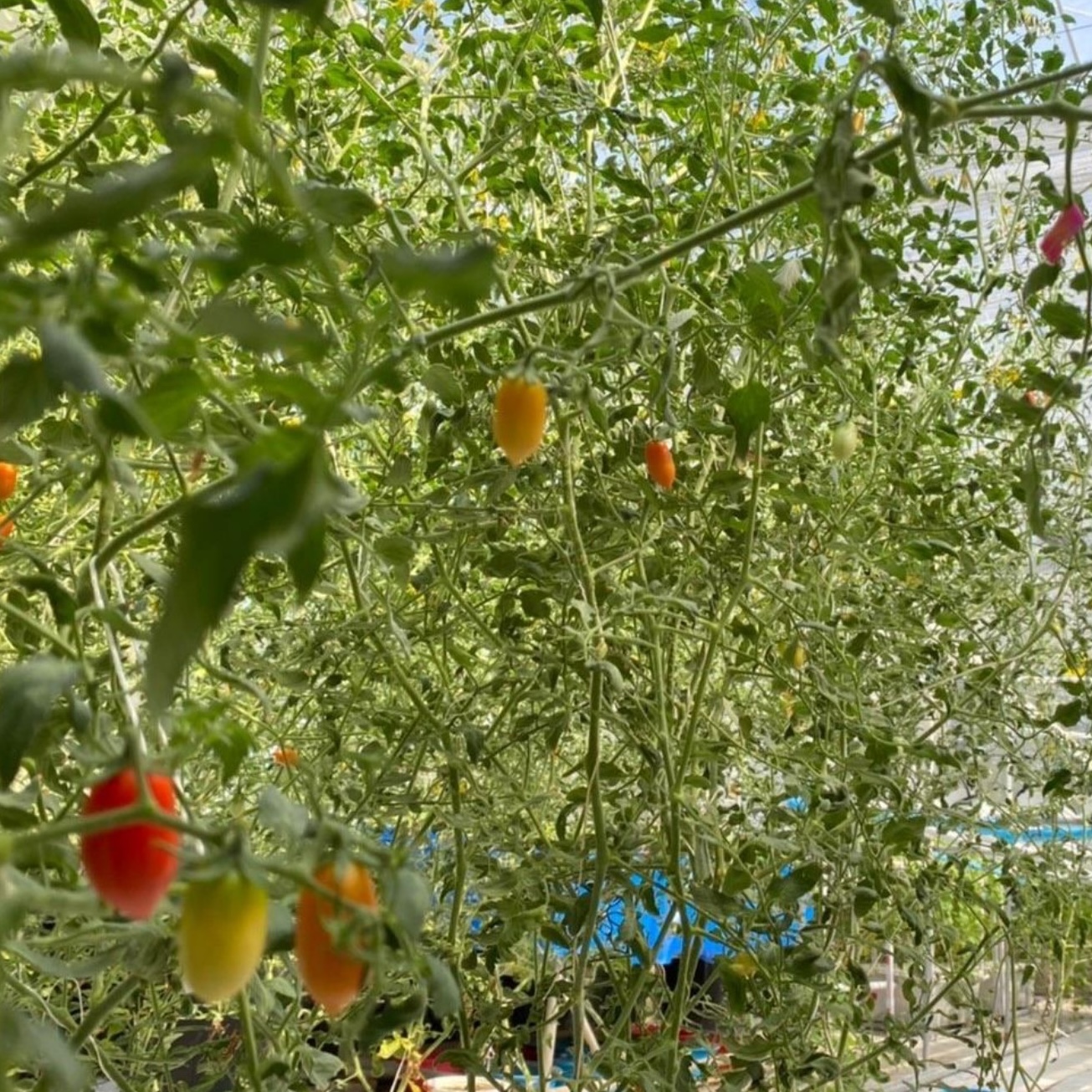
Background and Objective: Nowadays, cherry tomatoes are often grown in greenhouses to minimize the risk of pests and diseases. However, plants grown in a greenhouse might still receive high light intensity. Shading is a way to solve this problem. This experiment aimed to study the effect of shading on the physiology and yield of cherry tomatoes in a greenhouse.
Methodology: The experiment was done by a completely randomized design, with two treatments consisting of non-shading and 10% shading, with 5 replications/treatment. The experiment was conducted in 2 cultivars of cherry tomato ‘Tony TA 104’ and ‘Sweet Boy 1’. Differences between treatments were analyzed by Student’s t-test (P < 0.05).
Main Results: Shading significantly reduced the light saturation and compensation points of cherry tomatoes. Moreover, shading significantly increased the net photosynthetic rate, stomatal conductance, and transpiration rate in cultivar ‘Tony TA 104’, but shading decreased the net photosynthetic rate in ‘Sweet Boy 1’. Shading tended to decrease the fruit weight of ‘Sweet Boy 1’ but did not affect the fruit weight of ‘Tony TA 104’. Additionally, shading tended to increase the lycopene content in ‘Tony TA 104’.
Conclusions: Shading did not affect the total soluble solids and vitamin C content in either cultivar. While shading influenced physiological responses, it did not significantly increase the yield of cherry tomatoes.
Article Details

This work is licensed under a Creative Commons Attribution-NonCommercial-NoDerivatives 4.0 International License.
References
Anthon, G. and D.M. Barrett. 2007. Standardization of a rapid spectrophotometric method for lycopene analysis. Acta Hortic. 758: 111–128. https://doi.org/10.17660/ActaHortic.2007.758.12.
Bai, Y. and P. Lindhout. 2007. Domestication and breeding of tomatoes: What have we gained and what can we gain in the future?. Ann. Bot. 100(5): 1085–1094. https://doi.org/10.1093/aob/mcm150.
Baskins, S., J.K. Bond and T. Minor. 2019. Unpacking the growth in per capita availability of fresh market tomatoes. Available Source: https://www.ers.usda.gov/publications/pub-details?pubid=92441, April 6, 2022.
Camejo, D., P. Rodríguez, M. Angeles Morales, J.M. Dell’Amico, A. Torrecillas and J.J. Alarcón. 2005. High temperature effects on photosynthetic activity of two tomato cultivars with different heat susceptibility. J. Plant Physiol. 162(3): 281–289. https://doi.org/10.1016/j.jplph.2004.07.014.
Charlo, H.C.O., R. Castoldi, L.A. Ito, C. Fernandes and L.T. Braz 2007. Productivity of cherry tomatoes under protected cultivation carried out with different types of pruning and spacing. Acta Hortic. 761: 323–326. https://doi.org/10.17660/ActaHortic.2007.761.43.
Cook, R. and L. Calvin. 2005. Greenhouse tomatoes change the dynamics of the North American fresh tomato industry. Available Source: https://www.ers.usda.gov/publications/pub-details?pubid=45477, April 8, 2022.
Gill, N.S. and L. Kaur 2019. Economics of cherry tomato (Solanum lycopersicum var. cerasiforme) cultivation. J. Pharmacogn. Phytochem. 8(6): 880–881.
Gomez, R., J. Costa, M. Amo, A. Alvarruiz, M. Picazo and J.E. Pardo. 2001. Physicochemical and colorimetric evaluation of local varieties of tomato grown in SE Spain. J. Sci. Food Agric. 81(11): 1101–1105. https://doi.org/10.1002/jsfa.915.
Harel, D., H. Fadida, S. Gantz, K. Shilo and H. Yasuor. 2013. Evaluation of low pressure fogging system for improving crop yield of tomato (Lycopersicon esculentum Mill.) grown under heat stress conditions. Agronomy. 3(2): 497–507. https://doi.org/10.3390/agronomy3020497.
Hernández, V., P. Hellín, J. Fenoll and P. Flores. 2019. Interaction of nitrogen and shading on tomato yield and quality. Sci. Hortic. 255: 255–259. https://doi.org/10.1016/j.scienta.2019.05.040.
Jeeatid, N., J. Modnok, S. Techawongstien, C. Lapjit and S. Techawongstien. 2021. Fruit quality and carotenoids in fruits of cherry tomato (Solanum lycopersicum) grown under plant factory. Khon Kaen Agr. J. 49(3): 634–642. (in Thai)
Keren, N. and A. Krieger-Liszkay. 2011. Photoinhibition: Molecular mechanisms and physiological significance. Physiol. Plant. 142(1): 1–5. https://doi.org/10.1111/j.1399-3054.2011.01467.x.
Ketsakul, S. 2015. Tomato Production Technology. Available Source: https://www.doa.go.th/research/research-detail.php?id=114, March 10, 2022. (in Thai)
Khamchumphol, N., S. Wonprasaid and T. Machikowa. 2021. Effects of varieties and environments on quality and antioxidants of tomato. KKU Sci. J. 49(1): 108–116.
Kittas, C., N. Rigakis, N. Katsoulas and T. Bartzanas. 2009. Influence of shading screens on microclimate, growth and productivity of tomato. Acta Hortic. 807: 97–102. https://doi.org/10.17660/ActaHortic.2009.807.10.
Lopez-Andreu, F.J., A. Lamela, R.M. Estaban and J.G. Collado. 1986. Evolution of quality parameters in the maturation stage of tomato fruits. Acta Hortic. 191: 387–394. https://doi.org/10.17660/ActaHortic.1986.191.45.
Mathews, S. 2006. Phytochrome-mediated development in land plants: Red light sensing evolves to meet the challenges of changing light environments. Mol. Ecol. 15(12): 3483–3503. https://doi.org/10.1111/j.1365-294x.2006.03051.x.
Meteorological Development Division. 2021. Climate Center. Weather conditions in Thailand 2021. Available Source: https://www.tmd.go.th/programs/uploads/yearlySummary/สรุปสภาวะอากาศปี%202564.pdf, March 2, 2022. (in Thai)
Meteorological Development Division. 2022. Climate Center. Weather conditions in Thailand January 2022. Available Source: https://www.tmd.go.th/programs/uploads/monthlySummaryมกราคม%2025565.pdf, March 2, 2022. (in Thai)
Nath, A., B.C. Deka, A. Singh, R.K. Patel, D. Paul, L.K. Misra and H. Ojha. 2012. Extension of shelf life of pear fruits using different packaging materials. J. Food Sci. Technol. 49(5): 556–563. https://doi.org/10.1007/s13197-011-0305-4.
Phromjuang, N., N. Leksungnoen and P. Tor-ngern. 2019. Diurnal stomatal conductance of tree species responding to urban environments at the Chulalongkorn University Centenary Park. Thai Journal of Science and Technology. 8(4): 386–397. https://doi.org/10.14456/tjst.2019.46. (in Thai)
Rittiram, J. and A. Tira-umphon. 2019. Effects of light intensity on growth and yield of lettuce in plant factory system. Khon Kaen Agr. J. 47(6): 1243–1250. (in Thai)
Rockwell, N.C., Y.S. Su and J.C. Lagarias. 2006. Phytochrome structure and signaling mechanisms. Annu. Rev. Plant Biol. 57: 837–858. https://doi.org/10.1146/annurev.arplant.56.032604.144208.
Shahak, Y., E.E. Gussakovsky, Y. Cohen, S. Lurie, R. Stern, S. Kfir, A. Naor, I. Atzmon, I. Doron and Y. Greenblat-Avron. 2004. ColorNets: A new approach for light manipulation in fruit trees. Acta Hortic. 636: 609–616. https://doi.org/10.17660/ActaHortic.2004.636.76.
Shaish, A., A. Ben-Amotz and M. Avron. 1991. Production and selection of high β-carotene mutants of Dunaliella bardawil (Chlorophyta). J. Phycol. 27(5): 652–656. https://doi.org/10.1111/j.0022-3646.1991.00652.x.
Sharrock, R.A. 2008. The phytochrome red/far-red photoreceptor superfamily. Genome Biol. 9(8): 230. https://doi.org/10.1186/gb-2008-9-8-230.
Stommel, J.R., J.A. Abbott and R.A. Saftner. 2005. USDA 02L1058 and 02L1059: Cherry tomato breeding lines with high fruit β-carotene content. HortScience. 40(5): 1569–1570. https://doi.org/10.21273/HORTSCI.40.5.1569.
Takebe, M. and T. Yoneyama 1995. An analysis of nitrate and ascorbic acid in crop exudates using a simple reflection photometer system. Japanese Society of Soil Science and Plant Nutrition. 66(2): 155–158. https://doi.org/10.20710/dojo.66.2_155.
Teitel, M., O. Liron, Y. Haim and I. Seginer. 2008. Flow through inclined and concertina-shape screens. Acta Hortic. 801(5): 99–106. https://doi.org/10.17660/ActaHortic.2008.801.5.
Thornley, J.H.M. and I.R. Johnson. 1990. Plant and Crop Modeling. Oxford University Press, New York, USA. 669 pp.
Williams, M., E.B. Rastetter, D.N. Fernandes, M.L. Goulden, S.C. Wofsy, G.R. Shaver, J.M. Melillo, J.W. Munger, S.M. Fan and K.J. Nadelhoffer. 1996. Modelling the soil-plant-atmosphere continuum in a Quercus–Acer stand at Harvard Forest: The regulation of stomatal conductance by light, nitrogen and soil/plant hydraulic properties. Plant Cell Environ. 19(8): 911–927. https://doi.org/10.1111/j.1365-3040.1996.tb00456.x.
Yeshiwas, Y. and K. Tolessa. 2017. Postharvest quality of tomato (Solanum lycopersicum) varieties grown under greenhouse and open field conditions. Int. J. Biotechnol. Mol. Biol. Res. 9(1): 1–6. https://doi.org/10.5897/IJBMBR2015.0237.
Zhang, Y. and J.R. Stommel. 2000. RAPD and AFLP tagging and mapping of Beta (B) and Beta modifier (MoB), two genes which influence β-carotene accumulation in fruit of tomato (Lycopersicon esculentum Mill.). Theor. Appl. Genet. 100: 368–375. https://doi.org/10.1007/s001220050048.
