
Comparative study of atomic absorption spectroscopy and UV-visible spectroscopy techniques for assessing the availability levels of potassium in soil used for growing jasmine rice in Northeast Thailand
Article Sidebar
Main Article Content
Abstract
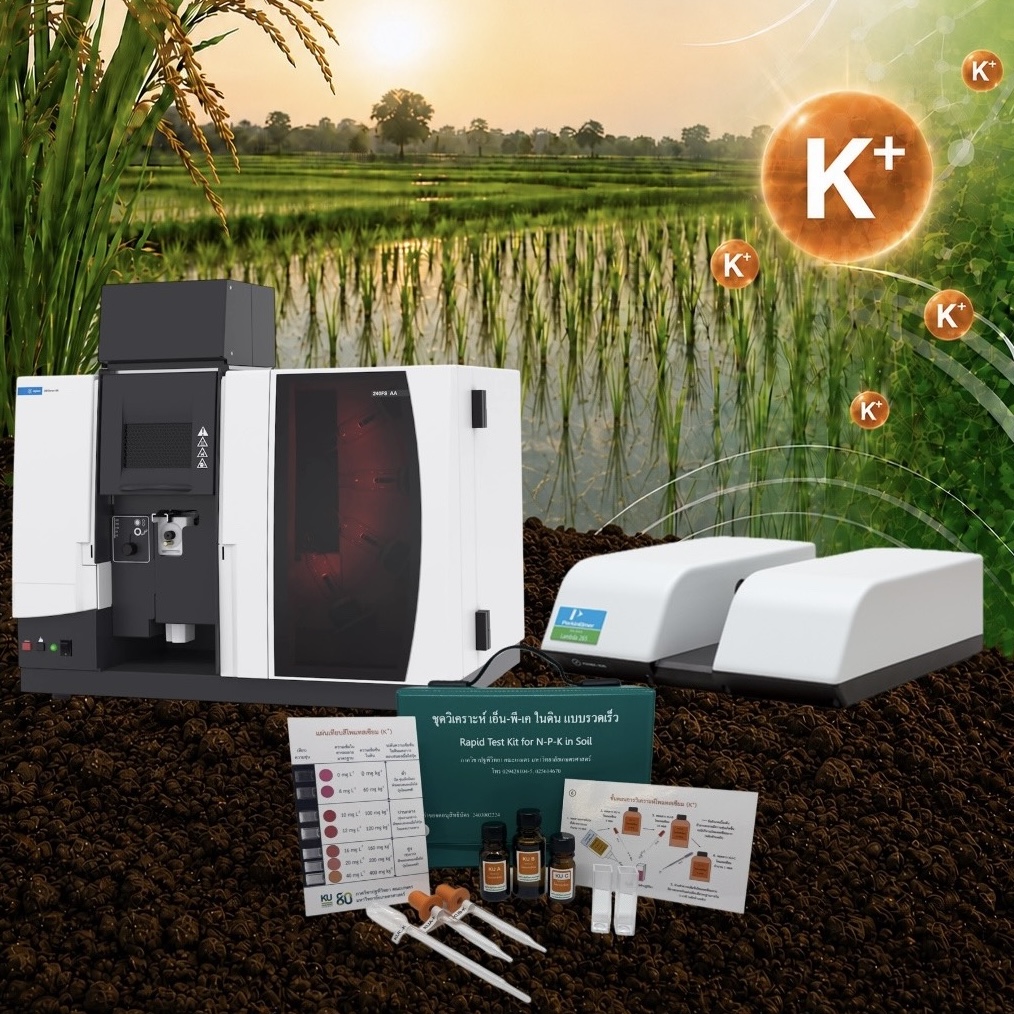
Background and Objective: Rapid and accurate assessment of plant-available potassium (K) in soils using appropriate extractants and analytical techniques is essential for effective potassium fertilizer management. This study aimed to compare the performance of four soil extractants—1 M NH4OAc, Bray II, Mehlich I, and 0.01 M CaCl2—combined with two analytical methods, atomic absorption spectroscopy (AAS) and UV-visible spectroscopy (UV-Vis), to evaluate their potential for use in low-cost, field-adaptable soil K test kits. The novelty of this research lies in verifying the agreement between the UV-Vis method and the standard AAS method, particularly with extractants free from interfering ions, to support the practical application in Thai agricultural contexts.
Methodology: A total of 178 soil samples were collected from jasmine rice cultivation areas in Northeast Thailand. Extractable potassium was measured using both AAS and UV-Vis, and statistical analyses were performed to evaluate correlations and cost-effectiveness.
Main Results: Most soil samples contained potassium predominantly in non-exchangeable forms. UV-Vis measurements using Mehlich I and CaCl2 extractants showed strong correlation with AAS values (r = 0.93 and 0.89, respectively). UV-Vis also offered lower analytical costs (1.54 THB per analysis) compared to AAS (2.05 THB). However, a key limitation was observed when using UV-Vis with extractants containing ammonium ions (NH4+), such as NH4OAc and Bray II, due to turbidity interference.
Conclusions: UV-Vis spectroscopy, when combined with Mehlich I and CaCl2extractants, is a promising alternative for developing cost-effective, rapid, and accurate soil K test kits suitable for field use, supporting site-specific fertilizer recommendations.
Article Details

This work is licensed under a Creative Commons Attribution-NonCommercial-NoDerivatives 4.0 International License.
References
Angelova, L., N. Genova, S. Stoyanova, O. Surleva, I.H. Nekov, D. Ilieva and A. Surleva. 2021. Comparative study of soil test methods for determination of plant available potassium in Bulgarian arable soils. Analytics and Control. 25(3): 182–192. https://journals.urfu.ru/index.php/analitika/article/view/5371.
Aramrak, S., J. Chanchareonsook, C. Suwannarat and E. Sarobol. 2007. Assessment of multielement extractants for prediction of available potassium in Thai soils. Kasetsart J. (Nat. Sci.). 41(3): 461–466.
Athokpam, H., S.H. Wani, D. Kamei, H.S. Athokpam, J. Nongmaithem, D. Kumar, Y.K. Singh, B.S. Naorem, T.R. Devi and L. Devi. 2013. Soil macro-and micro-nutrient status of Senapati district, Manipur (India). Afr. J. Agric. Res. 8(39): 4932–4936.
Attanandana, T., C. Suwannarat, S. Kritapirom and B. Tealnugutoom. 1999. Simple determination of NPK in the soils. Thai Journal of Soils and Fertilizers. 21(2): 46–51. (in Thai)
Awgchew, H., S. Beyene and A. Kifilu. 2024. Potassium adsorption capacity and desorption kinetics in soils of Qenberenaweti sub-watershed, central highlands of Ethiopia. Heliyon. 10(10): e31336. https://doi.org/10.1016/j.heliyon.2024.e31336.
Bray, R.H. and L.T. Kurtz. 1945. Determination of total, organic, and available forms of phosphorus in soils. Soil Sci. 59(1): 39–46.
Deng, J., K. Liu, X. Xiong, T. Hussain, L. Huang, P. de Voil, M.T. Harrison, X. Tian and Y. Zhang. 2024. Achieving sustainable rice production through nitrogen-potassium harmony for enhanced economic and environmental gains. Agric. Water Manag. 301: 108949. https://doi.org/10.1016/j.agwat.2024.108949.
Gee, G.W. and J.W. Bauder. 1986. Particle-size analysis, pp. 383–411. In A. Klute, ed. Methods of Soil Analysis. Part 1 Physical and Mineralogical Methods. 2nd edition. American Society of Agronomy, Inc., Soil Science Society of America, Inc., Wisconsin, USA.
Giavarina, D. 2015. Understanding bland altman analysis. Biochem. Med. 25(2): 141–151. https://doi.org/10.11613/BM.2015.015.
Kim, H.J., J.W. Hummel, K.A. Sudduth and P.P. Motavalli. 2007. Simultaneous analysis of soil macronutrients using ion-selective electrodes. Soil Sci. Soc. Am. J. 71(6): 1867–1877. https://doi.org/10.2136/sssaj2007.0002.
Kozak, M., M. Stepien and A.H. Joarder. 2005. Relationships between available and exchangeable potassium content and other soil properties. Pol. J. Soil Sci. 38: 179–186.
Liu, N., Z. Wei and H. Wei. 2021. Colorimetric detection of nitrogen, phosphorus, and potassium contents and integration into field irrigation decision technology. IOP Conf. Ser.: Earth Environ. Sci. 651: 042044. https://doi.org/10.1088/1755-1315/651/4/042044.
Mhalla, B., N. Ahmed, D. Das, B. Singh and A. Das. 2022. Potassium forms and their relationships with soil properties and clay mineralogy in the soils of Kumaon Himalayan Region of India. Clay Res. 41(2): 113–126.
Murashkina, M.A., R.J. Southard and G.S. Pettygrove. 2007. Silt and fine sand fractions dominate K fixation in soils derived from granitic alluvium of the San Joaquin Valley, California. Geoderma. 141(3–4): 283–293. https://doi.org/10.1016/j.geoderma.2007.06.011.
Mylavarapu, R.S., J.F. Sanchez, J.H. Nguyen and J.M. Bartos. 2002. Evaluation of Mehlich-1 and Mehlich-3 extraction procedures for plant nutrients in acid mineral soils of Florida. Commun. Soil Sci. Plant Anal. 33(5–6): 807–820. https://doi.org/10.1081/CSS-120003067.
National Soil Survey Center. 1996. Soil Survey Laboratory Methods Manual. Soil Survey Investigations Report No. 42, Version 3.0. Natural Resources Conservation Service, United States Department of Agriculture, Washington, D.C., USA.
Office of Agricultural Economics. 2024. Rice production data. Available Source: https://www.oae.go.th, September 30, 2024. (in Thai)
Paudel, M., K.R. Adhikari, B. Subedi, J.J. Gairhe, S.P. Vista and S. Lamichhane. 2020. Assessment of the relationship between soil pH and macronutrients at Baseshwor, Sindhuli. J. Inst. Agric. Anim. Sci. 36: 241–248.
Pratt, P.F. 1965. Potassium, pp. 1022–1030. In C.A. Black, ed. Methods of Soil Analysis. Part 2 Chemical and Microbiological Properties. American Society of Agronomy, Inc., Wisconsin, USA.
Ramamoorthi, V. and S. Meena. 2018. Evaluation of suitable extractant for estimating soil available potassium in soils of Tamil Nadu. Int. J. Chem. Stud. 6(6): 1662–1666.
Rice Department. 2024. Rice cultivation area. Available Source: https://files.ricethailand.go.th/files/9/documents/page_doc/files-rice-1707277364541.pdf, September 29, 2024. (in Thai)
Salomon, E. 1998. Extraction of soil potassium with 0.01 M calcium chloride compared to official Swedish methods. Commun. Soil Sci. Plant Anal. 29(19–20): 2841–2854.
Schollenberger, C.J. and R.H. Simon. 1945. Determination of exchange capacity and exchangeable bases in soil—ammonium acetate method. Soil Sci. 59(1): 13–24.
Shamsham, S.M., R.F. Nasra and R.Z. Ayoush. 2019. Effect of soil properties on forms of potassium in some soils of Homs Governorate. Assoc. Arab Univ. J. Eng. Sci. 26(3): 39–44. https://doi.org/10.33261/jaaru.2019.26.3.005.
Singh, R.P. and S.K. Mishra. 2012. Available macronutrients (N, P, K and S) in the soils of Chiragaon block of district Vanarasi (U.P.) in relation to soil characteristics. Indian J. Sci. Res. 3(1): 97–100.
Sparks, D.L., A.L. Page, P.A. Helmke, R.H. Loeppert, P.N. Soltanpour, M.A. Tabatabai, C.T. Johnston and M.E. Sumner. 1996. Methods of Soil Analysis. Part 3 Chemical Methods. Soil Science Society of America, Inc., American Society of Agronomy, Inc., Wisconsin, USA.
Thomas, G.W. 1982. Exchangeable cations, pp. 159–165. In A.L. Page, ed. Methods of Soil Analysis. Part 2 Chemical and Microbiological Properties. 2nd edition. American Society of Agronomy, Inc., Soil Science Society of America, Inc., Wisconsin, USA.
Vijayakumar, S., D. Kumar, K. Ramesh, P. Govindasamy, D. Jinger, R. Khanam, P. Saravanane, E. Subramanian, E. Joshi, V.K. Sharma and S.K. Rajpoot. 2021. Potassium nutrition in rice: A review. Oryza-An International Journal of Rice. 58(3): 341–353.
Walkley, A. and I. A. Black. 1934. An examination of the Degtjareff method for determining soil organic matter, and a proposed modification of the chromic acid titration method. Soil Sci. 37(1): 29–38.
Weil, R.R. and N.C. Brady. 2017. The Nature and Properties of Soils. 15th edition. Pearson Education, Inc., New Jersey, USA.
Werle, R., R.A. Garcia and C.A. Rosolem. 2008. Potassium leaching as affected by soil texture and potassium availability. Rev. Bras. Cienc. Solo. 32(6): 2297–2305. https://doi.org/10.1590/S0100-06832008000600009.
Zebec, V., D. Rastija, Z. Loncaric, A. Bensa, B. Popovic and V. Ivezic. 2017. Comparison of chemical extraction methods for determination of soil potassium in different soil types. Eurasian Soil Sci. 50: 1420–1427. https://doi.org/10.1134/S1064229317130051.
