
ความหลากหลายทางพันธุกรรมของไก่พื้นเมืองในพื้นที่จังหวัดอุตรดิตถ์เพื่อการใช้ประโยชน์และอนุรักษ์อย่างยั่งยืน
Article Sidebar
Main Article Content
บทคัดย่อ
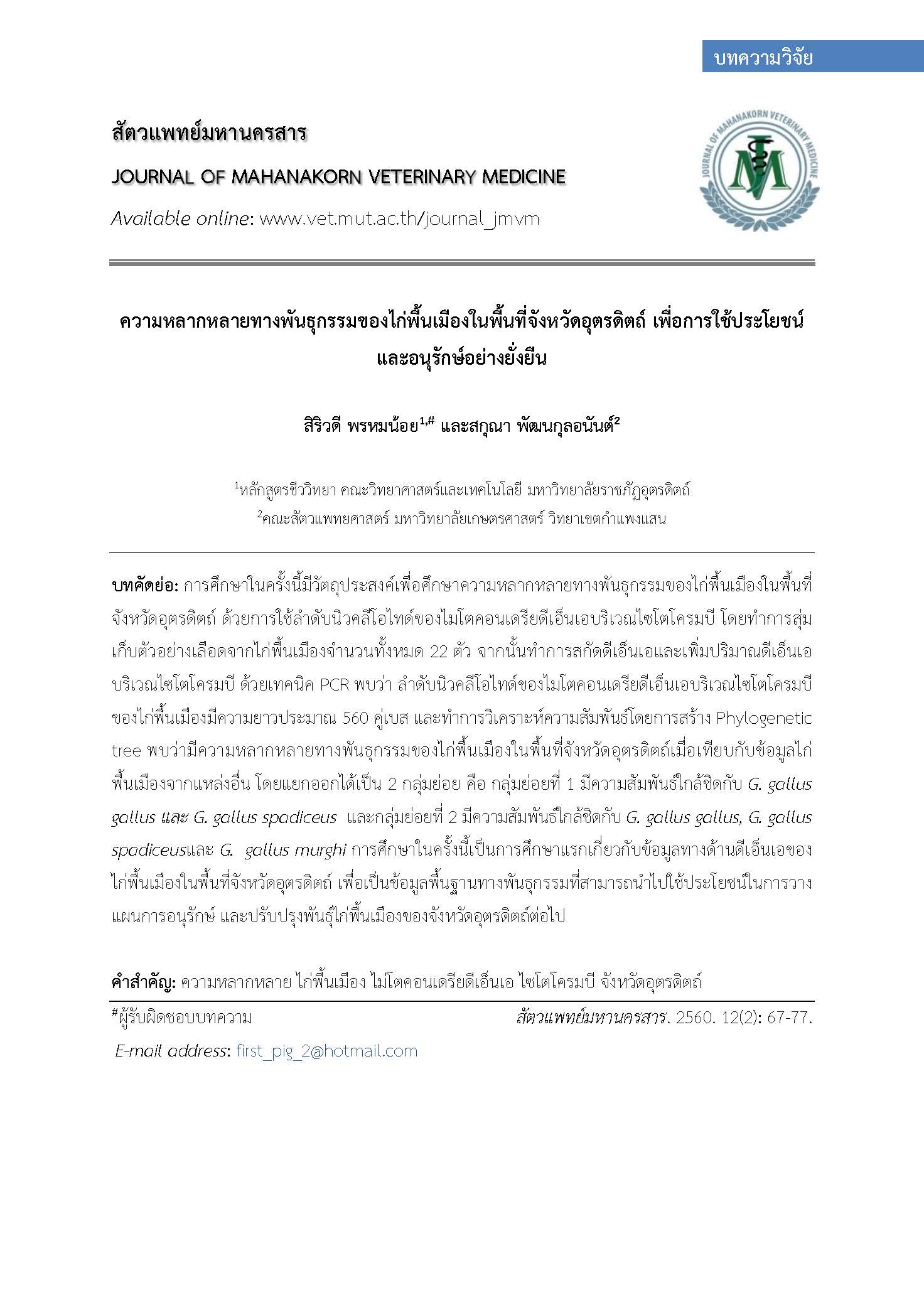
การศึกษาในครั้งนี้มีวัตถุประสงค์เพื่อศึกษาความหลากหลายทางพันธุกรรมของไก่พื้นเมืองในพื้นที่จังหวัดอุตรดิตถ์ ด้วยการใช้ลำดับนิวคลีโอไทด์ของไมโตคอนเดรียดีเอ็นเอบริเวณไซโตโครมบี โดยทำการสุ่มเก็บตัวอย่างเลือดจากไก่พื้นเมืองจำนวนทั้งหมด 22 ตัว จากนั้นทำการสกัดดีเอ็นเอและเพิ่มปริมาณดีเอ็นเอบริเวณไซโตโครมบี ด้วยเทคนิค PCR พบว่า ลำดับนิวคลีโอไทด์ของไมโตคอนเดรียดีเอ็นเอบริเวณไซโตโครมบีของไก่พื้นเมืองมีความยาวประมาณ 560 คู่เบส และทำการวิเคราะห์ความสัมพันธ์โดยการสร้าง Phylogenetic tree พบว่ารมีความหลากหลายทางพันธุกรรมของไก่พื้นเมืองในพื้นที่จังหวัดอุตรดิตถ์เมื่อเทียบกับข้อมูลไก่พื้นเมืองจากแหล่งอื่น โดยแยกออกได้เป็น 2 กลุ่มย่อย คือ กลุ่มย่อยที่ 1 มีความสัมพันธ์ใกล้ชิดกับ G. gallus gallus และ G. gallus spadiceus และกลุ่มย่อยที่ 2 มีความสัมพันธ์ใกล้ชิดกับ G. gallus gallus, G. gallus spadiceusและ G. gallus murghi การศึกษาในครั้งนี้เป็นการศึกษาแรกเกี่ยวกับข้อมูลทางด้านดีเอ็นเอของไก่พื้นเมืองในพื้นที่จังหวัดอุตรดิตถ์ เพื่อเป็นข้อมูลพื้นฐานทางพันธุกรรมที่สามารถนำไปใช้ประโยชน์ในการวางแผนการอนุรักษ์ และปรับปรุงพันธุ์ไก่พื้นเมืองของจังหวัดอุตรดิตถ์ต่อไป
Article Details
เอกสารอ้างอิง
เจนรงค์ คำมงคุณ ชัยตรี บุญดี และอำนวย เลี้ยวธารากุล. 2559. ความหลากหลายของไก่พื้นเมืองในพื้นที่ภาคเหนือและภาคตะวันออกเฉียงเหนือของไทย. วารสารแก่นเกษตร 44 ฉบับพิเศษ 1: (2559). หน้า 37-42.
เฉลิมชัย หอมตา. 2546. การจําแนกสายพันธุไกพื้นเมืองในภาคตะวันออกเฉียงเหนือดวย ไมโครแซทเทลไลท-มารกเกอร์. วิทยานิพนธ์หลักสูตรปริญญาวิทยาศาสตรมหาบัณฑิตสาขาวิชาเทคโนโลยีการผลิตสัตว มหาวิทยาลัยเทคโนโลยีสุรนารี. 90 หน้า.
สิริวดี พรหมน้อย และสมเกียรติ ดอนทองแดง. 2559. ความหลากหลายทางพันธุกรรมของไก่เขียวพาลีในพื้นที่อำเภอพิชัย จังหวัดอุตรดิตถ์ด้วยการวิเคราะห์ยีนไซโตโครมบีในไมโตคอนเดรีย. วารสารวิจัยราชภัฏพระนคร สาขาวิทยาศาสตร์และเทคโนโลยี. ปีที่ 11 ฉบับพิเศษ (พฤศจิกายน 2559). หน้า 355-365.
อลงกลด แทนออมทอง. (2542). ที่มาของต้นตระกูลไก่ (Origin of Fowl). สาส์นไก่. 3(46): 33-36.
Berthouly-Salazar, C., Rognon, X., Van, T.N., Gely, M., Chi, C.V., Tixier-Boichard, M., Bed’Hom, B., Bruneua, N., Verrier, E., Maillard, J.C. and Michaux, J.R. 2010. Vietnamese chickens: a gate towards Asian genetic diversity. BMC Genetics. 11: 53.
Fumihito, A., Miyake, T., Takada, M., Shingu, R., Endo, T., Gojobori, T., Kondo, N. and Ohno, S (1996). Monophyletic origin and unique dispersal patterns of domestic fowls. Proceeding of the National Academy of Sciences of the United States of America. 93: 6792-6795.
Giuffra, E., Kijas, M.H., Amarger, V., Carlborg, O., Jeon, J.T. and Andersson, L. (2000). The origin of the domestic pig: independent domestication and subsequent introgression. Genetics. 154: 1785-1791.
Hiendleder, S., Kaupe, B., Wassmuth, R. and Janke, A. (2002). Molecular analysis of wild and domestic sheep questions current nomenclature and provides evidence for domestication from two different subspecies. Proceeding of Royal Society B: Biol. Sci. 296: 893-904.
Kanginakudru, S., Metta, M., Jakati, R.D. and Nagaraju, J. (2008). Genetic evidence from Indian red junglefowl corroborates multiple domestication of modern day chicken. BMC Evolutionary Biology. 8: 174.
Lee, Y.J., Bhuiyan, M.S.A., Chung, H.J., Jung, W.Y., Choi, K.D., Jang, B.G., Paek, W.K., Jeon, J.T., Park, C.S. and Lee, J.H. (2007). Mitochondrial DNA diversity of Korean Ogal chicken. Asian-Austrarian J. Anim. Sci. 20(4): 477-481.
Liu, Y.P., Wu, G.S., Yao, Y.G., Miao, Y.W., Luikart, G., Baig, M., Beja-Pereira, A., Ding, Z.L., Palanichamy, M.G. and Zhang, Y.P. (2006). Multiple maternal origins of chickens: out of the Asian jungles. Mol. Phylogenet. Evol. 38: 12-19.
Mannen, H., Kohno, M., Nagata, Y., Tsuji, S., Bradley, D.G., Yeo, J.S., Nyamsamba, D., Zagdsuren, Y., Yokohama, M., Nomura, K. and Amano, T. (2004). Independent mitochondrial origin and historical genetic differentiation of north eastern Asian cattle. Mol. Phylogenet. Evol. 32: 539-544.
Nishibori, M., Shimogiri, T., Hayashi, T. and Yasue, H. (2005). Melecular evidence for hybridization of species in the genus Gallus except for Gallus varius. Animal Genetics. 36: 267-375.
Niu, D., F. Yan, L. Jung, R. Hui, Y. Xu-Ping, C Gong and Z Ya-Ping. (2002). The origin and genetic diversity of Chinese native chicken breeds. Biochem. Genetics. 40(5/6): 163-174.
Odahara, S., Chung, H.J., Choi, S.H., Yu, S.L., Sasazaki, S., Mannan, H., Park, C.S. and Lee, J.H. (2006). Mitochondrial DNA diversity of Korean natice goats. Asian-Australian J. Anim. Sci. 19(4): 482-485.
Peter, J.L., McCracken, K.G., Zhuravlev, Y.N., Lu, Y., Wilson, R.E., Johnson, K.P. and Omland, K.E. (2005). Phylogenetics of wigeons and allies (Anatidae: Anus): The importance of sampling multiple loci and multiple individuals. Mol. Phylogenet. Evol. 35: 209-224.
Pramual, P., Meeyen, K., Wongpakam, K. and Klinhom, U. (2013). Genetic diversity of Thai Native Chicken inferred from mitochondrial DNA sequences. Trop. Nat. Hist. 13(2): 97-106.
Ramadamptian, H.A.I., Galal, A., Fathi, M.M., El, F.S. and Yakoub, H.A. (2011). Characterization of two Egyptian native chicken breeds using genetic and immunological parameters. Biotech. Anim. Husbandry. 27: 1-16.
Smith, E.J., and D.W. Burt. 1998. Parameter of the chicken genome (Gallus domesticus). Anim. Genetic. 29: 290-294.
Tamura K., Peterson, D., Peterson, N., Stecher, G., Nei, M. and Kumar, S. 2011. MEGA5: molecular evolutionary genetics analysis using maximum likelihood, evolutionary distance and maximum parsimony methods. Mol. Biol. Evol. 28: 2731-2739.
Vila, C., Leonard, J.A., Gotherstorm, A., Marklund, S., Sandberg, K., Liden, K., Wayne, R.K. and Ellegren, H. (2001). Widespread prigin of domestic horse lineages. Science. 291: 474-477.
