
ผลของโดปามีนในระดับต่ำต่อการเพิ่มการกรองของไตในสุนัขไตวายเรื้อรัง
Article Sidebar
Main Article Content
บทคัดย่อ
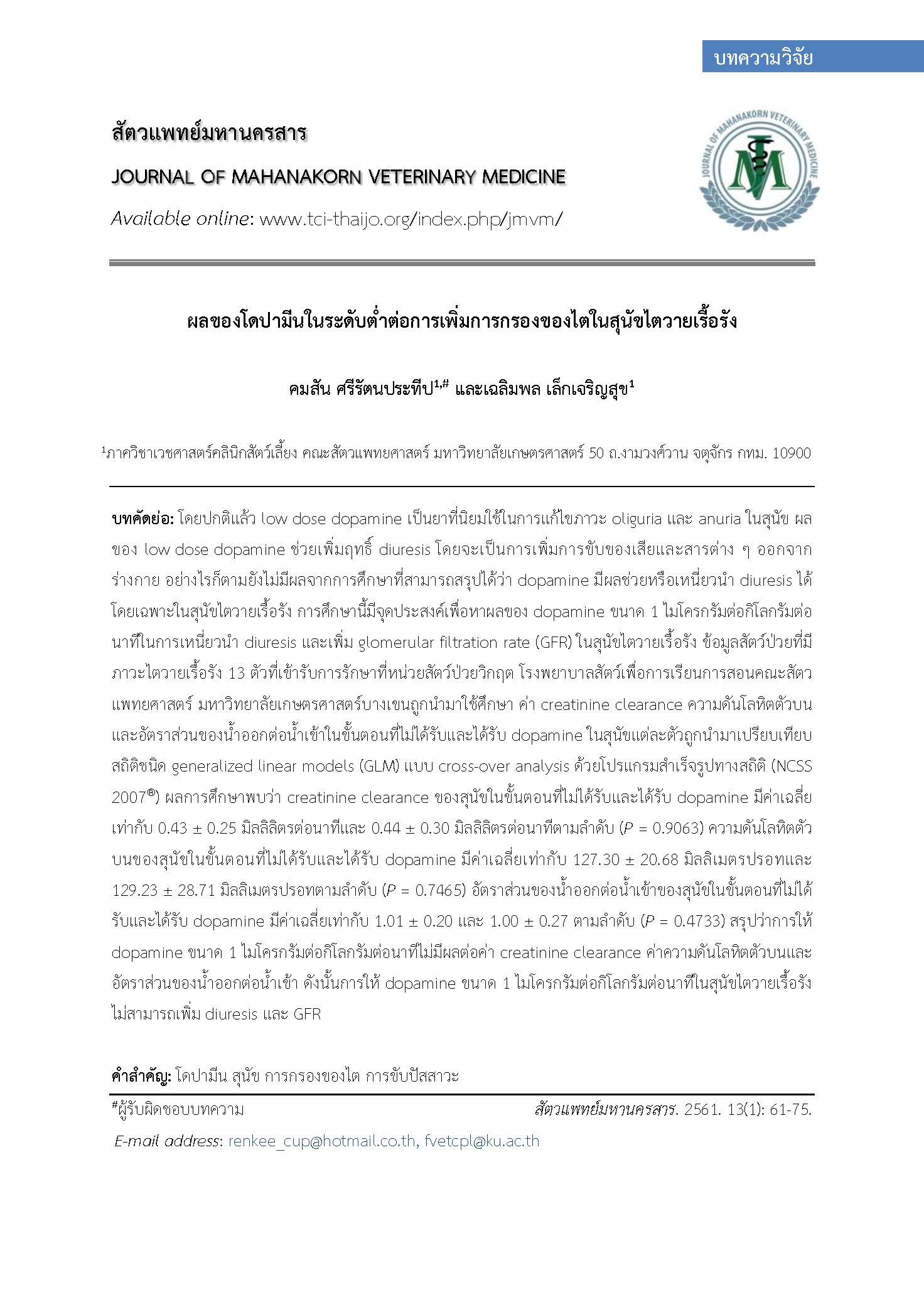
โดยปกติแล้ว low dose dopamine เป็นยาที่นิยมใช้ในการแก้ไขภาวะ oliguria และ anuria ในสุนัข ผลของ low dose dopamine ช่วยเพิ่มฤทธิ์ diuresis โดยจะเป็นการเพิ่มการขับของเสียและสารต่าง ๆ ออกจากร่างกาย อย่างไรก็ตามยังไม่มีผลจากการศึกษาที่สามารถสรุปได้ว่า dopamine มีผลช่วยหรือเหนี่ยวนำ diuresis ได้โดยเฉพาะในสุนัขไตวายเรื้อรัง การศึกษานี้มีจุดประสงค์เพื่อหาผลของ dopamine ขนาด 1 ไมโครกรัมต่อกิโลกรัมต่อนาทีในการเหนี่ยวนำ diuresis และเพิ่ม glomerular filtration rate (GFR) ในสุนัขไตวายเรื้อรัง ข้อมูลสัตว์ป่วยที่มีภาวะไตวายเรื้อรัง 13 ตัวที่เข้ารับการรักษาที่หน่วยสัตว์ป่วยวิกฤต โรงพยาบาลสัตว์เพื่อการเรียนการสอนคณะสัตวแพทยศาสตร์ มหาวิทยาลัยเกษตรศาสตร์บางเขนถูกนำมาใช้ศึกษา ค่า creatinine clearance ความดันโลหิตตัวบนและอัตราส่วนของน้ำออกต่อน้ำเข้าในขั้นตอนที่ไม่ได้รับและได้รับ dopamine ในสุนัขแต่ละตัวถูกนำมาเปรียบเทียบสถิติชนิด generalized linear models (GLM) แบบ cross-over analysis ด้วยโปรแกรมสำเร็จรูปทางสถิติ (NCSS 2007®) ผลการศึกษาพบว่า creatinine clearance ของสุนัขในขั้นตอนที่ไม่ได้รับและได้รับ dopamine มีค่าเฉลี่ยเท่ากับ 0.43 ± 0.25 มิลลิลิตรต่อนาทีและ 0.44 ± 0.30 มิลลิลิตรต่อนาทีตามลำดับ (P = 0.9063) ความดันโลหิตตัวบนของสุนัขในขั้นตอนที่ไม่ได้รับและได้รับ dopamine มีค่าเฉลี่ยเท่ากับ 127.30 ± 20.68 มิลลิเมตรปรอทและ 129.23 ± 28.71 มิลลิเมตรปรอทตามลำดับ (P = 0.7465) อัตราส่วนของน้ำออกต่อน้ำเข้าของสุนัขในขั้นตอนที่ไม่ได้รับและได้รับ dopamine มีค่าเฉลี่ยเท่ากับ 1.01 ± 0.20 และ 1.00 ± 0.27 ตามลำดับ (P = 0.4733) สรุปว่าการให้ dopamine ขนาด 1 ไมโครกรัมต่อกิโลกรัมต่อนาทีไม่มีผลต่อค่า creatinine clearance ค่าความดันโลหิตตัวบนและอัตราส่วนของน้ำออกต่อน้ำเข้า ดังนั้นการให้ dopamine ขนาด 1 ไมโครกรัมต่อกิโลกรัมต่อนาทีในสุนัขไตวายเรื้อรังไม่สามารถเพิ่ม diuresis และ GFR
Article Details
เอกสารอ้างอิง
2. Adam, W.R. 1980. Aldosterone and dopamine receptors in the kidney: sites for pharmacologic manipulation of renal function. Kidney Int. 18(5): 623-635.
3. Almy Frederic, S., Christopher Mary, M., King Don, P. and Brown Scott, A. 2002. Evaluation of cystatin C as an endogenous marker of glomerular filtration rate in dogs. J. Vet. Int. Med. 16(1): 45-51.
4. Armstrong, D.K., Dasta, J.F., Reilley, T.E. and Tallman, Jr., R.D. 1986. Effect of haloperidol on dopamine-induced increase in renal bood flow. Drug Intell. Clin. Pharm. 20(7-8): 543-546.
5. Baum, M. and Quigley, R. 1998. Inhibition of proximal convoluted tubule transport by dopamine. Kidney Int. 54(5): 1593-1600.
6. Bellomo, R., Chapman, M., Finfer, S., Hickling, K. and Myburgh, J. 2000. Low-dose dopamine in patients with early renal dysfunction: A placebo-แontrolled randomised trial. Australian and New Zealand Intensive Care Society (Anzics) Clinical Trials Group. Lancet 356(9248): 2139-2143.
7. Bradshaw, E.G., Pleuvry, B.J. and Sharma, H.L. 1980. Effect of droperidol on dopamine-induced increase in effective renal plasma flow in dogs. Br. J. Anaesth. 52(9): 879-883.
8. Braun, J.P., Lefebvre, H.P. and Watson, A.D. 2003. Creatinine in the dog: A review. Vet. Clin. Pathol. 32(4): 162-179.
9. Burton, C.J. and Tomson, C.R. 1999. Can the use of low-dose dopamine for treatment of acute renal failure be justified? Postgrad. Med. J. 75(883): 269-274.
10. Chertow, G.M., Sayegh, M.H., Allgren, R.L. and Lazarus, J.M. 1996. Is the administration of dopamine associated with adverse or favorable outcomes in acute renal failure? American J. Med. 101(1): 49-53.
11. Cobrin, A.R., Blois, S.L., Kruth, S.A., Abrams-Ogg, A.C.G. and Dewey, C. 2013. Biomarkers in the assessment of acute and chronic kidney diseases in the dog and cat. J. Small Anim. Pract. 54(12): 647-655.
12. Denton, M.D., Chertow, G.M. and Brady, H.R. 1996. "Renal-dose" dopamine for the treatment of acute renal failure: Scientific rationale, experimental studies and clinical trials. Kidney Int. 50(1): 4-14.
13. DiBartola, S.P. and Bateman, S. 2012. Fluid, electrolyte, and acid-base disorders in small animal practice. 4thed. Elsevier Saunders. Missouri. 744 p.
14. Faul, F. 2014. G*Power version 3.1.9.2, Universitat kiel, Germany.
15. Finco Delmar, R., Braselton, W.E. and Cooper Tanya, A. 2001. Relationship between ยlasma iohexol clearance and urinary exogenous creatinine clearance in dogs. J. Vet. Inter. Med. 15(4): 368-373.
16. Furukawa, S., Nagashima, Y., Hoshi, K., Hirao, H., Tanaka, R., Maruo, K. and Yamane, Y. 2002. Effects of dopamine infusion on cardiac and renal blood flows in dogs. J. Vet. Med. Sci. 64(1): 41-44.
17. Girbes, A.R., Patten, M.T., McCloskey, B.V., Groeneveld, A.B. and Hoogenberg, K. 2000. The renal and neurohumoral effects of the addition of low-dose dopamine in septic critically ill patients. Intensive Care Med. 26(11): 1685-1689.
18. Heiene, R. and Moe, L. 1998. Pharmacokineatic aspects of measurement of glomerular filtration rate in the dog: A review. J. Vet. Inter. Med. 12(6): 401-414.
19. Hintze, J., 2007. NCSS and GESS. NCSS.LLC. Kaysville, Utah.
20. Horio, M., Imai, E., Yasuda, Y., Hishida, A. and Matsuo, S. 2009. Simple sampling strategy for measuring inulin renal clearance. Clin. Exp. Nephrol. 13(1): 50-54.
21. Jose, P.A., Raymond, J.R., Bates, M.D., Aperia, A., Felder, R.A. and Carey, R.M. 1992. The renal dopamine receptors. J. Am. Soc. Nephrol. 2(8): 1265-1278.
22. Juste, R.N., Moran, L., Hooper, J. and Soni, N. 1998. Dopamine clearance in critically ill patients. Intensive Care Med. 24(11): 1217-1220.
23. Karthik, S. and Lisbon, A. 2006. Low-dose dopamine in the intensive care unit. Semin. Dial. 19(6): 465-471.
24. Kindgen-Milles, D. and Tarnow, J. 1997. [Low dosage dopamine improves kidney function: Current status of knowledge and evaluation of a controversial topic]. Anasthesiol. Intensivmed. Notfallmed. Schmerzther. 32(6): 333-342.
25. Lauschke, A., Teichgraber, U.K., Frei, U. and Eckardt, K.U. 2006. 'Low-dose' dopamine worsens renal perfusion in patients with acute renal failure. Kidney Int. 69(9): 1669-1674.
26. Lokhandwala, M.F. and Hegde, S.S. 1990. Cardiovascular dopamine receptors: Role of renal dopamine and dopamine receptors in sodium excretion. Pharmacol. Toxicol. 66(4): 237-243.
27. Luippold, G., H. Osswald and B. Muhlbauer. 1998. Renal Effects of Exogenous Dopamine: Modulation by Renal Nerves and Dopamine Receptor Antagonists. Naunyn Schmiedebergs Arch Pharmacol 358 (4): 445-451.
28. Lynch, S.K., K.V. Lemley and M.J. Polak. 2003. The Effect of Dopamine on Glomerular Filtration Rate in Normotensive, Oliguric Premature Neonates. Pediatr Nephrol 18 (7): 649-652.
29. Marinosci, G.Z., De Robertis, E., De Benedictis, G. and Piazza, O. 2012. Dopamine use in intensive care: Are we ready to turn it down? Transl. Med. UniSa. 4: 90-94.
30. McCrory, C. and Cunningham, A.J. 1997. Low-dose dopamine: Will there ever be a scientific rationale? Br. J. Anaesth. 78(4): 350-351.
31. Missale, C., Nash, S.R., Robinson, S.W., Jaber, M. and Caron, M.G. 1998. Dopamine receptors: From structure to function. Physiol. Rev. 78(1): 189-225.
32. Miyagawa, Y., Takemura, N. and Hirose, H. 2010. Assessments of factors that affect glomerular filtration rate and indirect markers of renal function in dogs and cats. J. Vet. Med. Sci. 72(9): 1129-1136.
33. Nguyen, L.B., Lievano, G., Radhakrishnan, J., Fornell, L.C., Jacobson, G. and John, E.G. 1999. Renal effects of low to moderate doses of dopamine in newborn piglets. J. Pediatr. Surg. 34(6): 996-999.
34. Olsen, N.V., Olsen, M.H., Bonde, J., Kanstrup, I.L., Plum, I., Strandgaard, S. and Leyssac, P.P. 1997. Dopamine natriuresis in salt-Repleted, water-loaded humans: A dose-response study. Br. J. Clin. Pharmacol. 43(5): 509-520.
35. Plumb, D.C. 2008. Plumb’s Veterinary Drug Handbook. 6thed. Blackwell Publishing. Iowa. 1120 p.
36. Prins, I., Plotz, F.B., Uiterwaal, C.S. and van Vught, H.J. 2001. Low-dose dopamine in neonatal and pediatric intensive care: A systematic review. Intensive Care Med. 27(1): 206-210.
37. Schenarts, P.J., Sagraves, S.G., Bard, M.R., Toschlog, E.A., Goettler, C.E., Newell, M.A. and Rotondo, M.F. 2006. Low-dose dopamine: A physiologically based review. Current Surgery. 63(3): 219-225.
38. Schoeppe, W. 1977. Effects of Dopamine on kidney function. Proc. R. Soc. Med. 70(Suppl 2): 36-42.
39. Sigrist, N.E. 2007. Use of dopamine in acute renal failure. J. Vet. Emerg.cy Critical Care. 17(2): 117-126.
40. Singer, I. and Epstein, M. 1998. Potential of dopamine a-1 agonists in the management of acute renal failure. Am. J. Kidney Dis. 31(5): 743-755.
41. Star, R.A. 1998. Treatment of acute renal failure. Kidney International, 54(6): 1817-1831.
42. Venkataraman, R. and Kellum, J.A. 2007. Prevention of acute renal failure. Chest. 131(1): 300-308.
43. Verderese, M.A., Vianna, P.T., Ganem, E.M. and Vane, L.A. 2003. Renal and cardiovascular effects of dopamine and 7.5% dodium chloride infusion: Experimental study in dogs with water restriction. Rev. Bras. Anestesiol. 53(5): 600-609.
44. Von Hendy-Willson, V.E. and Pressler, B.M. 2011. An overview of glomerular filtration rate testing in dogs and cats. Vet. J. (London, England : 1997). 188(2): 156-165.
45. Yatsu, T., Arai, Y., Takizawa, K., Kasai-Nakagawa, C., Takanashi, M., Uchida, W., Inagaki, O., Tanaka, A. and Takenaka, T. T. 1998. Effect of Ym435, a dopamine Da1 receptor agonist, in a canine model of ischemic acute renal failure. Gen. Pharmacol. 31(5): 803-807.
