
การศึกษาลักษณะและคุณสมบัติของแบคทีเรียสกุลวิบริโอที่แยกได้จากปลากะพงขาว ที่เลี้ยงในฟาร์ม อ.พระสมุทรเจดีย์ จ.สมุทรปราการ
Article Sidebar
Main Article Content
บทคัดย่อ
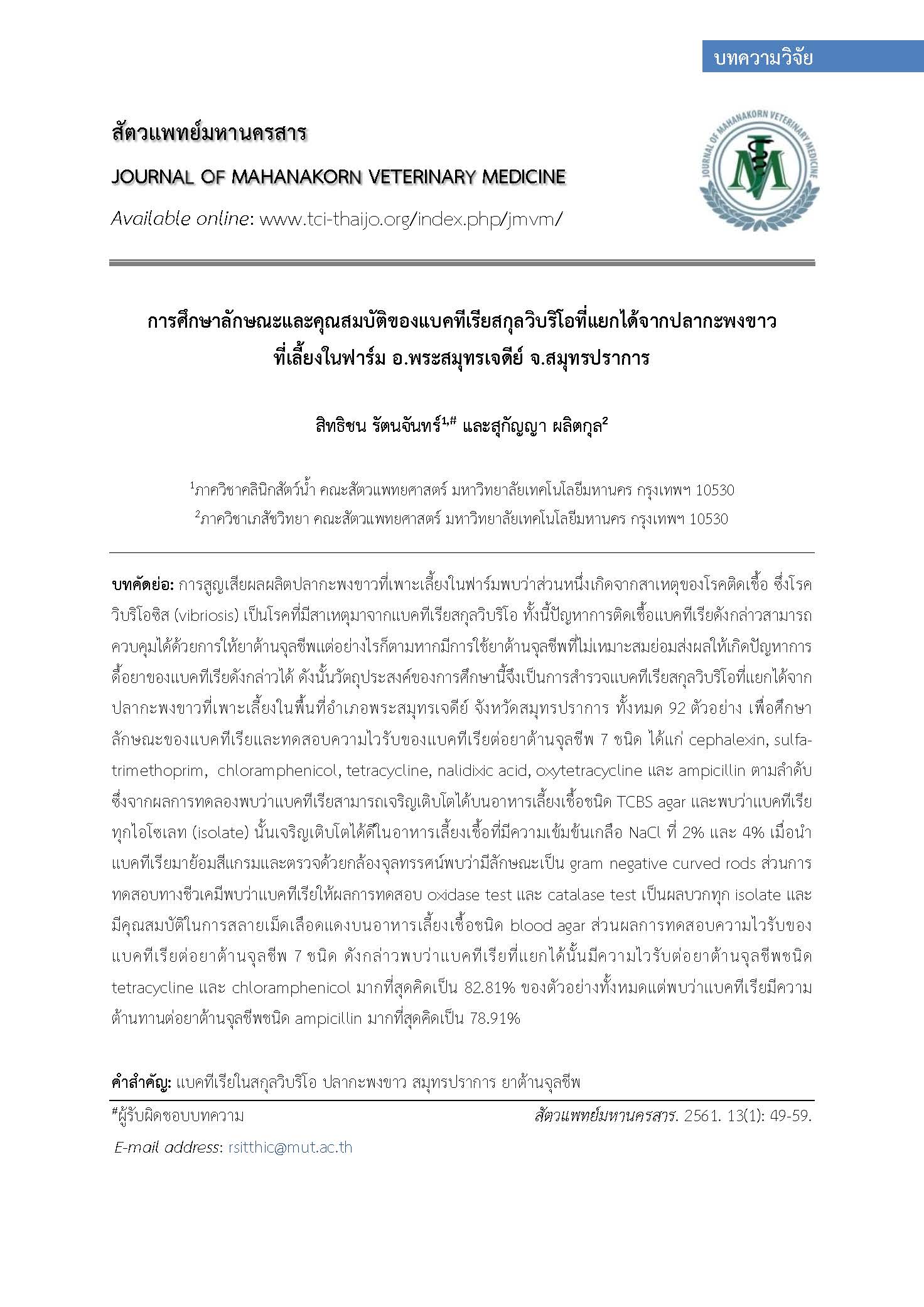
การสูญเสียผลผลิตปลากะพงขาวที่เพาะเลี้ยงในฟาร์มพบว่าส่วนหนึ่งเกิดจากสาเหตุของโรคติดเชื้อ ซึ่งโรควิบริโอซิส (vibriosis) เป็นโรคที่มีสาเหตุมาจากแบคทีเรียสกุลวิบริโอ ทั้งนี้ปัญหาการติดเชื้อแบคทีเรียดังกล่าวสามารถควบคุมได้ด้วยการให้ยาต้านจุลชีพแต่อย่างไรก็ตามหากมีการใช้ยาต้านจุลชีพที่ไม่เหมาะสมย่อมส่งผลให้เกิดปัญหาการดื้อยาของแบคทีเรียดังกล่าวได้ ดังนั้นวัตถุประสงค์ของการศึกษานี้จึงเป็นการสำรวจแบคทีเรียสกุลวิบริโอที่แยกได้จากปลากะพงขาวที่เพาะเลี้ยงในพื้นที่อำเภอพระสมุทรเจดีย์ จังหวัดสมุทรปราการ ทั้งหมด 92 ตัวอย่าง เพื่อศึกษาลักษณะของแบคทีเรียและทดสอบความไวรับของแบคทีเรียต่อยาต้านจุลชีพ 7 ชนิด ได้แก่ cephalexin, sulfa-trimethoprim, chloramphenicol, tetracycline, nalidixic acid, oxytetracycline และ ampicillin ตามลำดับ ซึ่งจากผลการทดลองพบว่าแบคทีเรียสามารถเจริญเติบโตได้บนอาหารเลี้ยงเชื้อชนิด TCBS agar และพบว่าแบคทีเรียทุกไอโซเลท (isolate) นั้นเจริญเติบโตได้ดีในอาหารเลี้ยงเชื้อที่มีความเข้มข้นเกลือ NaCl ที่ 2% และ 4% เมื่อนำแบคทีเรียมาย้อมสีแกรมและตรวจด้วยกล้องจุลทรรศน์พบว่ามีลักษณะเป็น gram negative curved rods ส่วนการทดสอบทางชีวเคมีพบว่าแบคทีเรียให้ผลการทดสอบ oxidase test และ catalase test เป็นผลบวกทุก isolate และมีคุณสมบัติในการสลายเม็ดเลือดแดงบนอาหารเลี้ยงเชื้อชนิด blood agar ส่วนผลการทดสอบความไวรับของแบคทีเรียต่อยาต้านจุลชีพ 7 ชนิด ดังกล่าวพบว่าแบคทีเรียที่แยกได้นั้นมีความไวรับต่อยาต้านจุลชีพชนิด tetracycline และ chloramphenicol มากที่สุดคิดเป็น 82.81% ของตัวอย่างทั้งหมดแต่พบว่าแบคทีเรียมีความต้านทานต่อยาต้านจุลชีพชนิด ampicillin มากที่สุดคิดเป็น 78.91%
Article Details
เอกสารอ้างอิง
2. กรมประมง กระทรวงเกษตรและสหกรณ์. 2559. การสำรวจสถิติฟาร์มเลี้ยงปลาน้ำกร่อยในรอบปี 2557. สถิติฟาร์มเลี้ยงปลาน้ำกร่อยประจำปี 2557. 59(3): 7-17.
3. ชาญณรงค์ รอดคํา. 2550. โรคสําคัญที่ส่งผลกระทบต่อการเพาะเลี้ยงสัตว์น้ำในประเทศไทย. ประมวลเรื่องการประชุมวิชาการทางสัตวแพทย์และการเลี้ยงสัตว์ ครั้งที่ 33 ณ ศูนย์ประชุมบางกอกคอนเวนชั่น โรงแรมโซฟิเทล เซ็นทารา แกรนด์ กรุงเทพฯ. 31 ตุลาคม – 2 พฤศจิกายน 2550. 319-326.
4. รสมา ภู่สุนทรธรรม เกษกนก ศิรินฤมิตร นิภัทรา สวนไพรินทร์ สุกัญญา ผลิตกุล รุ่งโรจน์ โอสถานนท์ ณัฐวรรณ นิยติวัฒน์ชาญชัย ทัศนีย์ เจริญทรง และสุชนา สุขกลัด. 2560. หลักการใช้ยาต้านจุลชีพในสัตว์เลี้ยง. บริษัท แอคทีฟ พริ้นท์ จำกัด. กรุงเทพฯ. 91 หน้า.
5. สุดสายชล หอมทอง และ ธดาภรณ์ วงศ์พุฒ. 2549. ความไวต่อยาปฏิชีวนะของ Vibrio spp. จากหอยนางรมบริเวณอ่างศิลา จังหวัดชลบุรี. วารสารวิชาการ มหาวิทยาลัยอุบลราชธานี. 8(1): 41-54.
6. Bullock, G.L. 1977. (cited 5 May 2018). Vibriosis in fish. Available from: https://www.pdfs.semanticscholar.org/d7be/ab8f40262caa97ee4292bafb4ae6945fcbf0.pdf.
7. Cabello, F. 2006. Heavy use of prophylactic antibiotics in aquaculture: a growing problem for human and animal health and for the environment. Environ. Microbiol. 8(7): 1137-1144.
8. Centers for Disease Control and Prevention. 2014. (cited 5 May 2018). Isolation of Vibrio chlorae from fecal specimens. Available from: https://www.cdc.gov/ cholera/pdf/laboratory-methods-for-the-diagnosis-of-vibrio-cholerae-chapter-4.pdf.
9. Centers for Disease Control and Prevention. 2016. (cited 15 December 2017). Vibrio Species Causing Vibriosis. Available from: https://www.cdc.gov/vibrio/index.html.
10. Damir, K., Irena, V.S., Damir, V., and Emin, T. 2012. Occurrence, characterization and antimicrobial susceptibility of Vibrio alginolyticus in the Eastern Adriatic Sea. Mar. Pollut. Bull. 75(1-2): 46-52.
11. Hervert, C.J., Martin, N.H., Boor, K.J., Wiedmann, M. 2017. Survival and detection of coliforms, Enterobacteriaceae, and gram-negative bacteria in Greek yogurt. J. Dairy Sci. 100(2): 950-960.
12. Kaysner, C.A. and DePaola, A. 2004. (cited 16 March 2018). Bacteriological Analytical Manual: Chapter 9 Vibrio. Available from: https://www.fda.gov/Food/Food ScienceResearch/LaboratoryMethods/ucm070830.htm.
13. Kumaran, S., Deivasigamani, B., Alagappan, K.M. and Sakthivel, M. 2010. Infection and immunization trials of Asian seabass (Lates calcarifer) against fish pathogen Vibrio anguillarum. J. Environ. Biol. 31(4): 539-541.
14. Ottaviani, D., Leoni, F., Rocchegiani, E., Canonico, C., Masini, L., Pianetti, A., Parlani, C., Luzzi, I., Caola, I., Paternoster, C., and Carraturo, A. 2011. Unusual case of necrotizing fasciitis caused by Vibrio cholerae O137. J. Clin. Microbiol. 49(2): 757-759.
15. Sarter, S., Nguyen, H.N., Hung, L.T., Lazard, J. and Montet, D. 2007. Antibiotic resistance in Gram-negative bacteria isolated from farmed catfish. Food Control. 18: 1391–1396.
16. Whitaker, W.B., Parent, M.A., Naughton, L.M., Richards, G.P., Blumerman, S.L., & Boyd, E.F. 2010. Modulation of Responses of Vibrio parahaemolyticus O3:K6 to pH and Temperature Stresses by Growth at Different Salt Concentrations. Appl. Environ. Microbio. 76(14): 4720–4729.
17. Woodring, J., Srijan, A., Puripunyakom, P., Oransathid, W., Wongstitwilairoong, B. and Mason, C. 2012. Prevalence and antimicrobial susceptibilities of Vibrio, Salmonella, and Aeromonas isolates from various uncooked seafoods in Thailand. J. Food Prot. 75(1): 41-47.
18. Yong, W.S. and Seng, L.T. 1990. A comparative study of Vibrio infections in healthy and disease marine finfishes cultured in floating cages near Penang, Malaysia. Asian Fish. Sci. 3(30): 353-359.
19. Zhang, X.H. and Austin, B. 2005. Haemolysins in Vibrio species. J. Appl. Microbiol. 98(5): 1011-1019.
