
ผลของการใช้โปรไบโอติก (GUT PRO) ต่อสมรรถภาพการเจริญเติบโตและสัณฐานวิทยาของลำไส้ของไก่เนื้อ
Article Sidebar
Main Article Content
บทคัดย่อ
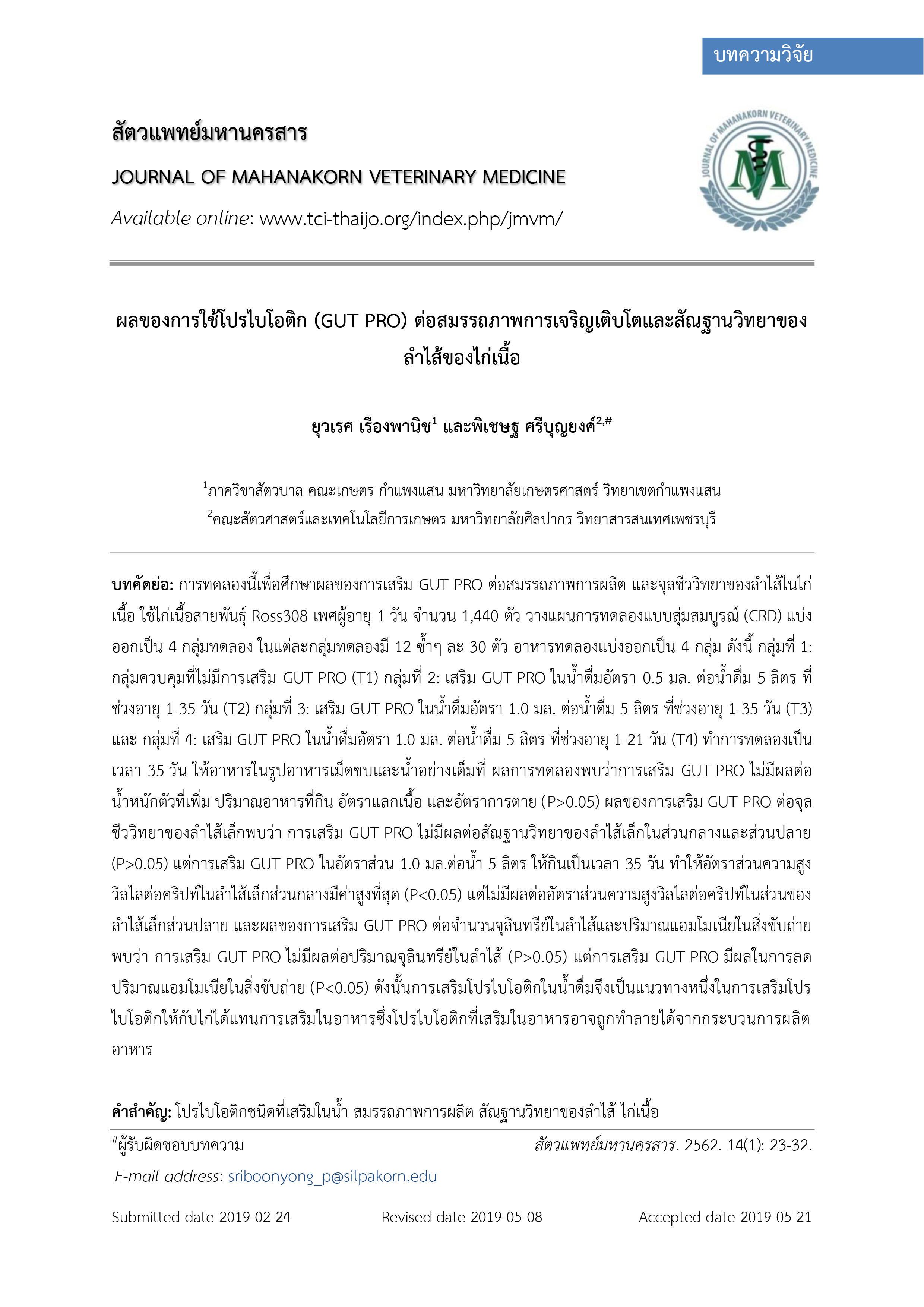
การทดลองนี้เพื่อศึกษาผลของการเสริม GUT PRO ต่อสมรรถภาพการผลิต และจุลชีววิทยาของลำไส้ในไก่เนื้อ ใช้ไก่เนื้อสายพันธุ์ Ross308 เพศผู้อายุ 1 วัน จำนวน 1,440 ตัว วางแผนการทดลองแบบสุ่มสมบูรณ์ (CRD) แบ่งออกเป็น 4 กลุ่มทดลอง ในแต่ละกลุ่มทดลองมี 12 ซ้ำๆ ละ 30 ตัว อาหารทดลองแบ่งออกเป็น 4 กลุ่ม ดังนี้ กลุ่มที่ 1: กลุ่มควบคุมที่ไม่มีการเสริม GUT PRO (T1) กลุ่มที่ 2: เสริม GUT PRO ในน้ำดื่มอัตรา 0.5 มล. ต่อน้ำดื่ม 5 ลิตร ที่ช่วงอายุ 1-35 วัน (T2) กลุ่มที่ 3: เสริม GUT PRO ในน้ำดื่มอัตรา 1.0 มล. ต่อน้ำดื่ม 5 ลิตร ที่ช่วงอายุ 1-35 วัน (T3) และ กลุ่มที่ 4: เสริม GUT PRO ในน้ำดื่มอัตรา 1.0 มล. ต่อน้ำดื่ม 5 ลิตร ที่ช่วงอายุ 1-21 วัน (T4) ทำการทดลองเป็นเวลา 35 วัน ให้อาหารในรูปอาหารเม็ดขบและน้ำอย่างเต็มที่ ผลการทดลองพบว่าการเสริม GUT PRO ไม่มีผลต่อน้ำหนักตัวที่เพิ่ม ปริมาณอาหารที่กิน อัตราแลกเนื้อ และอัตราการตาย (P>0.05) ผลของการเสริม GUT PRO ต่อจุลชีววิทยาของลำไส้เล็กพบว่า การเสริม GUT PRO ไม่มีผลต่อสัณฐานวิทยาของลำไส้เล็กในส่วนกลางและส่วนปลาย (P>0.05) แต่การเสริม GUT PRO ในอัตราส่วน 1.0 มล.ต่อน้ำ 5 ลิตร ให้กินเป็นเวลา 35 วัน ทำให้อัตราส่วนความสูงวิลไลต่อคริปท์ในลำไส้เล็กส่วนกลางมีค่าสูงที่สุด (P<0.05) แต่ไม่มีผลต่ออัตราส่วนความสูงวิลไลต่อคริปท์ในส่วนของลำไส้เล็กส่วนปลาย และผลของการเสริม GUT PRO ต่อจำนวนจุลินทรีย์ในลำไส้และปริมาณแอมโมเนียในสิ่งขับถ่ายพบว่า การเสริม GUT PRO ไม่มีผลต่อปริมาณจุลินทรีย์ในลำไส้ (P>0.05) แต่การเสริม GUT PRO มีผลในการลดปริมาณแอมโมเนียในสิ่งขับถ่าย (P<0.05) ดังนั้นการเสริมโปรไบโอติกในน้ำดื่มจึงเป็นแนวทางหนึ่งในการเสริมโปรไบโอติกให้กับไก่ได้แทนการเสริมในอาหารซึ่งโปรไบโอติกที่เสริมในอาหารอาจถูกทำลายได้จากกระบวนการผลิตอาหาร
Article Details
เอกสารอ้างอิง
Hartke, J. L., M. H. Monaco, M. B. Wheeller and S. M. Donovan. 2005. Effect of a short-term fast on intestinal disaccharidase activity and villus morohology of piglet suckling insulin-like growth factor-I transgenic sows. Journal of Animal Science. 83(10):2404-2413.
Hatairat, M. 2008. Screening of lactic acid bacteria as probiotics in chicken and enhancement of bacteria survival by microencapsulation. MS Thesis, Prince of Songkla University, Songkla. (in Thai)
Hedemann, M. S., M. Eskildsen, H. N. Laerke, C. Pedersen, J. E. Lindberg, P. Laurinen and K. E. Knudsen. 2006. Intestinal morphology and enzymatic activity in newly weaned pigs fed contrasting fiber concentrations and fiber properties. Journal of Animal Science. 84(6):1375-1386.
Jacob, M. B. 1960. The chemical analysis of air pollutants. New York, USA: Interscience Publishers Inc, p. 43.
Lilian, F.A. de Souzaa, N. A. Denise, M. S. Lenita, C. G. Ines, C. C. Valquíria, P. Gustavo and F. B. Maria. 2018. Probiotics on performance, intestinal morphology and carcass characteristics of broiler chickens raised with lower or higher environmental challenge. Austral J Vet Sci.50:35-41.
Murry, A. C. Jr., A. Hilton, Jr. and R. J. Buhr. 2006. Effect of botanical probiotic containing Lactobacilli on growth performance and populations of bacteria in the ceca, cloaca, and carcass rinse of broiler chickens. Inter. J. Pault. Sci. 5(4):344-350.
Nopparatmaitree, M., W. Kitpipit, J. Sri-onlerd, S. Prajukboonjatsada, C. Phuengpathomphorn, S. Mongphuank, E. Kamonlapworakul and S. Khianngam. 2017. The effects of multi-strain Bacillus species supplementation in drinking water of broilers on performance, carcass characteristics, meat quality, cholesterol and fatty acid in meat. J. Sci. Technol MSU 37(2):191-201. (in Thai)
Pascual, M., H. Marta, I. B. Jose, M. M. Josep and G. Magarita. 1999. Lactobacillus salivarius CTC2197 Prevents Salmonella enteritidis Colonization in Chickens. Applied and Environmental Microbiology. Nov.:4981–4986.
R Core Team. 2016. R: A language and environment for statistical computing. R. Foundation for Statistical Computing, Vienna, Austria. URL https://www.R-project.org/
Saenmahayak, B., S. Bureenok and K. Ampaporn. 2014. Efect of lactic acid bacteria as probiotic on broiler carcass quality. Khon Kaen Agr. J. 42(Suppl. 1): 307-311. (in Thai)
Saguanpan, S., P. Ak-Karamathurakul and N. Paraksa. 2017. Study of the inhibitory efficiency of probiotic (Bacillus subtilis) on intestinal pathogenic bacteria and affecting on productive performances of broilers. Khon Kaen Agr. J. 45(2): 255-262. (in Thai)
Sakamoto, K., H. Hirose, A. Onizuka, M. Hayashi, N. Futamura, Y. Kawamura and T. Ezaki. 2000. Quantitative study of changes in intestinal morphology and mucus gel on total parenteral nutrition in rats. J Surg Res. 94(2):99-106.
Vimon, S. 2014. Effecys of Bacillus subtilis and Bacillus licheniformis supplementation on growth performance, nutrient digestibility, cecal microbiota and small intestinal morphology in broilers. MS Thesis, Chulalongkorn University, Bangkok. (in Thai)
Zhang, Z. F. and I. H. Kim. 2013. Effects of probiotic supplementation in different energy and nutrient density diets on performance, egg quality, excreta microflora, excreta noxious gas emission, and serum cholesterol concentrations in laying hens. J. Anim. Sci. 91:4781–4787.
