
The Prevalence of Ehrlichia/Anaplasma spp. Infection in Dogs Associated with Uveitis
Article Sidebar
Main Article Content
Abstract
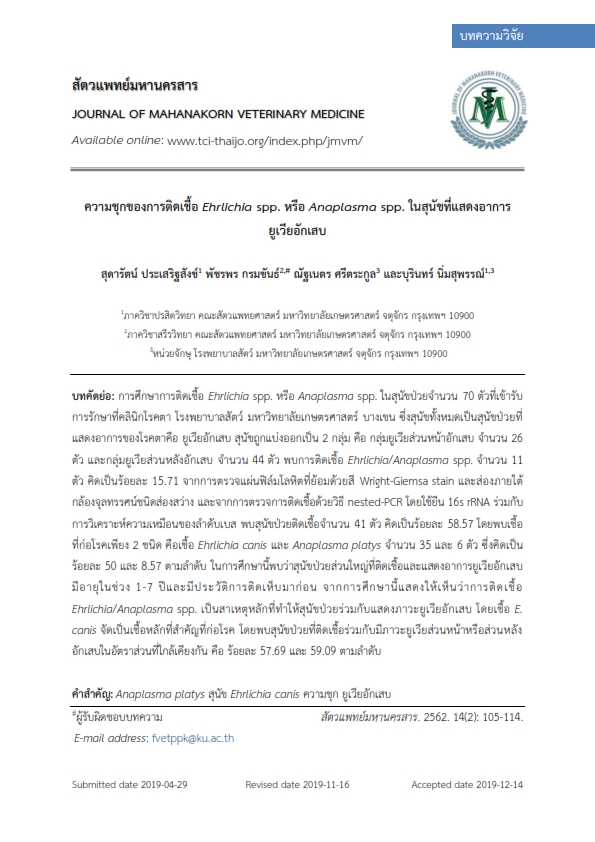
The infection of Ehrlichia spp. or Anaplasma spp. in 70 dogs brought into an Ophthalmology Clinic, Veterinary Teaching Hospital, Kasetsart University, Bangkhen were studied. All studied dogs were suspected for the infection and showed the ocular sign of uveitis. Dogs were divided into two groups, group 1: 26 dogs showed anterior uveitis and group 2: 44 dogs showed posterior uveitis. Eleven dogs (15.71%) showed positive results when the morula stage of Ehrlichia spp. or Anaplasma spp. were detected by blood smear Wright-Giemsa staining under microscopic examination. However, 41 dogs (58.57%) were found positive when detected the parasites by nested-PCR assay using 16s rRNA gene. Only Ehrlichia canis and Anaplasma platys were detected by nested-PCR and DNA sequencing in 35 (50%) and 6 (8.57) dogs, respectively. In the present study, most of Ehrlichia/Anaplasma spp.-infected dogs associated with uveitis were 1 to 7-year-old and ticks were detected between the physical examination or dogs had history of tick infestation. The results from present study, Ehrlichia/Anaplasma spp. were the main etiology of uveitis which E. canis was the important species causing uveitis in infected dogs. The infection rates of dogs associated with anterior uveitis or posterior uveitis were 57.69% and 59.09%, respectively.
Article Details
References
Bakken, J. S., and J. S. Dumler. 2000. Human granulocytic ehrlichiosis. Clin. Infect. Dis. 31: 554-560.
Buller, R. S., M. Arens, S. P. Hmiel, C. D. Paddock, J. W. Sumner, Y. Rikhisa, A. Unver, M. Gaudreault-Keener, F. A. Manian, A. M. Liddell, N. Schmulewitz, and G. A. Storch. 1999. Ehrlichia ewingii, a newly recognized agent of human ehrlichiosis. N. Engl. J. Med. 341: 148-155.
Donatien A, A. Lestoquard. 1935. Existence en Algerie d’une rikettsia du chien. Bull. Soc. Pathol. Exot. 28: 418-419.
Dumler, J. S., A. F. Barbet, C. P. J. Bekker, G. A. Dasch, G. H. Palmer, S. C. Ray, Y. Rikihisa, and F. R. Rurangirwa. 2001. Reorganization of genera in the Families Rickettsiaceae and Anaplasmataceae in the order Rickettsiales; unification of some species of Ehrlichia with Anaplama, Cowdria with Ehrlichia, and Ehrlichia with Neorickettsia; description of six new species combinations; and designation of Ehrlichia equi and “ HGE agent” as subjective synonyms of Ehrlichia phagocytophilum. Int. J. Syst. Evol. Microbiol. 51: 2145-2165.
Dumler, J. S. 2005. Anaplasma and Ehrlichia infection. Ann. N. Y. Acad. Sci. 1063: 361-373.
Ewing, S. A. 1963. Observations on leukocytic inclusion bodies from dogs infected with Babesia canis. J. Am. Vet. Med. Assoc. 143: 503-506.
Glaze, M. B., and S. D. Gaunt. 1986. Uveitis associated with Ehrlichia platys infection in dog. J. Am. Vet. Med. Assoc. 188: 916-917.
Groves, M. G., G. L. Dennis, H. L. Amyx, and D. L. Huxsoll. 1975. Transmission of Ehrlichia canis to dogs by ticks (Rhipicephalus sanguineus). Am. J. Vet. Res. 36: 937-940.
Guedes, P. E. B., T. N. de A. Oliveira, F. S. Carvalho, R. S. A. Carlos, G. R. Albuquerque, A. D. Munhoz, A. A. Wenceslau, and F. L. Silva. 2015. Canine ehrlichiosis: prevalence and epidemiology in northeast Brazil. Braz. J. Vet. Parasitol. 24: 115-121.
Harrus, S., T. Waner, H. Bark, F. Jongejan, and A. Cornelissen. 1999. Recent advances in determining the pathogenesis of canine monocyticehrlichiosis. J. Clin. Microbiol. 37: 2745-2749.
Jittapalapong, S., and S. Tipsawake. 1991. Survey of blood protozoa and blood parasites of pet dogs in Samut-Prakan Province. Kasetsart J. (Natural Science). 25: 75-82.
Konto, M., S. M. Tukur, M. Watanabe, P. A. M Abd-Rani, R. S. K. Sharma, L. S. Fong, and M. Watanabe. 2017. Molecular and serological prevalence of Anaplasma and Ehrlichia sp. among stray dogs in East Malaysia. Trop. Biomed. 34: 570-575.
Laummaunwai, P., P. Sriraj, R. Aukkanimart, T. Boonmars, S. Boonjaraspinyo, S. Sangmaneedet, P. Potchimplee, P. Khianman, and W. Maleewong. 2014. Molecular detection and treatment of tick-borne pathogens in domestic dogs in Khon Kaen, northeastern Thailand. Southeast Asian J. Trop. Med. Public Health. 45:1157- 1166.
Lauzi, S., J. P. Maia, S. Epis, R. Marcos, C. Pereira, C. Luzzago, M. Santos, P. Puente-Payo, A. Giordano, M. Pajoro, G. Sironi, and A. Faustino. 2016. Molecular detection of Anaplasma platys, Ehrlichia canis, Hepatozoon canis and Rickettsia monacensis in dogs from Maio Island of Cape Verde Archipelago. Ticks Tick Borne. Dis. 7: 964-969.
Leiva, M., C. Naranjo, and M. T. Peña. 2005. Ocular signs of canine monocytic ehrlichiosis: A retrospective study in dogs from Barcelona Spain. Vet. Ophthalmol. 8: 387-393.
Paulino, P. G., M. S. Pires, C. B. da Silva, M. Peckle, R. L. da Costa, G. V. Vitari, J. A. R. Vilela, A. P. M. de Abreu, C. L. Massard, and H. A. Santos. 2018. Epidemiology of Ehrlichia canis in healthy dogs from the Southeastern region of the state of Rio de Janeiro, Brazil Prev. Vet. Med.159: 135-142.
Pérez-Macchi, S., R. Pedrozo, P. Bittencourt, and A. Müllera. 2019. Prevalence, molecularcharacterization and risk factor analysis of Ehrlichia canis and Anaplasma platys in domestic dogs from Paraguay. Comp. Immunol. Microbiol. Infect. Dis. 62: 31-39.
Pinyoowong, D., S. Jittapalapong, F. Suksawat, R. W. Stich, and A. Thamchiapenat. 2008. Molecular characterization of Thai Ehrlichia canis and Anaplasma platys strains detected in dogs. Infectใ Genet. Evol. 8: 433-438.
Saeng-Chuto, K., A. Thayananuphat, N. Sritrakoon, and B. Nimsuphan. 2016. Thrombocytopenia and anemia related to retinal detachment in dogs infected with Ehrlichia canis and Anaplasma platys. Trop. Biomed. 33: 519-525.
Sambrook, J., and D. W. Russell. 2001. Molecular cloning. In: A laboratory manual. 3rd ed. Cold Spring Harbour Laboratory Press, New York.
Sangmaneedat, S., P. Kanbutra, and S. Viriyametharoj. 2002. Prevalence of blood parasites in dogs examined at the KKU-Veterinary Teaching Hospital during 1994-2001. KKU. Vet. J. 12: 1-7. (in Thai)
Suksawat, J., Y. Xuejie, S. I. Hancock, B. C. Hegarty, P. Nilkumhang, and E. B. Breitschwerdt. 2001. Serologic and molecular evidence of co-infection with multiple vector-borne pathogens in dog from Thailand. J. Vet. Intern. Med. 15: 453-462.
