
The Study of Physical, Chemical Properties, and Apparent Metabolizable Energy of Glycerol in Broiler
Article Sidebar
Main Article Content
Abstract
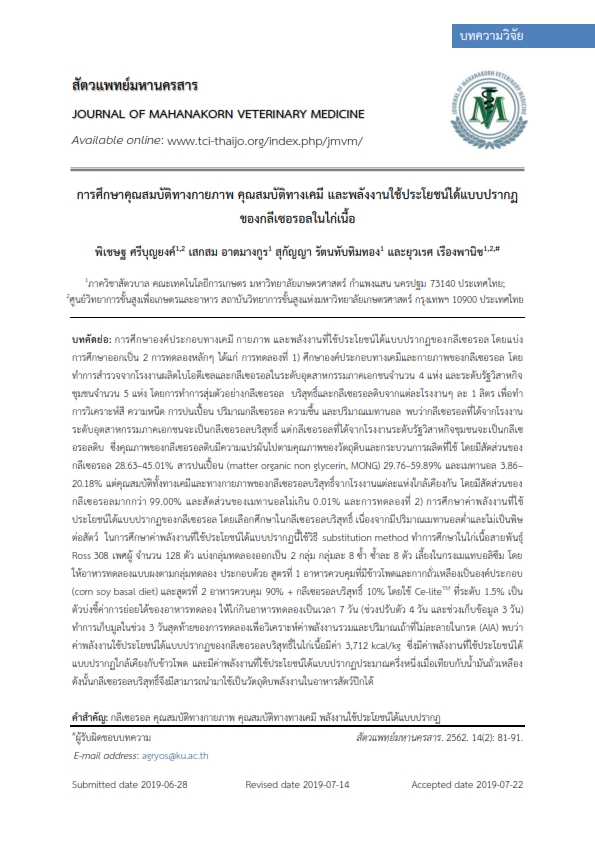
The study of physical properties, chemical elements, and apparent metabolizable energy (AME) of glycerol was conducted in two experiments. Experiment 1 was a survey of physical properties and chemical content of glycerol produced by 4 industrial and 5 community biodiesel factories operating in Thailand. Representative samples of refined and crude glycerol (1 liter) from each factory was collected and evaluated for color, viscosity, impurity, glycerol content, moisture content, and methanol content. Representative samples of crude glycerol from community biodiesel factories contain highly variable glycerol content (28.63 – 45.01%) and methanol content (3.86 – 20.18%), depending on the quality of raw materials and efficacy of methanol recovery. Glycerol content in crude glycerol is relatively low because of high contamination with matter organic non-glycerin (29.76 – 59.89%) and methanol content (3.86 – 20.18%). Representative samples of refined glycerol from the four industrial factories were consistent in terms of glycerol (>99%) and methanol content (< 0.01%). Experiment 2 measured the AME of refined glycerol for broiler chickens. The AME of a representative sample of refined glycerol was determined by using a substitution method. A total of 128 male Ross308 broilers 15 days old were assigned to two dietary treatments: (1) corn-soy basal diet and (2) 90% corn-soy basal diet plus 10% refined glycerol. CeliteTM at a level of 1.5% was added to both diets as an indigestible marker. Experimental diets were offered to the birds for a total of 7 days. Excreta were collected for 3 consecutive days to evaluate the AME. The result show that the AME of refined glycerol for broiler chicken was 3,712 kcal/kg, which is similar to that of corn and approximately half of the AME for soybean oil. Therefore, refined glycerol can be used as an energy source in broiler chicken diets.
Article Details
References
Atadashi, I. M., M. K. Aroua, and A. Abdul. 2010. High quality biodiesel and its diesel engine application: A review. Adv. Mater. Res-Switz. Reviews. 14(7): 1999-2008.
Bartelt, J. and D. Schneider. 2002. Investigation on the energy value of glycerol in the feeding of poultry and pig. Pages 15-36 in Union for the Promotion of Oilseeds-Schriften Heft 17. Union Zur Forderung Von Oel-Und Proteinplafalzen E. V., Berlin, Germany.
Bolin, D. W., R. P. King, and E. W. Klosterman. 1952. A simplified method for the determination of chromic oxide (Cr2O3) when used as an index substance. Science. 116: 634-635.
Brisson, D., M. C. Vohl, J. St. Pierre, T. J. Hudson, and D. Gaudet. 2001. Glycerol: a neglected variable in metabolic processes. Bioessays. 23: 534–542.
Cerrate, S., F. Yan, Z. Wang, C. Coto, P. Sacakli and P. W. Waldroup. 2006. Evaluating of glycerine from biodiesel production a feed ingredient for broilers. Int. J. of Poult. Sci. 11: 1001-1007.
Dozier III, W. A., B. J. Kerr, A. Corzo, M. T. Kidd, T. E. Weber, and K. Bregendahl. 2008. Apparent metabolizable chickens. Poult. Sci. 87: 317-322.
Gomes, M. C. S., N. C. Pereira, and S. T. D. Barros. 2010. Separation of biodiesel and glycerol using ceramic membranes. J. Membrane Sci. 352: 271–276.
Helwani, M. R., N. Othman, W. J. N. Aziz, and J. K. Fernando. 2009. Technologies for production of biodiesel focusing on green catalytic techniques: A review. Fuel Process. Technol. 90: 1502–1514.
Hill, F. W., D. L. Anderson, R. R. Renner, and L. B. Jr. Carew. 1960. Studies of the metabolizable energy of grain and grain products for chickens. Poult. Sci. 40:573-579.
Kijora, C., H. Bergner, R. D. Kupsch, and L. Hagemann. 1995. Glycerol as a feed component in diets of fattening pigs. Arch. Anim. Nutr. 47: 345–360.
Lammers, P. J., B. J. Kerr, M. S. Honeyman, K. Stalder, W. A. Dozier III, T. E. Weber, M. T. Kidd. and K. Bregendahl. 2008. Nitrogen-Corrected Apparent Metabolizable Energy Value of Crude Glycerol for Laying Hens. Poult. Sci., 87: 104–107
Lehninger, A. L., D. L. Nelson, and M. M. Cox. 1993. Principles of Biochemistry. 2nd ed. New York: Worth Publisher. 1012 p.
Lin, E. C. C. 1977. Glycerol utilization and its regulation in mammals. Annu. Rev. Biochem. 46: 765–795.
Nalle, C. L., V. Ravindran, and G. Ravindran. 2011. Nutritional value of peas (Pisum sativum L.) for broilers: apparent metabolizable energy, apparent ileal amino acid digestibility and production performance. Anim. Prod. Sci. 51: 150-155.
Németh, K., E. Zsédly, and J. Schmidt. 2013. Nitrogen-corrected apparent metabolizable energy value of crude glycerol for laying hens. Ann. Anim. Sci. 13(4): 829–836
Ondul, E and N. Dizge. 2014. Glycerol: a major by-product in the biodiesel manufacturing process. Journal of The Institute of Natural & Applied Sciences. 19(1-2): 75-79.
Silva, C. L. S., J. F. M. Menten, A. B. Traldi, R. PeREira, K. C. Zavarize, and J. Santarosa. 2012. Glycerine derived from biodiesel production as a feedstuff for broiler diets. Rev. Bras. Cienc. Avic. 14(3): 193-202.
Simon, A., H. Bergener, and M. Schwabe. 1996. Glycerol feed ingredient for broiler chickens. Arch. Anim. Nutr. 49: 103–112.
Sungwaraporn, Y. 2004. Lipid and protein quality of poultry by-products preserved by phosphoric acid stabilization. Ph.D. Thesis. North Carolina State University. North Carolina, USA.
