
ประสิทธิภาพของน้ำมันหอมระเหยพลูต่อเชื้อยีสต์มาลาสซีเซีย พาไคเดอมาติส ที่คัดแยกจากรอยโรคผิวหนังอักเสบของสุนัข
Article Sidebar
Main Article Content
บทคัดย่อ
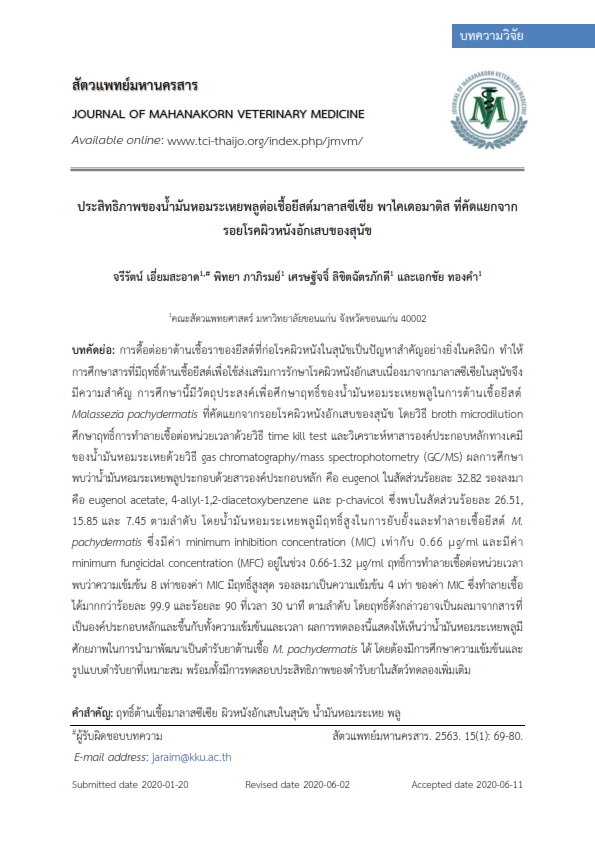
การดื้อต่อยาต้านเชื้อราของยีสต์ที่ก่อโรคผิวหนังในสุนัขเป็นปัญหาสำคัญอย่างยิ่งในคลินิก ทำให้การศึกษาสารที่มีฤทธิ์ต้านเชื้อยีสต์เพื่อใช้ส่งเสริมการรักษาโรคผิวหนังอักเสบเนื่องมาจากมาลาสซีเซียในสุนัขจึงมีความสำคัญ การศึกษานี้มีวัตถุประสงค์เพื่อศึกษาฤทธิ์ของน้ำมันหอมระเหยพลูในการต้านเชื้อยีสต์ Malassezia pachydermatis ที่คัดแยกจากรอยโรคผิวหนังอักเสบของสุนัข โดยวิธี broth microdilution ศึกษาฤทธิ์การทำลายเชื้อต่อหน่วยเวลาด้วยวิธี time kill test และวิเคราะห์หาสารองค์ประกอบหลักทางเคมีของน้ำมันหอมระเหยด้วยวิธี gas chromatography/mass spectrophotometry (GC/MS) ผลการศึกษาพบว่าน้ำมันหอมระเหยพลูประกอบด้วยสารองค์ประกอบหลัก คือ eugenol ในสัดส่วนร้อยละ 32.82 รองลงมา คือ eugenol acetate, 4-allyl-1,2-diacetoxybenzene และ p-chavicol ซึ่งพบในสัดส่วนร้อยละ 26.51, 15.85 และ 7.45 ตามลำดับ โดยน้ำมันหอมระเหยพลูมีฤทธิ์สูงในการยับยั้งและทำลายเชื้อยีสต์ M. pachydermatis ซึ่งมีค่า minimum inhibition concentration (MIC) เท่ากับ 0.66 µg/ml และมีค่า minimum fungicidal concentration (MFC) อยู่ในช่วง 0.66-1.32 µg/ml ฤทธิ์การทำลายเชื้อต่อหน่วยเวลาพบว่าความเข้มข้น 8 เท่าของค่า MIC มีฤทธิ์สูงสุด รองลงมาเป็นความเข้มข้น 4 เท่า ของค่า MIC ซึ่งทำลายเชื้อได้มากกว่าร้อยละ 99.9 และร้อยละ 90 ที่เวลา 30 นาที ตามลำดับ โดยฤทธิ์ดังกล่าวอาจเป็นผลมาจากสารที่เป็นองค์ประกอบหลักและขึ้นกับทั้งความเข้มข้นและเวลา ผลการทดลองนี้แสดงให้เห็นว่าน้ำมันหอมระเหยพลูมีศักยภาพในการนำมาพัฒนาเป็นตำรับยาต้านเชื้อ M. pachydermatis ได้ โดยต้องมีการศึกษาความเข้มข้นและรูปแบบตำรับยาที่เหมาะสม พร้อมทั้งมีการทดสอบประสิทธิภาพของตำรับยาในสัตว์ทดลองเพิ่มเติม
Article Details
เอกสารอ้างอิง
Adorjan, B., and G. Buchbauer. 2010. Biological properties of essential oils: an updated review. Flavour. Fragr. J. 25(6): 407-426.
Aiemsaard, J., and K. Punareewattana. 2017. Antifungal activities of essential oils of Syzygium aromaticum, Piper betle, and Ocimum sanctum against clinical isolates of canine dermatophytes. ScienceAsia. 43(4): 223-228.
Aiemsaard, J., S. Aiumlamai, S. Taweechaisupapong, C. Aromdee, and W. Khunkitti. 2010. Chemical composition, antioxidant activity and antibacterial action of eight essential oils against clinical isolates of mastitis pathogens. Int. J. Essent. Oil. Ther. 4: 37-43.
Ali, B., N. A. Al-Wabel, S. Shams, A. Ahamad, S. A. Khan, and F. Anwar. 2015. Essential oils used in aromatherapy: A systemic review. Asian. Pac. J. Trop. Biomed. 5(8): 601-611.
Ali, I., F. G. Khan, K. A. Suri, B. D. Gupta, N. K. Satti, P. Dutt, et al. 2010. In vitro antifungal activity of hydroxychavicol isolated from Piper betle L. Ann. Clin. Microbiol. Antimicrob. 9: 7.
Ali, I., N. K. Satti, P. Dutt, and R. Prasad. 2016. Hydroxychavicol: A phytochemical targeting cutaneous fungal infections. Sci. Rep. 6: 37867.
Amelia, B., E. Saepudin, A. H. Cahyana, D. U. Rahayu, A. S. Sulistyoningrum, and J. Haib. 2017. GC-MS analysis of clove (Syzygium aromaticum) bud essential oil from Java and Manado. AIP. Conf. Proc. 1862: 030082.
Asawapattanakul, T, W. Khunkitti, R. Leesing, and J. Aiemsaard. 2013. The efficacy of essential oils against Malassezia pachydermatis isolated from canine otitis externa. Isan. J. Pharm. Sci. 9: 40-51.
Cafarchia, C., S. Gallo, G. Capelli, and D. Otranto. 2005. Occurrence and population size of Malassezia spp. in the external ear canal of dogs and cats both healthy and with otitis. Mycopathologia. 160(2): 143-149.
Crespo, M. J., M. L. Abarca, and F. J. Cabanes. 2002. Occurrence of Malassezia spp. in the external ear canals of dogs and cats with and without otitis externa. Med. Mycol. 40(2): 115-121.
da Silva Nascente, P., A. R. M. Meinerz, R. O. de Faria, L. F. D. Schuch, M. C. A. Meireles, and J. R. B. de Mello. 2009. CLSI broth microdilution method for testing susceptibility of Malassezia pachydermatis to thiabendazole. Brazilian. J. Microbiol. 40: 222-226.
Dagli, N., R. Dagli, R. S. Mahmoud, and K. Baroudi. 2015. Essential oils, their therapeutic properties, and implication in dentistry: A review. J. Int. Soc. Prevent. Communit. Dent. 5(5): 335-340.
Department of medical sciences. 2014. Standard Method for Food Analysis Volume 2; DMSc F 2009 Analytical method of yeasts and molds in food by pour plate and spread plate. National Office of Buddhism publishing. Bangkok. 211 p.
Ernst, E. J., D. J. Keele, M. E. Klepser, C. R. Petzold, and E. E. Roling. 2002. In vitro activity of micafungin (FK-463) against Candida spp.: microdilution, time-Kill, and post antifungal-effect studies. Antimicrob. Agents. Chemother. 46(12): 3846-3853.
Fan, Y. M., W. M. Huang, S. F. Li, G. F. Wu, K. Lai, and R. Y. Chen. 2006. Granulomatous skin infection caused by Malassezia pachydermatis in a dog owner. Arch. Dermatol. 142(9): 1181-1184.
Kaypetch, R., and S. Thaweboon. 2018. Antifungal property of Piper betle leaf oil against oral Candida species. MATEC. Web. Conf. 242: 01021.
Kumar, A., K. Singh, and A. Sharma. 2002. Prevalence of Malassezia pachydermatis and other organisms in healthy and infected dogs ears. Isr. Vet. Med. Assoc. 57(4): 145–148.
Mamilla, R., C. Raja, V. Srinivasan, S. Selvaraj, and S. K. Mahapatra. 2015. Versatile and synergistic potential of eugenol: A review. Pharmaceutica. Analytica. Acta. 6(5): 1000367.
Markey, B. K., F. C. Leonard, M. Archambault, A. Cullinane, and D. Maguire, editor. 2013. Clinical veterinary microbiology. 2nd ed. Elsevier, Missouri.
Mohottalage, S., R. Tabacchi, and P. M. Guerin. 2007. Components from Sri Lankan Piper betle L. leaf oil and their analogues showing toxicity against the housefly, Musca domestica. Flavour Fragr. J. 22(2): 130-138.
Nakano, Y., M. Wada, H. Tani, K. Sasai, and E. Baba. 2005. Effects of beta-thujaplicin on anti-Malassezia pachydermatis remedy for canine otitis externa. J. Vet. Med. Sci. 67(12): 1243-1247.
Nguyen, T. N. T., T. N. N. Huynh, V. T. Tran, C. H. Dang, T. K. D. Hoang, and T. D. Nguyen. 2018. Physicochemical characterization and bioactivity evaluation of essential oils from Citrus microcarpa Bunge leaf and flower. J. Essent. Oil. Res. 30(4): 285-292.
Nijima, M., R. Kano, M. Nagata, A. Hasegawa, and H. Kamata. 2011. An azole-resistant isolate of Malassezia pachydermatis. Vet. Microbiol. 149(1-2): 288-290.
Park, M. J., K. S. Gwak, I. Yang, W. S. Choi, H. J. Jo, J. W. Chang, et al. 2007. Antifungal activities of the essential oils in Syzygium aromaticum (L.) Merr. Et Perry and Leptospermum petersonii Bailey and their constituents against various dermatophytes. J. Microbiol. 45: 460-465.
Ravindran, P. N., and G. S. Pillai. 2004. Under-utilized herbs and spices. In: K.V. Peter, editor, Handbook of Herbs and Spices Volume 2, Woodhead Publishing, Cambridge, pp 52-607. 68-102.
Row, L. M., and J. Ho. 2009. The antimicrobial activity, mosquito larvicidal activity, antioxidant property and tyrosinase inhibition of Piper betle. J. Chin. Chem. Soc. 56(3): 653-658.
Sugumaran, M., M. Suresh Gandhi, K. Sankarnarayanan, M. Yokesh, M. Poornima, and R. Sreerama. 2011. Chemical composition and antimicrobial activity of vellaikodi variety of Piper betle Linn leaf oil against dental pathogens. Int. J. PharmTech. Res. 3(4): 2135-2139.
Thosar, N., S. Basak, R. N. Bahadure, and M. Rajurkar. 2013. Antimicrobial efficacy of five essential oils against oral pathogens: An in vitro study. Eur. J. Dent. 7(1): S071-S077.
Usman, M. S., M. E. E. Zowalaty, K. Shameli, N. Zainuddin, M. Salama, and N. A. Ibrahim. 2013. Synthesis, characterization, and antimicrobial properties of copper nanoparticles. Int. J. Nanomed. 8: 4467-4479.
Wiebe, V. J., editor. 2015. Drug therapy for infectious diseases of the dog and cat. John Wiley & Sons, Iowa.
Yurayart, C., A. Chindemporn, S. Suradhat, P. Tummaruk, S. Kajiwara, and N. Prapasarakul. 2011. Comparative analysis of the frequency, distribution and population sizes of yeasts associated with canine seborrheic dermatitis and healthy skin. Vet. Microbiol. 148(2-4): 356-362.
