
การเปรียบเทียบประสิทธิภาพในการฆ่าเชื้อแบคทีเรียของคลอรีนที่ความเข้มข้นแตกต่างกันในน้ำทะเลสำหรับการเลี้ยงปลากะพงขาว (Lates calcarifer)
Article Sidebar
Main Article Content
บทคัดย่อ
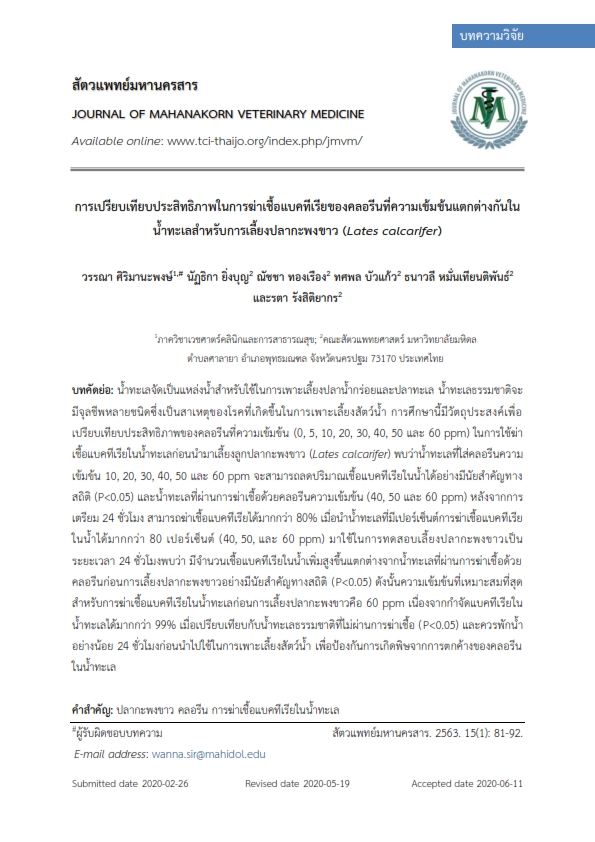
น้ำทะเลจัดเป็นแหล่งน้ำสำหรับใช้ในการเพาะเลี้ยงปลาน้ำกร่อยและปลาทะเล น้ำทะเลธรรมชาติจะมีจุลชีพหลายชนิดซึ่งเป็นสาเหตุของโรคที่เกิดขึ้นในการเพาะเลี้ยงสัตว์น้ำ การศึกษานี้มีวัตถุประสงค์เพื่อเปรียบเทียบประสิทธิภาพของคลอรีนที่ความเข้มข้น (0, 5, 10, 20, 30, 40, 50 และ 60 ppm) ในการใช้ฆ่าเชื้อแบคทีเรียในน้ำทะเลก่อนนำมาเลี้ยงลูกปลากะพงขาว (Lates calcarifer) พบว่าน้ำทะเลที่ใส่คลอรีนความเข้มข้น 10, 20, 30, 40, 50 และ 60 ppm จะสามารถลดปริมาณเชื้อแบคทีเรียในน้ำได้อย่างมีนัยสำคัญทางสถิติ (P<0.05) และน้ำทะเลที่ผ่านการฆ่าเชื้อด้วยคลอรีนความเข้มข้น (40, 50 และ 60 ppm) หลังจากการเตรียม 24 ชั่วโมง สามารถฆ่าเชื้อแบคทีเรียได้มากกว่า 80% เมื่อนำน้ำทะเลที่มีเปอร์เซ็นต์การฆ่าเชื้อแบคทีเรียในน้ำได้มากกว่า 80 เปอร์เซ็นต์ (40, 50, และ 60 ppm) มาใช้ในการทดสอบเลี้ยงปลากะพงขาวเป็นระยะเวลา 24 ชั่วโมงพบว่า มีจำนวนเชื้อแบคทีเรียในน้ำเพิ่มสูงขึ้นแตกต่างจากน้ำทะเลที่ผ่านการฆ่าเชื้อด้วยคลอรีนก่อนการเลี้ยงปลากะพงขาวอย่างมีนัยสำคัญทางสถิติ (P<0.05) ดังนั้นความเข้มข้นที่เหมาะสมที่สุดสำหรับการฆ่าเชื้อแบคทีเรียในน้ำทะเลก่อนการเลี้ยงปลากะพงขาวคือ 60 ppm เนื่องจากกำจัดแบคทีเรียในน้ำทะเลได้มากกว่า 99% เมื่อเปรียบเทียบกับน้ำทะเลธรรมชาติที่ไม่ผ่านการฆ่าเชื้อ (P<0.05) และควรพักน้ำอย่างน้อย 24 ชั่วโมงก่อนนำไปใช้ในการเพาะเลี้ยงสัตว์น้ำ เพื่อป้องกันการเกิดพิษจากการตกค้างของคลอรีนในน้ำทะเล
Article Details
เอกสารอ้างอิง
Arimoto, M., J. Sato, K. Maruyama, G. Mimura, and I. Furusawa. 1996. Effect of chemical and physical treatments on the inactivation of striped jack nervous necrosis virus (SJNNV). Aquaculture. 143(1): 15-22.
Austin, B. 1988. Marine microbiology. Cambridge university press: New York, USA. p. 1-8.
Benarde, M. A., W. B. Snow, V. P. Olivieri, and B. Davidson. 1967. Kinetics and mechanism of bacterial disinfection by chlorine dioxide. Appl. Environ. Microbiol. 15(2): 257-265.
Boyette, M. D., D. F. Ritchie, S. J. Carballo, S. M. Blankenship, and D. C. Sanders. 1993. Chlorination and postharvest disease control. Horttechnology. 3(4): 395-400.
Bullock, G. L., S. T. Summerfelt, A. C. Noble, A. L. Weber, M. D. Durant, and J. A. Hankins. 1997. Ozonation of a recirculating rainbow trout culture system I. Effects on bacterial gill disease and heterotrophic bacteria. Aquaculture. 158(1-2): 43-55.
Chang, P. S., L. J. Chen, and Y. C. Wang. 1998. The effect of ultraviolet irradiation, heat, pH, ozone, salinity and chemical disinfectants on the infectivity of white spot syndrome baculovirus. Aquaculture. 166(1-2): 1-17.
Egidius, E. 1987. Vibriosis: pathogenicity and pathology, A review. Aquaculture. 67: 15-28.
Frerichs, G., A. Tweedie, W. Starkey, and R. Richards. 2000. Temperature, pH and electrolyte sensitivity, and heat, UV and disinfectant inactivation of sea bass (Dicentrarchus labrax) neuropathy nodavirus. Aquaculture. 185(1-2): 13-24.
Huang, J., L. Wang, N. Ren, and F. Ma. 1997. Disinfection effect of chlorine dioxide on bacteria in water. Water Res. 31(3): 607-613.
Kungvankij, P., L. B. Tiro Jr, B. J. Pudadera Jr, and I. O. Potestas. 1986. Biology and culture of sea bass (Lates calcarifer). Network of Aquaculture Centers in Asia. Seafdec. p. 12-15.
Lafferty, K. D., C. D. Harvell, J. M. Conrad, C. S. Friedman, M. L. Kent, A. M. Kuris, E. N. Powell, D. Rondeau, and S. M. Saksida. 2015. Infectious diseases affect marine fisheries and aquaculture economics. Annu. Rev. Mar. Sci. 7: 471-496.
Liltved, H., and S. Cripps. 1999. Removal of particle-associated bacteria by prefiltration and ultraviolet irradiation. Aquac Res. 30(6): 445-450.
Liltved, H., H. Hektoen, and H. Efraimsen. 1995. Inactivation of bacterial and viral fish pathogens by ozonation or UV irradiation in water of different salinity. Aquacult. Eng. 14(2): 107-122.
Martinez-Picado, J., M. Alsina, A. R. Blanch, M. Cerda, and J. Jofre. 1996. Species-specific detection of Vibrio anguillarum in marine aquaculture environments by selective culture and DNA Hybridization. Appl. Environ. Microbiol. 62(2): 443-449.
Petrucci, G., and M. Rosellini. 2005. Chlorine dioxide in seawater for fouling control and post-disinfection in potable waterworks. Desalination. 182(1-3): 283-291.
Puente, M. E., F. Vega-Villasante, G. Holguin, and Y. Bashan. 1992. Susceptibility of the brine shrimp Artemia and its pathogen Vibrio parahaemolyticus to chlorine dioxide in contaminated sea-water. J. Appl. Bacteriol. 73(6): 465-471.
Reilly, A., and F. Käferstein. 1997. Food safety hazards and the application of the principles of the hazard analysis and critical control point (HACCP) system for their control in aquaculture production. Aquac. Res. 28(10): 735-752.
Sudthongkong, C., M. Miyata, and T. Miyazaki. 2002. Iridovirus disease in two ornamental tropical fresh-water fishes: African lampeye and dwarf gourami. Dis. Aquat. Organ. 48(3): 163-173.
Suttle, C. A. 2007. Marine viruses-major players in the global ecosystem. Nat. Rev. Microbiol. 5(10): 801-812.
Whipple, M., and J. Rohovec. 1994. The effect of heat and low pH on selected viral and bacterial fish pathogens. Aquaculture. 123(3-4): 179-189.
Yanong, R. P., and C. Erlacher-Reid. 2012. Biosecurity in aquaculture, part 1: an overview. SRAC Publication No 4707. Stoneville (MS): Southern Regional Aquaculture Center. http://fisheries.tamu.edu/files/2013/09/SRAC-Publication-No.-4707-Biosecurity-in-Aquaculture-Part-1-An-Overview.pdf (Accessed 1 January 2020)
