ผลของสารสกัดหยาบจากสมุนไพรไทยในการยับยั้งการเจริญของเชื้อรา Dermatophyte DT01 ที่แยกได้จากไก่ชน
Article Sidebar
Main Article Content
บทคัดย่อ
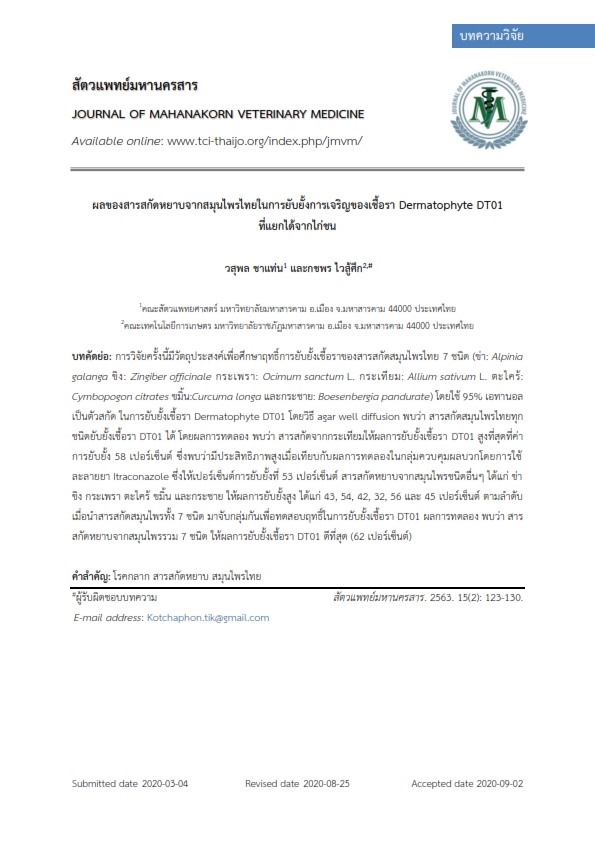
การวิจัยครั้งนี้มีวัตถุประสงค์เพื่อศึกษาฤทธิ์การยับยั้งเชื้อราของสารสกัดสมุนไพรไทย 7 ชนิด (ข่า: Alpinia galanga ขิง: Zingiber officinale กระเพรา: Ocimum sanctum L. กระเทียม: Allium sativum L. ตะไคร้: Cymbopogon citrates ขมิ้น:Curcuma longa และกระชาย: Boesenbergia pandurate) โดยใช้ 95% เอทานอลเป็นตัวสกัด ในการยับยั้งเชื้อรา Dermatophyte DT01 โดยวิธี agar well diffusion พบว่า สารสกัดสมุนไพรไทยทุกชนิดยับยั้งเชื้อรา DT01 ได้ โดยผลการทดลอง พบว่า สารสกัดจากกระเทียมให้ผลการยับยั้งเชื้อรา DT01 สูงที่สุดที่ค่าการยับยั้ง 58 เปอร์เซ็นต์ ซึ่งพบว่ามีประสิทธิภาพสูงเมื่อเทียบกับผลการทดลองในกลุ่มควบคุมผลบวกโดยการใช้ละลายยา Itraconazole ซึ่งให้เปอร์เซ็นต์การยับยั้งที่ 53 เปอร์เซ็นต์ สารสกัดหยาบจากสมุนไพรชนิดอื่นๆ ได้แก่ ข่า ขิง กระเพรา ตะไคร้ ขมิ้น และกระชาย ให้ผลการยับยั้งสูง ได้แก่ 43, 54, 42, 32, 56 และ 45 เปอร์เซ็นต์ ตามลำดับ เมื่อนำสารสกัดสมุนไพรทั้ง 7 ชนิด มาจับกลุ่มกันเพื่อทดสอบฤทธิ์ในการยับยั้งเชื้อรา DT01 ผลการทดลอง พบว่า สารสกัดหยาบจากสมุนไพรรวม 7 ชนิด ให้ผลการยับยั้งเชื้อรา DT01 ดีที่สุด (62 เปอร์เซ็นต์)
Article Details
เอกสารอ้างอิง
Chermette, R., L. Ferreiro, and J. Guillot. 2008. Dermatophytoses in animals. Mycopathologia. 166: 385-405.
Havlickova, B., V. A. Czaika, and M. Friedrich. 2008. Epidemiological trends in skin mycoses worldwide. Mycoses. 51(4): 2–15.
Ibrahim, J., M. S. Mohd Yassin, C. B. Chin, L. L. Chen, and N. L. Sim. 2003. Antifungal activity of the essential oils of nine Zingiberaceace species. Pharm. Biol. 41(5); 392-397.
Ilkit, M. 2010. Favus of the scalp: an overview and update. Mycopathologia. 170: 143-154.
Kelly, B. P. 2012. Superficial fungal infections. Pediatr Rev. 33(4): 22-37.
Khosravi, A. R. and M. Mahmoudi. 2003. Dermatophytes isolated from domestic animals in Iran. Mycoses. 46: 222-225.
Meenakshi, S. and S. Richa. 2011. Synergistic Antifungal Activity of Curcuma longa (Turmeric) and Zingiber officinale (Ginger) Essential Oils Against Dermatophyte Infections. J. Essent. Oil-Bear. Plants. 14(1): 38-47.
Murata, M., H. Takahashi, S. Takahashi, Y. Takahashi, H. Chibana, Y. Murata, K. Sugiyama, T. Kaneshima, S. Yamaguchi, H. Miyasato, M. Murakami, R. Kano, A. Hasegawa, H. Uezato, A. Hosokawa, and A. Sano. 2013. Isolation of Microsporum gallinae from a fighting cock (Gallus gallus domesticus) in Japan. Med Mycol. 51(2): 144-149.
O'Gara, E. A., D. J. Hill, and D. J. Maslin. 2000. Activities of garlic oil, garlic powder and their diallyl constituents against Helicobacter pylori. Applied Environ. Microbiol. 66: 2269-2273.
Phitak, T., K. Choocheep, P. Pothacharoen, W. Pompimon, B. Premanode and P. Kongtawelert. 2009. The effects of phydroxycinnamaldehyde from Alpinia galanga extracts on human chondrocytes. Phytochemistry. 70: 237-243.
Siripongvutikorn, S., P. Thummaratwasik, and Y. W. Huang. 2005. Antimicrobial and antioxidation effects of Thaiseasoning, Tom-Yum. LWT-FOOD SCI TECHNOL. 38(4): 347-352.
Vena, G. A., P. Chieco, F. Posa, A. Garofalo, A. Bosco and N. Cassano. 2012. Epidemiology of dermatophytoses : retrospective analysis from 2005 to 2010 and comparison with previous data from 1975. New Microbiol. 35(2): 207–213.
Zafar, K. K. and K. Ratna. 2000 Potent Antifungal Activity of Garlic (Allium Sativum) Against Experimental Murine Disseminated Cryptococcosis. Pharm. Biol. 38(2): 87-100.
