
เทคนิคทางโปรติโอมิกส์ในการระบุการแสดงออกของโปรตีนของ Proteobacteria ในน้ำเลือดปูทะเล (Scylla serrata Forsskal, 1775) ที่เป็นโรคท้องแดง
Article Sidebar
Main Article Content
บทคัดย่อ
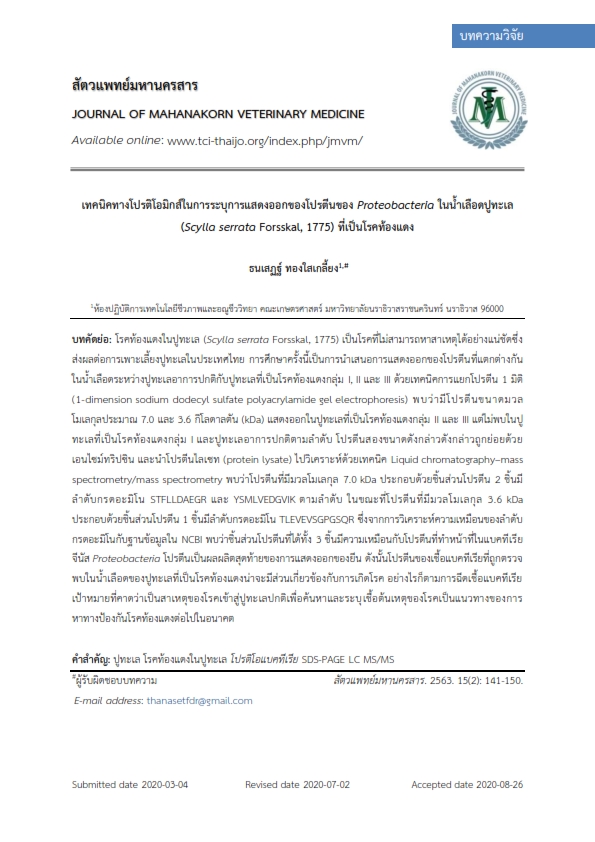
โรคท้องแดงในปูทะเล (Scylla serrata Forsskal, 1775) เป็นโรคที่ไม่สามารถหาสาเหตุได้อย่างแน่ชัดซึ่งส่งผลต่อการเพาะเลี้ยงปูทะเลในประเทศไทย การศึกษาครั้งนี้เป็นการนำเสนอการแสดงออกของโปรตีนที่แตกต่างกันในน้ำเลือดระหว่างปูทะเลอาการปกติกับปูทะเลที่เป็นโรคท้องแดงกลุ่ม I, II และ III ด้วยเทคนิคการแยกโปรตีน 1 มิติ (1-dimension sodium dodecyl sulfate polyacrylamide gel electrophoresis) พบว่ามีโปรตีนขนาดมวลโมเลกุลประมาณ 7.0 และ 3.6 กิโลดาลตัน (kDa) แสดงออกในปูทะเลที่เป็นโรคท้องแดงกลุ่ม II และ III แต่ไม่พบในปูทะเลที่เป็นโรคท้องแดงกลุ่ม I และปูทะเลอาการปกติตามลำดับ โปรตีนสองขนาดดังกล่าวดังกล่าวถูกย่อยด้วยเอนไซม์ทริปซิน และนำโปรตีนไลเซท (protein lysate) ไปวิเคราะห์ด้วยเทคนิค Liquid chromatography–mass spectrometry/mass spectrometry พบว่าโปรตีนที่มีมวลโมเลกุล 7.0 kDa ประกอบด้วยชิ้นส่วนโปรตีน 2 ชิ้นมีลำดับกรดอะมิโน STFLLDAEGR และ YSMLVEDGVIK ตามลำดับ ในขณะที่โปรตีนที่มีมวลโมเลกุล 3.6 kDa ประกอบด้วยชิ้นส่วนโปรตีน 1 ชิ้นมีลำดับกรดอะมิโน TLEVEVSGPGSQR ซึ่งจากการวิเคราะห์ความเหมือนของลำดับกรดอะมิโนกับฐานข้อมูลใน NCBI พบว่าชิ้นส่วนโปรตีนที่ได้ทั้ง 3 ชิ้นมีความเหมือนกับโปรตีนที่ทำหน้าที่ในแบคทีเรียจีนัส Proteobacteria โปรตีนเป็นผลผลิตสุดท้ายของการแสดงออกของยีน ดังนั้นโปรตีนของเชื้อแบคทีเรียที่ถูกตรวจพบในน้ำเลือดของปูทะเลที่เป็นโรคท้องแดงน่าจะมีส่วนเกี่ยวข้องกับการเกิดโรค อย่างไรก็ตามการฉีดเชื้อแบคทีเรียเป้าหมายที่คาดว่าเป็นสาเหตุของโรคเข้าสู่ปูทะเลปกติเพื่อค้นหาและระบุเชื้อต้นเหตุของโรคเป็นแนวทางของการหาทางป้องกันโรคท้องแดงต่อไปในอนาคต
Article Details
เอกสารอ้างอิง
Areekijseree, M., T. Chuen-Im, and B. Panyarachun. 2010. Characterization of red sternum syndrome in mud crab farms from Thailand. Biologia. 65(1): 150-156.
Boettcher, K. J., K. K. Geaghan, A. P. Maloy, and B. J. Barber. 2005. Roseovarius crassostreae sp. nov., a member of the Roseobacter clade and the apparent cause of juvenile oyster disease (JOD) in cultured Eastern oysters. Int. J. Syst. Evol. Microbiol. 55: 1531–1537.
Bradford, M. M. 1967. A rapid and sensitive method for the quantitation of microgram quantities of protein utilizing the principle of protein-dye binding. Anal. Biochem. 72: 248-254.
Eddy, F., A. Powell, S. Gregory, L. M. Nunan, D. V. Lightner, P. J. Dyson, A. F. Rowley, and R. J. Shields. 2007. A novel bacterial disease of the European shore crab, Carcinus maenas–molecular pathology and epidemiology. Microbiology. 153: 2839-2849.
Fu, L., T. Gao, H. Jiang, F. Qiang, Y. Zhang, and J. Pan. 2019. Staphylococcus aureus causes hepatopancreas browned disease and hepatopancreatic necrosis complications in Chinese mitten crab, Eriocheir sinensis. Aquac. Int. 27: 1301–1314.
Getchell, R. G. 1989. Bacterial shell disease in crustaceans: a review. J. Shellfish Res. 8: 1-6.
Laemmli, U.K. 1970. Cleavage of structural proteins during the larvae of the head of bacteriophage T. Nature. 227: 680-685.
Maloy, A. P., S. E. Ford, R. C. Karney, and K. J. Boettcher. 2007. Roseovarius crassostreae, the etiological agent of Juvenile Oyster Disease (now to be known as Roseovarius Oyster Disease) in Crassostrea virginica. Aquaculture. 269: 71–83.
Meyers, T.R., T.M. Koeneman, C. Botelho, and S. Short. 1987. Bitter crab disease: a fetal dinoflagellate infection and marketing problem for Alaska tanner crabs Chionoecetes bairdi. Dis. Aquat.Organ. 3: 195-126.
Rameshthangam, P. and P. Ramasamy. 2005. Protein expression in white spot syndrome virus infected Penaeus monodon fabricius. Virus Res. 110(1–2): 133-141.
Salaenoi, J., A. Sangcharoen, A. Thongpan, and M. Mingmuang. 2006. Morphology and Haemolymph composition changes in red sternum mud crab (Scylla serrata). Kasetsart J. (Nat. Sci.). 40: 158-166.
Shields, J. D. and C. M. Squyars. 2000. Mortality and hematology of blue crabs, Callinectes sapidus, experimentally infected with the parasitic dinoflagellate Hematodinium perezi. Fish. Bull. 98: 139-152.
Stentiford, G. D., M. Green, K. Baterman, H. J. Small, D. M. Nail, and S. W. Feist. 2002. Infection by a Hematodinium-like parasitic dinoflagellate causes Pink Crab Disease (PCD) in the edible crab Cancer pagurus. J. Invertebr. Pathol. 37: 201-209.
Stewart, J. E. 1993. Infectious disease of marine crustaceans, pp. 319-342. In J. A. Couch and J. W. Fournie, eds. Pathobiology of Marine and Estuarine Organism. CRC Press, Boca Raton, Florida.
Tongsaikling, T., J. Salaenoi, and M. Mingkwan. 2013. Ca2+ATPase, carbonic anhydrase and alkaline phosphatase activities in red sternum mud crabs (Scylla serrata). Kasetsart J. (Nat. Sci.). 47: 252–260.
Wang, H. C., H. C. Wang, G. H. Kou, C. F. Lo, and W. P. Huang. 2007. Identification of icp11, the most highly expressed gene of shrimp white spot syndrome virus (WSSV). Dis. Aquat. Organ. 74: 179–189.
