
A การศึกษาระดับความชุกทางซีรัมของโรคไข้หวัดใหญ่ชนิด เอ ของสัตว์ตระกูลม้าในเขตพื้นที่จังหวัดเชียงใหม่และจังหวัดกาญจนบุรี -
Article Sidebar
Main Article Content
บทคัดย่อ
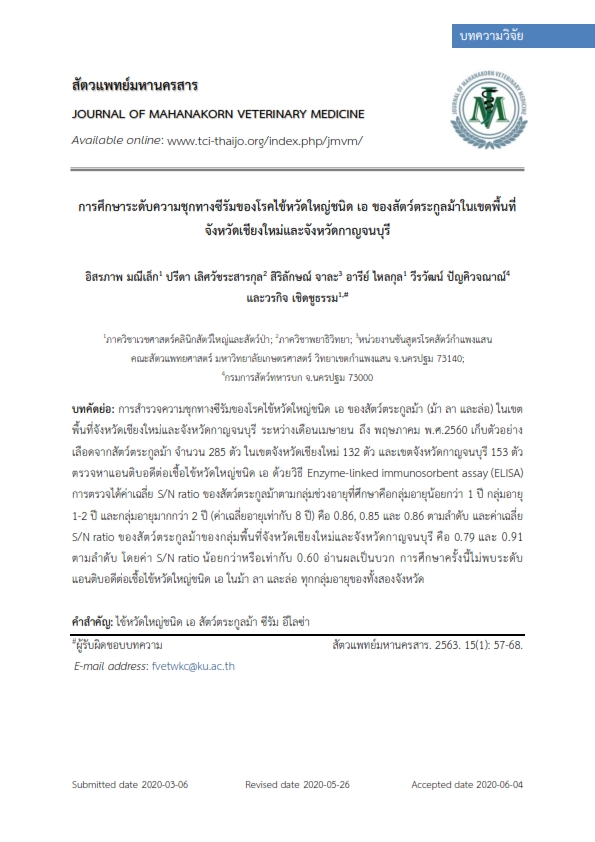
การสำรวจความชุกทางซีรัมของโรคไข้หวัดใหญ่ชนิด เอ ของสัตว์ตระกูลม้า (ม้า ลา และล่อ) ในเขตพื้นที่จังหวัดเชียงใหม่และจังหวัดกาญจนบุรี ระหว่างเดือนเมษายน ถึง พฤษภาคม พ.ศ.2560 เก็บตัวอย่างเลือดจากสัตว์ตระกูลม้า จำนวน 285 ตัว ในเขตจังหวัดเชียงใหม่ 132 ตัว และเขตจังหวัดกาญจนบุรี 153 ตัว ตรวจหาแอนติบอดีต่อเชื้อไข้หวัดใหญ่ชนิด เอ ด้วยวิธี Enzyme-linked immunosorbent assay (ELISA) การตรวจได้ค่าเฉลี่ย S/N ratio ของสัตว์ตระกูลม้าตามกลุ่มช่วงอายุที่ศึกษาคือกลุ่มอายุน้อยกว่า 1 ปี กลุ่มอายุ 1-2 ปี และกลุ่มอายุมากกว่า 2 ปี (ค่าเฉลี่ยอายุเท่ากับ 8 ปี) คือ 0.86, 0.85 และ 0.86 ตามลำดับ และค่าเฉลี่ย S/N ratio ของสัตว์ตระกูลม้าของกลุ่มพื้นที่จังหวัดเชียงใหม่และจังหวัดกาญจนบุรี คือ 0.79 และ 0.91 ตามลำดับ โดยค่า S/N ratio น้อยกว่าหรือเท่ากับ 0.60 อ่านผลเป็นบวก การศึกษาครั้งนี้ไม่พบระดับแอนติบอดีต่อเชื้อไข้หวัดใหญ่ชนิด เอ ในม้า ลา และล่อ ทุกกลุ่มอายุของทั้งสองจังหวัด
Article Details
เอกสารอ้างอิง
Abdel-Moniem, A., A. E. Abdel-Ghany, and S. A. Shany. 2010. Isolation and characterization of highly pathogenic avian influenza virus subtype H5N1 from donkeys. J. Biomed. Sci. 17: 25.
Anon. 2008. Summary of the Australian equine influenza outbreak. Vet. Rec. 163: 378.
Barquero, N., J. M. Daly, and J. R. Newton, 2007. Risk factors for influenza infection in vaccinated racehorses: lessons from an outbreak in Newmarket, UK in 2003. Vaccine. 25: 7520–7529.
Centers for Disease Control and Prevention (CDC). 2017. (cited 1 April 2017). Influenza Type A Virus. Available from: https://www.cdc.gov/flu/avianflu/influenza-a-virus-subtypes.htm.
Chang, H., F. Dai, Z. Liu, F. Yuan, S. Zhao, X. Xiang, F. Zou, B. Zeng, Y. T. Fan, and G. Duan. 2014. Seroprevalence survey of avian influenza A (H5) in wild migratory birds in Yunnan Province, Southwestern China. Virol. J. 11:18.
Chenchev, Iv., N. Rusenova, and N. Sandev. 2011. Seroepidemiological studies of donkeys’blood for detection of some virus infections on ungulates. Trakia J. Sci. 9(2): 82-86.
Crawford, P. C., E. J. Dubovi, W. L. Castleman, I. Stephenson, E. P. Gibbs, L. Chen, C. Smith, R. C. Hill, P. Ferro, J. Pompey, R. A. Bright, M. J. Medina, C. M. Johnson, C. W. Olsen, N. J. Cox, A. I. Klimov, J. M. Katz, and R. O. Donis. 2005. Transmission of equine influenza virus to dogs. Science. 310: 482.
Cullinane, A., D. Elton, and J. Mumford. 2010. Equine influenza – surveillance and control. Influenza and other Respiratory Viruses, Blackwell, UK, 339-344.
Ducatez, M. F., R. G. Webster, and R. J. Webby. 2008. Animal influenza epidemiology. Vaccine. 12 (Suppl. 26): D67-D69.
Fouchier, R. A. M., A. D. M. E Osterhaus, and I. H. Brown. 2003. Animal influenza virus surveillance. Vaccine. 21:1754-1757.
Galvin, P., S. Gildea, S. Arkins, C. Walsh, and A. Cullinane. 2013. The evaluation of a nucleoprotein ELISA for the detection of equine influenza antibodies and the differentiation of infected from vaccinated horses (DIVA). Influenza Other Respir. Viruses. 7 (Suppl. 4): 73-80.
Gildea, S., S. Arkins, and A. Cullinane. 2011. Management and environmental factors involved in equine influenza outbreaks in Ireland 2007-2010. Equine Vet. J. 43(5): 608-617.
Gildea, S., D. A. Fitzpatrick, and A. Cullinane. 2013. Epidemiological and virological investigations of equine influenza outbreaks in Ireland (2010-2012). Influenza Other Respir. Viruses (Suppl. 4): 61-72.
Happold, J. and R. Rubira. 2011. Equine influenza: patterns of disease and seroprevalence in Thoroughbred studs and implications for vaccination. Aust. Vet. J. 89 (Suppl. 1): 135-137.
Hemida, M. G., R. A. P. M. Perera, D. K. W Chu, A. A. Alnaeem, and M. Peiris. 2019. Evidence of equine influenza A (H3N8) activity in horses from Eastern and Central Saudi Arabia: 2013-2015. Equine Vet. J. 51: 218-221.
Jang, H., Y. K. Jackson, J. B. Daniels, A. Ali, K. Kang, M. Elaish, and C-W. Lee. 2017. Seroprevalence of three influenza A viruses (H1N1, H3N2, and H3N8) in pet dogs presented to a veterinary hospital in Ohio. J. Vet. Sci. 18(S1): 291-298.
Major, D. A. and B. Jones. 2011. Behaviour of equine influenza virus in a naïve population: a practitioner’s perspective. Aust. Vet. J. 89(Suppl. 1): 13-14.
Mavadiya, S. V., S. K. Raval, S. A. Mehta, A. N. Kanani, A. A. Vagh, P. H. Tank, and P. R. Patel. 2012. Epidemiology survey of equine influenza in horses in India. Rev. sci. tech. Off. int. EpiZ. 31(3): 871-875.
Meseko, C. A., D. O. Ehizibolo, E. C. Nwokike, and Y. S. Wungak. 2016. Serological evidence of equine influenza virus in horse stables in Kaduna, Nigeria. J. Equine Sci. 27(3): 99-105.
Morley, P. S., H. G. Townsend, J. R. Bogdan, and D. M. Haines. 2000. Risk factors for disease associated with influenza virus infections during three epidemics in horses. J. Am. Vet. Med. Assoc. 216: 545-550.
Neuman, G. and Y. Kawaoka. 2015. Transmission of influenza A viruses. Virology 479-480: 234-246.
Office International des Epizooties (OIE). 2016 (cited 1 January 2016) Equine influenza Malaysia. Available from: http://www.oie.int/wahis_2/public/wahid.php/Reviewreport/Review?reportid=19160.
Pusterla, N., P. H. Kass, S. Mapes, C. Wademan, N. Akana, C. Barnett, C. MacKenzie, and W. Vaala. 2015. Voluntary Surveillance Program for Equine Influenza Virus in the United States from 2010 to 2013. J. Vet. Intern. Med. 29: 417–422.
Songserm, T., A. Amonsin, R. Jam-on, N. Sae-Heng, N. Meemak, N. Pariyothorn, S. Yayungporn, A. Theamboonlers, and Y. Poo-vorawan. 2006. Avian influenza H5N1 naturally infected domestic cat. Emerg. Infect. Dis. 12: 681-683.
Stephen, C. 2002. Isolation of influenza A virus from a 7-day-old foal with bronchointerstitial pneumonia. Can. Vet. J. 43: 55-56.
Suzuki, Y., T. Ito, T. Suzuki, R. E. Jr. Holland, T. M. Chambers, M. Kiso, H. Ishida, and Y. Kawkoka. 2000. Sialic acid species as a determinant of the host range of influenza A viruses. J. Virol. 74: 11825-11831.
Virmani, N., B. K. Singh, B. R. Gulati, and S. Kumar. 2010. Equine influenza outbreak in India (2008-09): Virus isolation, sero-epidemiology and phylogenetic analysis of HA gene. Vet. Microbiol. 143: 224-237.
Vitoonpong, R. K., C. Sirivan, and R. D. Punyahotra. 2006. Serological study of equine influenza in Thailand. J.Thai Vet. Med. Assoc. 57: 59-67. (in Thai)
Wang, X., S. Liu, H. Mao, Z. Yu, E. Chen, and C. Chai. 2015. Surveillance of avian H7N9 in various environments of Zhejiang Province, China before and after live poultry markets were closed in 2013-2014. PloS ONE 10(8): e0135718.
Weese, J. S. 2014. Infection control and biosecurity in equine disease control. Equine Vet. J. 46: 654-660.
Wegdan, H. A., K. S. Intisar, M. M. Shaza, O. A. Algezoli, A. Ballal, H. A. Ihsan, M. E. Sahar, A. M. Baraa, K. M. Taha, E. M. Nada, Y. M. Nouri, and Y. H. Ali. 2016. Investigation on influenza virus A infection I different animals in Sudan. Sudan J. Sci. Tech. 17(2): 57-64.
Yadav, M. P., P. K. Uppal, and J. A. Mumford. 1993. Physico-chemical and biological characterization of A / Equi-2 virus isolated from 1987 equine influenza epidemic in India. Int. J. Anim. Sci. 8: 93-98.
