
การศึกษาค่าโลหิตวิทยาของไก่เนื้อที่เลี้ยงในเชิงพาณิชย์สายพันธุ์ Cobb 500 Ross 308 และ Arbor Acres Plus
Article Sidebar
Main Article Content
บทคัดย่อ
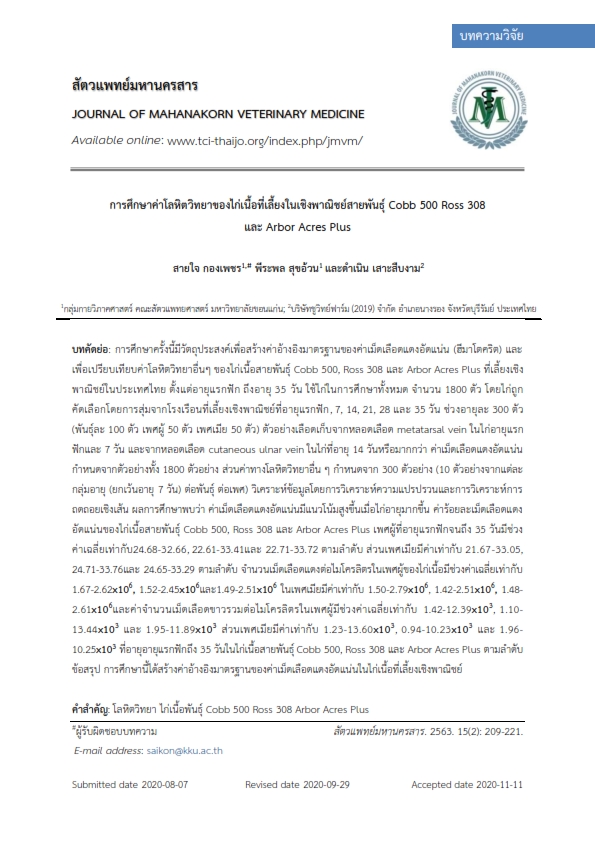
การศึกษาครั้งนี้มีวัตถุประสงค์เพื่อสร้างค่าอ้างอิงมาตรฐานของค่าเม็ดเลือดแดงอัดแน่น (ฮีมาโตคริต) และเพื่อเปรียบเทียบค่าโลหิตวิทยาอื่นๆ ของไก่เนื้อสายพันธุ์ Cobb 500, Ross 308 และ Arbor Acres Plus ที่เลี้ยงเชิงพาณิชย์ในประเทศไทย ตั้งแต่อายุแรกฟัก ถึงอายุ 35 วัน ใช้ไก่ในการศึกษาทั้งหมด จำนวน 1800 ตัว โดยไก่ถูกคัดเลือกโดยการสุ่มจากโรงเรือนที่เลี้ยงเชิงพาณิชย์ที่อายุแรกฟัก, 7, 14, 21, 28 และ 35 วัน ช่วงอายุละ 300 ตัว (พันธุ์ละ 100 ตัว เพศผู้ 50 ตัว เพศเมีย 50 ตัว) ตัวอย่างเลือดเก็บจากหลอดเลือด metatarsal vein ในไก่อายุแรกฟักและ 7 วัน และจากหลอดเลือด cutaneous ulnar vein ในไก่ที่อายุ 14 วันหรือมากกว่า ค่าเม็ดเลือดแดงอัดแน่นกำหนดจากตัวอย่างทั้ง 1800 ตัวอย่าง ส่วนค่าทางโลหิตวิทยาอื่น ๆ กำหนดจาก 300 ตัวอย่าง (10 ตัวอย่างจากแต่ละกลุ่มอายุ (ยกเว้นอายุ 7 วัน) ต่อพันธุ์ ต่อเพศ) วิเคราะห์ข้อมูลโดยการวิเคราะห์ความแปรปรวนและการวิเคราะห์การถดถอยเชิงเส้น ผลการศึกษาพบว่า ค่าเม็ดเลือดแดงอัดแน่นมีแนวโน้มสูงขึ้นเมื่อไก่อายุมากขึ้น ค่าร้อยละเม็ดเลือดแดงอัดแน่นของไก่เนื้อสายพันธุ์ Cobb 500, Ross 308 และ Arbor Acres Plus เพศผู้ที่อายุแรกฟักจนถึง 35 วันมีช่วงค่าเฉลี่ยเท่ากับ24.68-32.66, 22.61-33.41และ 22.71-33.72 ตามลำดับ ส่วนเพศเมียมีค่าเท่ากับ 21.67-33.05, 24.71-33.76และ 24.65-33.29 ตามลำดับ จำนวนเม็ดเลือดแดงต่อไมโครลิตรในเพศผู้ของไก่เนื้อมีช่วงค่าเฉลี่ยเท่ากับ 1.67-2.62x10⁶, 1.52-2.45x10⁶และ1.49-2.51x10⁶ในเพศเมียมีค่าเท่ากับ 1.50-2.79x10⁶, 1.42-2.51x10⁶, 1.48-2.61x10⁶และค่าจำนวนเม็ดเลือดขาวรวมต่อไมโครลิตรในเพศผู้มีช่วงค่าเฉลี่ยเท่ากับ 1.42-12.39x10³, 1.10-13.44x10³ และ 1.95-11.89x10³ส่วนเพศเมียมีค่าเท่ากับ 1.23-13.60x10³, 0.94-10.23x10³และ 1.96-10.25x10³ ที่อายุอายุแรกฟักถึง 35 วันในไก่เนื้อสายพันธุ์ Cobb 500, Ross 308 และ Arbor Acres Plus ตามลำดับ ข้อสรุป การศึกษานี้ได้สร้างค่าอ้างอิงมาตรฐานของค่าเม็ดเลือดแดงอัดแน่นในไก่เนื้อที่เลี้ยงเชิงพาณิชย์
Article Details
เอกสารอ้างอิง
Abdulazeez, H., S. B. Adamu, J. U. Igwebuike, G. I. Gwayo, A. I., and Muhammad. 2016. Haematology and Serum Biochemistry of Broiler Chickens Fed Graded Levels of Baobab (Adansonia digitata L.) Seed Meal. J. Agri. Vet. Sci. 9(10): 48-53.
Al-Daraji, H. J. and A. M. Salih. 2012. The Influence of Dietary Arginine Supplementation on Blood Traits of Broiler Chickens. Pak. J. Nutr. 11(3): 258-264.
Al-Mansour, S., A. Al-Khalf, I. Al-Homidan, and M. M. Fathi. 2011. Feed Efficiency and Blood Hematology of Broiler Chicks Given a Diet Supplemented with Yeast Culture. Inter. J. Poult. Sci. 10 (8): 603-607.
Ala Al Deen, H. J. 2007. Some Haematological and Biochemical Effect of Garlic on Broiler Chickens. Bas. J. Vet. Res. 6(2): 56-63.
Al-Nedawi, D. A., 2018. Reference hematology for commercial Ross 308 broilers. Onl. J. Vet. Res. 22(7): 566-570.
Ashayerizadeh, A., N. Dabiri, O. Ashayerizadeh, K. H. Mirzadeh, H. Roshanfekr, and M. Mamooee. 2009. Effect of dietary antibiotic, probiotic and prebiotic as growth promoters, on growth performance, carcass characteristics and hematological indices of broiler chickens. Pak. J. Biol. Sci. 12(1): 52-57.
Begum, M., M. M. Hossain, and I. H. Kim. 2014. Effects of the plant extract YGF251 on growth performance, meat quality, relative organ weight, nutrient digestibility and blood profiles in broiler chickens: Possible role of insulin-like growth factor 1. Veterinární Medicína 59(9): 415-423.
Berwanger, E., S. L. Vieira, C. R. Angel, L. Kindlein, A. N. Mayer, M. A. Ebbing, and M. Lopes. 2018. Copper requirements of broiler breeder hens. Poult. Sci. 97(8): 2785-2797.
Borges, S. A., A. Silva, A. Majorka, D. Hooge, and K. Cummings. 2004. Physiological responses of broiler chickens to heat stress and dietary electrolyte balance (Sodium plus potassium minus chloride, milliequivalents per kilogram). Poult. Sci. 83(9): 1551-1558.
Cömert, M., Y. Şayan, F. Kırkpınar, Ö. H. Bayraktar, and S. Mert. 2016. Comparison of Carcass Characteristics, Meat Quality, and Blood Parameters of Slow and Fast Grown Female Broiler Chickens Raised in Organic or Conventional Production System. Asian- Australas. J. Anim. Sci. 29(7): 987-997.
Druyan, S., D. Shinder, A. Shlosberg, A. Cahaner, and S. Yahav. 2009. Physiological parameters in broiler lines divergently selected for the incidence of ascites. Poult. Sci. 88(9): 1984-1990.
Duwa, H., B. Saleh, M. Lamido, and A. Saidu. 2014. Growth, Haematological and Serum Biochemical Indices of Broiler Chickens Fed Banana Peel Meal as Replacement for Maize in the Semi-Arid Zone of Nigeria. J. Anim. Feed Res. 4(5): 121-126.
Egbunike, G. N., E. A. Agiang, A. O. Owosibo, and A. A. Fatufe. 2009. Effect of Protein on Performance and Haematology of Broilers Fed Cassava Peel-Based Diet. Arch. Zootec. 58 (224): 655-662.
Elaroussi, M. A., F. R. Mohamed, E. M. El Barkouky, A. M. Atta, A. M., Abdou, and H. M., Hatab. 2006. Experimental ochratoxicosis in broiler chickens. Avian Pathol. 35(4): 263-269.
Graczyk, S., J. Kuryszko, and J. Madej. 2003. Reactivity of Spleen Germinal Centres in Immunized and ACTH-treated Chickens. Acta. Vet. Brno. 72(4): 523–531.
Kim, M. J., R. Parvin, M. M. Mushtaq, J. Hwangbo, J. H. Kim, J. C. Na, D. W. Kim, H. K. Kang, C. D. Kim, K. O. Cho, C. B. Yang, and H. C. Choi. 2013. Growth performance and hematological traits of broiler chickens reared under assorted monochromatic light sources. Poult. Sci. 92(6): 1461-1466.
Owosibo, A. O., O. M. Odetola, O. O. Odunsi, O. O., Adejinmi, and O. O. Lawrence-Azua. 2013. Growth,haematology and serum biochemistry of broilers fed probiotics based diets. Afr. J. Agric. Res. 8(41): 5076-5081.
Peebles, E. D., R. W. Keirs, L. W. Bennett, T. S. Cummings, S. K. Whitmarsh, and P. D> Gerard. 2004. Relationships among Post-Hatch Physiological Parameters in Broiler Chicks Hatched from Young Breeder Hens and Subjected to Delayed Brooding Placement. Int. J. Poult. Sci. 3(9): 371-376.
Şekeroğlu, A., M. Sarica, M. Sukru Gulay, and M. Duman. 2011. Effect of Stocking Density on Chick Performance, Internal Organ Weights and Blood Parameters in Broilers. J. Anim. Vet. Adv. 10(2): 246-250.
Stefaniak, T., J. P. Madej, S. Graczyk, M. Siwek, E. Łukaszewicz, A. Kowalczyk, M. Sieńczyk, and M. Bednarczyk. 2019. Selected prebiotics and synbiotics administered in ovo can modify innate immunity in chicken broilers. BMC Vet. Res. 15(105): 1-9.
Tehrani, A., J. Javanbakht, S. Askari, M. A. Hassan, A. Solati, S. Golami, and H. Akbari, H., 2012. Haematological Studies on Broiler Chickens Fed with Different Levels of Artemia Urmiana. J. Biotechnol. Biomater. 2(4): 1-6.
