
ความชุกและการดื้อต่อยาปฏิชีวนะของเชื้อ Salmonella spp. ที่แยกได้จากสิ่งแวดล้อมและสัตว์ปศุสัตว์ ณ ชุมชนแห่งหนึ่งในอำเภอศรีราชา จ.ชลบุรี
Article Sidebar
Main Article Content
บทคัดย่อ
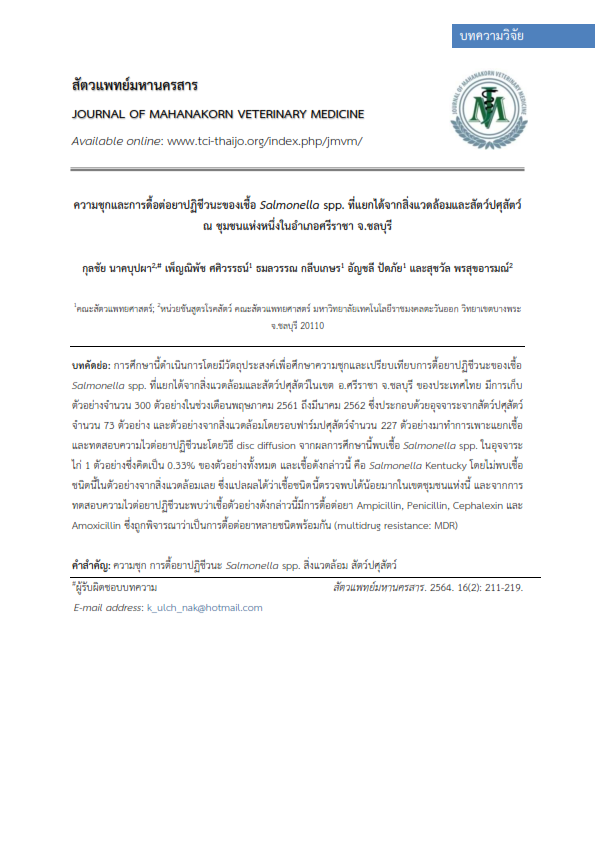
การศึกษานี้ดำเนินการโดยมีวัตถุประสงค์เพื่อศึกษาความชุกและเปรียบเทียบการดื้อยาปฏิชีวนะของเชื้อ Salmonella spp. ที่แยกได้จากสิ่งแวดล้อมและสัตว์ปศุสัตว์ในเขต อ.ศรีราชา จ.ชลบุรี ของประเทศไทย มีการเก็บตัวอย่างจำนวน 300 ตัวอย่างในช่วงเดือนพฤษภาคม 2561 ถึงมีนาคม 2562 ซึ่งประกอบด้วยอุจจาระจากสัตว์ปศุสัตว์จำนวน 73 ตัวอย่าง และตัวอย่างจากสิ่งแวดล้อมโดยรอบฟาร์มปศุสัตว์จำนวน 227 ตัวอย่างมาทำการเพาะแยกเชื้อ และทดสอบความไวต่อยาปฏิชีวนะโดยวิธี disc diffusion จากผลการศึกษานี้พบเชื้อ Salmonella spp. ในอุจจาระไก่ 1 ตัวอย่างซึ่งคิดเป็น 0.33% ของตัวอย่างทั้งหมด และเชื้อดังกล่าวนี้ คือ Salmonella Kentucky โดยไม่พบเชื้อชนิดนี้ในตัวอย่างจากสิ่งแวดล้อมเลย ซึ่งแปลผลได้ว่าเชื้อชนิดนี้ตรวจพบได้น้อยมากในเขตชุมชนแห่งนี้ และจากการทดสอบความไวต่อยาปฏิชีวนะพบว่าเชื้อตัวอย่างดังกล่าวนี้มีการดื้อต่อยา Ampicillin, Penicillin, Cephalexin และ Amoxicillin ซึ่งถูกพิจารณาว่าเป็นการดื้อต่อยาหลายชนิดพร้อมกัน (multidrug resistance: MDR)
Article Details

อนุญาตภายใต้เงื่อนไข Creative Commons Attribution-NonCommercial-NoDerivatives 4.0 International License.
เอกสารอ้างอิง
Christie, B. M. 2020. Biosecurity (Salmonella Enteritidis) Control Order 2019. Department of Planing, Industry and Environment, Biosecurity & Food Safety New South Wales. 2-4 pp.
Clinical and Laboratory Standards Institute. 2012. Performance standards for antimicrobial susceptibility testing; twenty-second informational supplement. CLSI Document M100-S22. 32(3). Wayne, PA. 44-49 pp.
Feder, I., Nietfeld, J. C., Galland, J., Yeary, T., Sargeant, J. M., Oberst, R., Tamplin, M. L., and Luchansky, J. B. 2001. Comparison of Cultivation and PCR-Hybridization for Detection of Salmonella in Porcine Fecal and Water Samples. J. Clin. Microb. 39(7): 2477-2484.
Finn, S., Condell, O., McClure, P., Amezquita, A., and Fanning, S. 2013. Mechanisms of survival, responses, and sources of Salmonella in low-moisture environments. Frontiers Microb. 4(331): 1, 2, 8.
Fuche, F. J., Sow, O., Simon, R., Tennant, S. M. 2016. Salmonella Serogroup C: Current Status of Vaccines and Why They Are Needed. Cli. Vac. Immun. 23(9): 737, 739.
Kumpapong, K., Sintuya, D., Awaiwanont, N., Nuanualsuwan, S., Yamsakul, P., Tadee, P., and Patchanee, P. 2013. Concern Relation of Salmonella Contamination Isolated from Human, Animal, and Environment in Swine Farm. Chiang Mai Vet. J. 11(1): 21-29. (in Thai)
Lim, S-K., Byun, J-R., Nam, H-M., Lee, H-S., and Jung, S-C. 2010. Phenotypic and Genotypic Characterization of Salmonella spp. Isolated from Pigs and their Farm Environment in Korea. J. Microb. Biotech. 21(1): 50-51.
Magiorakos, A. P., Srinivasan, A., Carey, R. B., et al. 2012. Multidrug-resistant, extensively drug-resistant and pandrug-resistant bacteria: an international expert proposal for interim standard definitions for acquired resistance. Clin. Microb. Infect. 18: 268-270.
Majowicz, S .E., Musto, J., Scallan, E., et al. 2010. The global burden of nontyphoidal Salmonella gastroenteritis. Clin. Infect. Diseases. 50: 882-887.
Mikoleit, M. L. 2014. Laboratory Protocol: Biochemical Identification of Salmonella and Shigella Using an Abbreviated Panel of Tests. WHO Global Foodborne Infections Network. World Health Organization, 4, 6, 7, 9, 10, 15-18.
Park, S-G., Park, S-K., Jung, J-H., et al. 2002. Antibiotic susceptibility of Salmonella spp. isolated from diarrhoea patients in Seoul from 1996 to 2001. J. Food Hyg. Safety. 17: 61-70.
Poppe, C., Martin, L. C., Gyles, C. L., et al. 2005. Acquisition of Resistance to Extended Spectrum Cephalosporins by Salmonella enterica subsp. enterica Serovar Newport and Escherichia coli in the Turkey Poult Intestinal Tract. Appl. Envi. Microb. 71(3): 1184-1192.
Rayamajhi, N., Kang, S. G., Kang, M. L., et al. 2008. Assessment of antibiotic resistance phenotype and integrons in Salmonella enterica serovar Typhimurium isolated from swine. J. Vet. Med. Science. 70: 1133-1136.
Roberts, R. R., Hota, B., Ahmad, I. et al. 2009. Hospital and societal costs of antimicrobial-resistant infections in a Chicago teaching hospital: implications for antibiotic stewardship. Clin. Infect. Diseases. 49: 1175–1182.
Ronnqvist, M., Valttila, V., Heinola, K., Ranta, J., Niemi, J., and Tuominen, P. 2018. Risk assessment and cost-benefit analysis of Salmonella in feed and animal production. Evira Research Report 3/2018. Finnish Food Safety Authority Evira, 41-42, 63-64, 128-129.
Sayah, R. S., Kaneene, J. B., Johnson, Y., and Miller, R. 2005. Patterns of Microbial Resistance Observed in Escherichia coli Isolates Obtained from Domestic- and Wild-Animal Fecal Samples, Human Septage, and Surface Water. Appl. Envi. Microb. 71(3): 1394-1398.
Silva, M. A., Marvulo, M. F.V., Mota, R. A., and Silva, J. C. R. 2010. The role of order Ciconiiformes in the epidemiological chain of Salmonella spp. for public health and biological diversity conservation. Pesq. Vet. Brasileira. 30(7): 573–575.
Strohbehn, C. H. 2006. Salmonella: Hotel, Restaurant, and Institution Management. Iowa State University. U.S.A.
Travers, K. and Barza, M. 2002. Morbidity of infections Caused by Antimicrobial Resistant Bacteria. Clin. Infect. Diseases. 34. (Suppl.) 3: S131 - S134.
USDA Food Inspection Service. 2010. Serotypes profile of Salmonella isolates from meat and poultry products: January 1998 through December 2010. USDA. Washington, DC.
Voogt, N., Raes, M., Wannet, W. J., Henken, A. M., and van de Giessen, A. W. 2001. Comparison of selective enrichment media for the detection of Salmonella in poultry faeces. Lett. Appl. Microb. 32: 89–92.
Wattanasin, S. 2006. Food Microbiology. 2nd ed. Jamjuree Products. Bangkok. 150-154 pp. (in Thai)
Winokur, P. L., Vonstein, D. L., Hoffman, L. J., Uhlenhopp, E. K., and Doern, G. V. 2001. Evidence of transfer of CMY-2 AmpC_-lactamase plasmids between Escherichia coli and Salmonella isolates from food animals and humans. Antimic. Agen. Chemotherapy. 45: 2716–2720.
Wongkhumma, A. 2012. Gastrointestinal Communicable Diseases: Food Poisoning. In Annual epidemiological surveillance report 2012. Bureau of Epidemiology, Department of Disease Control, Ministry of Public Health. Bangkok. 119P. (in Thai)
World Health Organization. 1997. The medical impact of antimicrobial use in food animals. Report and proceedings of a WHO meeting; 1997 Oct 13–17; Berlin, Germany. Geneva: WHO. WHO document WHO/EMC/ZOO/97.4.
Yoon, K-B., Song, B-J., Shin, M-Y., et al. 2017. Antibiotic Resistance Patterns and Serotypes of Salmonella spp. Isolated at Jeollanam-do in Korea. Osong Publ. Hea. Res. Perspectives. 8(3): 211-212.
Yue, H., Zhang, B., Zhu, X., Zhang, H., Tang, C. 2014. Comparison of Culture Methods for Isolation of Salmonella in Yak Fecal Samples. Indian J. Microb. 54(2): 224-225.
