
รายงานสัตว์ป่วย: ภาวะต่อมหมวกไตชั้นนอกทำงานน้อยกว่าปกติชนิดปฐมภูมิในสุนัขพันธุ์ไทยผสม
Article Sidebar
Main Article Content
บทคัดย่อ
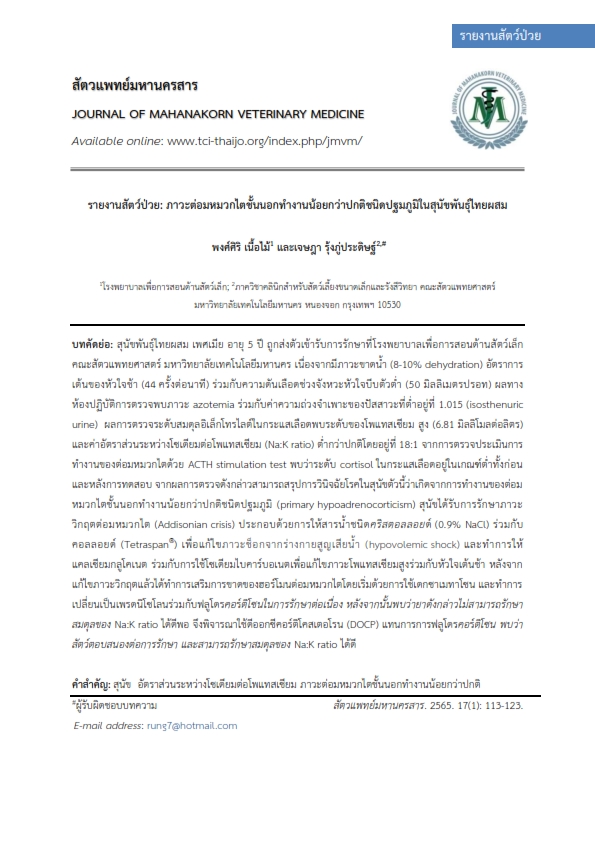
สุนัขพันธุ์ไทยผสม เพศเมีย อายุ 5 ปี ถูกส่งตัวเข้ารับการรักษาที่โรงพยาบาลเพื่อการสอนด้านสัตว์เล็ก คณะสัตวแพทยศาสตร์ มหาวิทยาลัยเทคโนโลยีมหานคร เนื่องจากมีภาวะขาดน้ำ (8-10% dehydration) อัตราการเต้นของหัวใจช้า (44 ครั้งต่อนาที) ร่วมกับความดันเลือดช่วงจังหวะหัวใจบีบตัวต่ำ (50 มิลลิเมตรปรอท) ผลทางห้องปฏิบัติการตรวจพบภาวะ azotemia ร่วมกับค่าความถ่วงจำเพาะของปัสสาวะที่ต่ำอยู่ที่ 1.015 (isosthenuric urine) ผลการตรวจระดับสมดุลอิเล็กโทรไลต์ในกระแสเลือดพบระดับของโพแทสเซียม สูง (6.81 มิลลิโมลต่อลิตร) และค่าอัตราส่วนระหว่างโซเดียมต่อโพแทสเซียม (Na:K ratio) ต่ำกว่าปกติโดยอยู่ที่ 18:1 จากการตรวจประเมินการทำงานของต่อมหมวกไตด้วย ACTH stimulation test พบว่าระดับ cortisol ในกระแสเลือดอยู่ในเกณฑ์ต่ำทั้งก่อนและหลังการทดสอบ จากผลการตรวจดังกล่าวสามารถสรุปการวินิจฉัยโรคในสุนัขตัวนี้ว่าเกิดจากการทำงานของต่อมหมวกไตชั้นนอกทำงานน้อยกว่าปกติชนิดปฐมภูมิ (primary hypoadrenocorticism) สุนัขได้รับการรักษาภาวะวิกฤตต่อมหมวกไต (Addisonian crisis) ประกอบด้วยการให้สารน้ำชนิดคริสตอลลอยด์ (0.9% NaCl) ร่วมกับคอลลอยด์ (Tetraspan®) เพื่อแก้ไขภาวะช็อกจากร่างกายสูญเสียน้ำ (hypovolemic shock) และทำการให้แคลเซียมกลูโคเนต ร่วมกับการใช้โซเดียมไบคาร์บอเนตเพื่อแก้ไขภาวะโพแทสเซียมสูงร่วมกับหัวใจเต้นช้า หลังจากแก้ไขภาวะวิกฤตแล้วได้ทำการเสริมการขาดของฮอร์โมนต่อมหมวกไตโดยเริ่มด้วยการใช้เดกซาเมทาโซน และทำการเปลี่ยนเป็นเพรดนิโซโลนร่วมกับฟลูโดรคอร์ติโซนในการรักษาต่อเนื่อง หลังจากนั้นพบว่ายาดังกล่าวไม่สามารถรักษาสมดุลของ Na:K ratio ได้ดีพอ จึงพิจารณาใช้ดีออกซีคอร์ติโคสเตอโรน (DOCP) แทนการการฟลูโดรคอร์ติโซน พบว่าสัตว์ตอบสนองต่อการรักษา และสามารถรักษาสมดุลของ Na:K ratio ได้ดี
Article Details

อนุญาตภายใต้เงื่อนไข Creative Commons Attribution-NonCommercial-NoDerivatives 4.0 International License.
เอกสารอ้างอิง
Adler, J.A., Drobatz, K.J., and Hess, R.S. 2007. Abnormalities of Serum Electrolyte Concentrations in Dogs with Hypoadrenocorticism. J. Vet. Intern. Med. 21(6): 1168–1173.
Bates, J.A., Shott, S., and Schall, W.D. 2013. Lower initial dose deoxycorticosterone pivalate for treatment of canine primary hypoadrenocorticism. Aus. Vet. J. 91(3): 77-82.
Brady, C.A., Vite, C.H., and Drobatz, K.J. 1999. Severe neurologic sequelae in a dog after treatment of hypoadrenal crisis. J. Am. Vet. Med. Assoc. 215(2): 222–225, 210.
Church, D.B. 2004. Canine hypoadrenocorticism In: Mooney, C.M. and Peterson, M.E. BSAVA manual of canine and feline endocrinology. 3rd ed. British Small Animal Veterinary Association. Quedgeley, Gloucester: 172.
Kintzer, P., and Peterson, M. 1997. Treatment and long-term follow-up of 205 dogs with hypoadrenocorticism. J. Vet. Intern. Med. 11(2): 43-49.
Klein, S.C., and Peterson, M.E. 2010. Canine hypoadrenocorticism: Part I. Can. Vet. J. 51: 63-69.
Lathan, P., and Thompson, A. 2018. Management of hypoadrenocorticism (Addison’s disease) in dogs. Vet. Med. (Auckl). 9: 1-10.
Lathan, P., and Tyler, J. 2005. Canine hypoadrenocorticism: pathogenesis and clinical features. Comp. Cont. Educ. Pract. 27(2): 110-120.
Lathan, P., Scott-Moncrieff, J.C., and Wills, R. W. 2014. Use of the Cortisol-to-ACTH Ratio for Diagnosis of Primary Hypoadrenocorticism in Dogs. J. Vet. Intern. Med. 28(5): 1546-1550.
Lennon, E.M., Boyle, T.E., and Hutchnins, R.G. 2007. Use of basal serum or plasma cortisol concentrations to rule out a diagnosis of hypoadrenocorticism in Dogs: 123 cases (2000-2005). JAVMA. 231(3): 413-416.
McCabe, M.D., Feldman, E.C., Lynn, R.C., and Kass, P.H. 1995. Subcutaneous administration of deoxycorticosterone pivalate for treatment of canine hypoadrenocorticism. JAAHA. 31(2): 151-155.
Melián, C., and Peterson, M.E. 1996. Diagnosis and treatment of naturally occurring hypoadrenocorticism in 42 dogs. J. Small Anim. Pract. 37(6): 268-275.
Nielsen, L., Bell, R., Zoia, A., Mellor, D.J., Neiger, R., and Ramsey, I. 2008. Low ratios of sodium to potassium in the serum of 238 dogs. VET. REC. 162(14): 431-435.
Oberbauer, A.M., Bell, J.S., Belanger, J.M., and Famula, T.R. 2006. Genetic evaluation of Addison’s disease in the Portuguese Water dog. BMC Vet. Res. 2: 15.
Peterson, M.E., Kintzer, P.P., and Kass, P.H. 1996. Pretreatment clinical and laboratory findings in dogs with hypoadrenocorticism: 225 cases (1979-1993). J. Am. Vet. Med. Assoc. 208(1): 85-91.
Platt, S.R., Chrisman, C.L., Graham, J. and Clemmons, R.M. 1999. Secondary hypoadrenocorticism associated with craniocerebral trauma in dog. JAAHA. 35(2): 117-122.
Plumb, D.C. 2015. Plumb's veterinary drug handbook. 8th ed. PharmaVet. Stockholm, Wisconsin: 1296 p.
Roth, L., and Tyler, R.D. 1999. Evaluation of Low Sodium: Potassium Ratios in Dogs. J. VET. DIAGN. INVEST. 11(1): 60-64.
Scott-Moncrieff, J.C. 2015. Chapter 12: Hypoadrenocorticism. In: Feldman, E.C., Nelson, R.W., and Reusch, C.E. Canine and Feline Endocrinology. 4thed. Elsevier. St. Louis, Missouri: 485-520.
Seitz, M. 2018. (cited 1 March 2020). Managing Canine Addisonian Crisis. Available from: https://www.cliniciansbrief.com/article/managing-canine-addisonian-crisis. 25-30.
Seth, M., Drobatz, K.J., Church, D.B., and Hess, R.S. 2011. White blood cells count and the sodium to potassium ratio to screen for hypoadrenocorticism in dogs. J. Vet. Intern. Med. 25(6): 1351-1356.
Van Lanen, K., and Sande, A. 2014. Canine Hypoadrenocorticism: Pathogenesis, Diagnosis, and Treatment. Top. Comp. Anim. Med. 29(4): 88-95.
