
ความชุกและคุณลักษณะทางพันธุกรรมของเชื้อแบคทีเรียคลามัยเดียในสัตว์เลื้อยคลานในสวนสัตว์ จังหวัดเชียงใหม่
Article Sidebar
Main Article Content
บทคัดย่อ
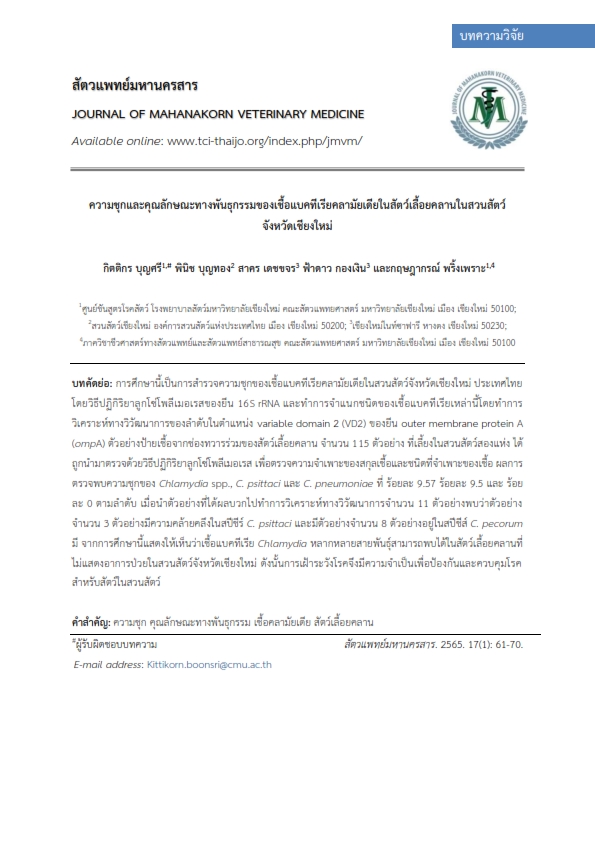
การศึกษานี้เป็นการสำรวจความชุกของเชื้อแบคทีเรียคลามัยเดียในสวนสัตว์จังหวัดเชียงใหม่ ประเทศไทย โดยวิธีปฏิกิริยาลูกโซ่โพลีเมอเรสของยีน 16S rRNA และทำการจำแนกชนิดของเชื้อแบคทีเรียเหล่านี้โดยทำการวิเคราะห์ทางวิวัฒนาการของลำดับในตำแหน่ง variable domain 2 (VD2) ของยีน outer membrane protein A (ompA) ตัวอย่างป้ายเชื้อจากช่องทวารร่วมของสัตว์เลื้อยคลาน จำนวน 115 ตัวอย่าง ที่เลี้ยงในสวนสัตว์สองแห่ง ได้ถูกนำมาตรวจด้วยวิธีปฏิกิริยาลูกโซ่โพลีเมอเรส เพื่อตรวจความจำเพาะของสกุลเชื้อและชนิดที่จำเพาะของเชื้อ ผลการตรวจพบความชุกของ Chlamydia spp., C. psittaci และ C. pneumoniae ที่ ร้อยละ 9.57 ร้อยละ 9.5 และ ร้อยละ 0 ตามลำดับ เมื่อนำตัวอย่างที่ได้ผลบวกไปทำการวิเคราะห์ทางวิวัฒนาการจำนวน 11 ตัวอย่างพบว่าตัวอย่างจำนวน 3 ตัวอย่างมีความคล้ายคลึงในสปีชีร์ C. psittaci และมีตัวอย่างจำนวน 8 ตัวอย่างอยู่ในสปีชีส์ C. pecorum มี จากการศึกษานี้แสดงให้เห็นว่าเชื้อแบคทีเรีย Chlamydia หลากหลายสายพันธุ์สามารถพบได้ในสัตว์เลื้อยคลานที่ไม่แสดงอาการป่วยในสวนสัตว์จังหวัดเชียงใหม่ ดังนั้นการเฝ้าระวังโรคจึงมีความจำเป็นเพื่อป้องกันและควบคุมโรคสำหรับสัตว์ในสวนสัตว์
Article Details

อนุญาตภายใต้เงื่อนไข Creative Commons Attribution-NonCommercial-NoDerivatives 4.0 International License.
เอกสารอ้างอิง
Beeckman, D.S. and Vanrompay, D.C. 2009. Zoonotic Chlamydophila psittaci infectious from a clinical perspective. Clin. Microbiol. Infect. 15(1): 11-17.
Bodetti, T.J., Jacobson, E., Wan, C., Hafner, L., Pospischil, A., Rose, K. and Timms, P. 2002. Molecular evidence to support the expansion of the host range of Chlamydia pneumoniae to include reptiles as well as humans, horses, koalas and amphibians. Syst. Appl. Microbiol. 25: 146-52.
Gaydos, C.A., Roblin, P.M., Hammerschlag, M.R., Hyman, C.L., Eiden, J.J., Schachter, J. and Quinn, T.C. 1994. Diagnostic utility of PCR-enzyme immunoassay, culture, and serology for detection of Chlamydia pneumoniae in symptomatic and asymptomatic patients. J. Clin. Microbiol. 32: 903-5.
Grayston, J.T., Campbell, L.A., Kuo, C.C., Mordhorst, CH., Saikku, P., Thom, D.H., Wang, S.P. 1990. A new respiratory tract pathogen: Chlamydia pneumoniae strain TWAR. J. infect. Dis. 161: 618-25.
Jackson, M., White, N., Giffard, P. and Timms, P. 1999. Epizootiology of Chlamydia infections in two free-range koala populations. Vet. Microbiol. 65: 255-64.
Kabeya, H., Sato, S. and Maruyama, S. 2015. Prevalence and characterization of Chlamydia DNA in zoo animals in Japan. Microbiol. Immunol. 59: 507-515.
Kaltenboeck, B., Heard, D., DeGraves, F.J., Schmeer, N. 1997a. Use of synthetic antigens improves detection by enzyme-linked immunosorbent assay of antibodies against abortigenic Chlamydia psittaci in ruminants. J. Clin. Microbiol. 35: 2293-2298.
Myers, G.S., Mathews, S.A., Eppinger, M., Mitchell, C., O’Brien, K.K., White, O.R., Benahmed, F., Brunham, R.C., Read, T.D., Ravel, J., Bavoil, P.M. and Timms, P. 2009. Evidence that human Chlamydia pneumoniae was zoonotically acquired. J. Bacteriol. 191: 7225-33.
Messmer, T.O., Skelton, S.K., Moroney, J.F., Daughrty, H. and Fields B.S. 1997. Application of a nested, multiplex PCR to psittacosis outbreaks. J. Clin. Microbiol. 35: 20436.
Office International des Epizooties. (2012). Avian chlamydiosis. OIE terrestrial Manual 2012: 401-414.
Pantchev, A., Sting, R., Bauerfeind, R., Tyczka, J. and Sachse, K., 2009. New real-time PCR tests for species-specific detection of Chlamydophila psittaci and Chlamydophila abortus from tissue samples. Vet. J. doi:10.1016/j.tvjl.2008.02.025
Reed, K.D., Ruth, G.R., Meyer, J.A. and Shukla, S.K. 2000. Chlamydia pneumonia infection in a breeding colony of African clawed frogs (Xenopus tropicalis). Emerg. Infect. Dis. 6: 196-9.
Sachse, K., Bavoil, PM., Kaltenboeck, B., Stephens, R.S., Kuo, C.C., Rossello-Mora, R. and Horn, M. 2015. Emendation of the family Chlamydiaceae: proposal of a single genus, Chlamydia, to include all currently recognized species. Syst. Appl. Microbiol. 38:99-103.
Sachse K., Vretou E., Livingstone M., Borel N., Pospischil A. & Longbottom D. (2009). Recent developments in the laboratory diagnosis of chlamydial infections (review). Vet. Microbiol. 135: 2–21.
Storz, J. and Kaltenboeck, B. 1933(b). Diversity of Chlamydia-Induce Disease. In: Woldehiwet, Z. and Ristic, M. (Eds), Rickettsial and Chlamydial disease of domestic animal, Pergamon Press, Oxford, UK, pp.363-393.
Suksai, P., Lorsunyaluck, B., Dittawong, P., Sanyathitiseree, P. and Lertwatcharasarakul, P. 2016. Genetic detection and identification of Chlamydophila psittaci in captive psittacine birds in Thailand. Thai. J. Vet. Med. 46(1): 67-75.
Suksai, P., Onket, R., Wiriyarat, W., Sangkachai, N., Lekcharoen, P. and Sariya, S. 2019. Occurrence of Chlamydia spp. in wild birds in Thailand. Asian. Pac. J. Trop. Med. 12(2): 67-71.
Vanrompay, D., Ducatelle, R. and Haesebrouck, F. 1995. Chlamydia psittaci infection: a review with emphasis on avian chlamydosis. Vet. Microbiol. 45: 93-119.
Wannaratana, S., Thontiravong, A., Amonsin, A. and Pakpinyo S. 2017. Persistence of Chlamydia psittaci in various temperatures and times. Avian Disease. 61: 40-45.
Walker, E., Lee, E.J., Timms, P. and Polkinghorne, A. 2015. Chlamydia pecorum infections in sheep and cattle: a common and under-recognised infectious disease with significant impact on animal health. Vet. J. 206:252–260.
Wills, J.M., Watson, G., Lusher, M., Mair, T.S., Wood, D. and Richmond, S.J. 1990. Characterization of Chlamydia psittaci isolates from horse. Vet. Microbiol. 24: 11-19.
Yoshida, H., Kishi, Y., Shiga, S., Hagiwara, T., 1998. Differentiation of Chlamydia species by combined use of polymerase chain reaction and restriction endonuclease analysis. Microbiol. Immunol. 42: 411-414.
