
คุณสมบัติการเป็นแอนติเจนของโปรตีนโอเพ่นรีดดิ้งเฟรม 2 ของเชื้อพอร์ไซน์เซอร์โคไวรัสไทป์ 2 ที่สกัดจากวัคซีนด้วยวิธีอัลตราฟิลเตรชั่น
Article Sidebar
Main Article Content
บทคัดย่อ
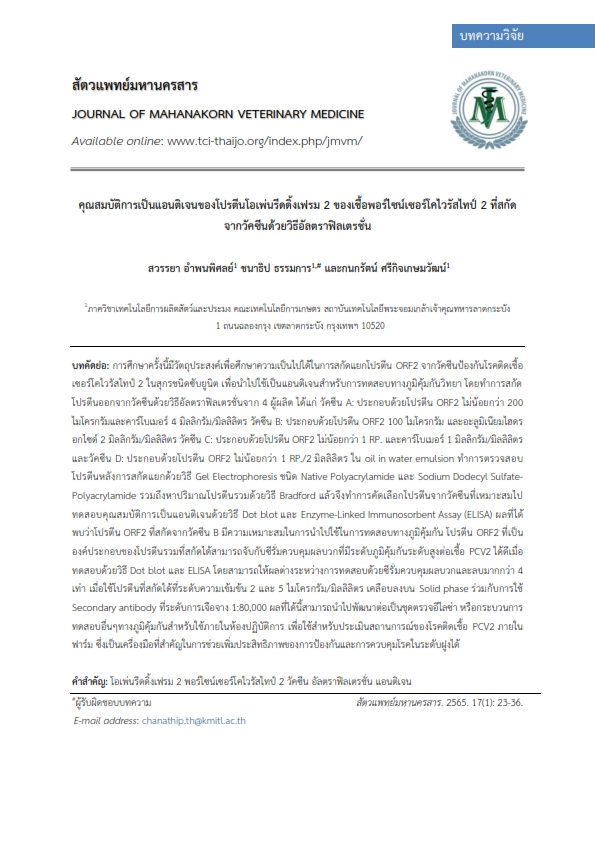
การศึกษาครั้งนี้มีวัตถุประสงค์เพื่อศึกษาความเป็นไปได้ในการสกัดแยกโปรตีน ORF2 จากวัคซีนป้องกันโรคติดเชื้อเซอร์โคไวรัสไทป์ 2 ในสุกรชนิดซับยูนิต เพื่อนำไปใช้เป็นแอนติเจนสำหรับการทดสอบทางภูมิคุ้มกันวิทยา โดยทำการสกัดโปรตีนออกจากวัคซีนด้วยวิธีอัลตราฟิลเตรชั่นจาก 4 ผู้ผลิต ได้แก่ วัคซีน A: ประกอบด้วยโปรตีน ORF2 ไม่น้อยกว่า 200 ไมโครกรัมและคาร์โบเมอร์ 4 มิลลิกรัม/มิลลิลิตร วัคซีน B: ประกอบด้วยโปรตีน ORF2 100 ไมโครกรัม และอะลูมิเนียมไฮดรอกไซด์ 2 มิลลิกรัม/มิลลิลิตร วัคซีน C: ประกอบด้วยโปรตีน ORF2 ไม่น้อยกว่า 1 RP. และคาร์โบเมอร์ 1 มิลลิกรัม/มิลลิลิตร และวัคซีน D: ประกอบด้วยโปรตีน ORF2 ไม่น้อยกว่า 1 RP./2 มิลลิลิตร ใน oil in water emulsion ทำการตรวจสอบโปรตีนหลังการสกัดแยกด้วยวิธี Gel Electrophoresis ชนิด Native Polyacrylamide และ Sodium Dodecyl Sulfate- Polyacrylamide รวมถึงหาปริมาณโปรตีนรวมด้วยวิธี Bradford แล้วจึงทำการคัดเลือกโปรตีนจากวัคซีนที่เหมาะสมไปทดสอบคุณสมบัติการเป็นแอนติเจนด้วยวิธี Dot blot และ Enzyme-Linked Immunosorbent Assay (ELISA) ผลที่ได้พบว่าโปรตีน ORF2 ที่สกัดจากวัคซีน B มีความเหมาะสมในการนำไปใช้ในการทดสอบทางภูมิคุ้มกัน โปรตีน ORF2 ที่เป็นองค์ประกอบของโปรตีนรวมที่สกัดได้สามารถจับกับซีรั่มควบคุมผลบวกที่มีระดับภูมิคุ้มกันระดับสูงต่อเชื้อ PCV2 ได้ดีเมื่อทดสอบด้วยวิธี Dot blot และ ELISA โดยสามารถให้ผลต่างระหว่างการทดสอบด้วยซีรั่มควบคุมผลบวกและลบมากกว่า 4 เท่า เมื่อใช้โปรตีนที่สกัดได้ที่ระดับความเข้มข้น 2 และ 5 ไมโครกรัม/มิลลิลิตร เคลือบลงบน Solid phase ร่วมกับการใช้ Secondary antibody ที่ระดับการเจือจาง 1:80,000 ผลที่ได้นี้สามารถนำไปพัฒนาต่อเป็นชุดตรวจอีไลซ่า หรือกระบวนการทดสอบอื่นๆทางภูมิคุ้มกันสำหรับใช้ภายในห้องปฏิบัติการ เพื่อใช้สำหรับประเมินสถานการณ์ของโรคติดเชื้อ PCV2 ภายในฟาร์ม ซึ่งเป็นเครื่องมือที่สำคัญในการช่วยเพิ่มประสิทธิภาพของการป้องกันและการควบคุมโรคในระดับฝูงได้
Article Details

อนุญาตภายใต้เงื่อนไข Creative Commons Attribution-NonCommercial-NoDerivatives 4.0 International License.
เอกสารอ้างอิง
Bollag, D. M. E., S. J. Rozycki, M. D. Bollag, M. D. Rozycki, and S. J. Edelstein. 1996. Protein methods. (No. 547.96 BOL).
Boyer, R. F. 2012. Biochemistry laboratory: modern theory and techniques. 2nded. Prentice Hall. New Jersey. 166-175.
Bradford, M. M. 1976. A rapid and sensitive method for the quantitation of microgram quantities of protein utilizing the principle of protein-dye binding. Anal. Biochem. 72: 248-254.
Buapijit, K. 2015. Development of indirect PCV2b-based ELISA for detection PCV2 antibodies. Department of Veterinary Medicine, Faculty of Veterinary Science, Chulalongkorn University.
Chae, C. 2012. Commercial porcine circovirus type 2 vaccines: efficacy and clinical application. Vet. J. 194: 151–157.
Ellis, J., M. Spinato, C. Yong, K. West, F. McNeilly, B. Meehan, S. Kennedy, E. Clark, S. Krakowka, and G. Allan. 2003. Porcine circovirus 2-associated disease in Eurasian wild boar. J. Vet. Diagn. Invest. 15(4): 364-368.
Liu, Q., S. K. Tikoo, and L. A. Babiuk. 2001. Nuclear localization of the ORF2 protein encoded by porcine circovirus type 2. J. Virol. 285: 91-99.
Mahe, D., P. Blanchard, C. Truong, C. Arnauld, P. Le Cann, R. Cariolet, F. Madec, E. Albina, and A. Jestin. 2000. Differential recognition of ORF2 protein from type 1 and type 2 porcine circoviruses and identification of immunorelevant epitopes. J. Gen. Virol. 81: 1815-1824.
Nawagitgul, P., I. Morozov, S. R. Bolin, P. A. Harms, S. D. Sorden, and P. S. Paul. 2000. Open reading frame 2 of porcine circovirus type 2 encodes a major capsid protein. J. Gen. Virol. 81: 2281-2287.
Pogranichnyy, R. M., K. J. Yoon, P. A. Harms, S. L. Swenson, J. J. Zimmerman, and S. D. Sorden. 2000. Characterization of immune response of young pigs to porcine circovirus type 2 infection. Viral. Immunol. 13(2): 143-153.
Seelapai, J. 2016. Screening, partial purification and characterization of cellulolytic enzyme from Actinomycetes. Department of Microbiology, Faculty of Science, Prince of Songkla University. (In Thai).
Sun, S. Q., H. C. Guo, D. H. Sun, S. H. Yin, Y. J. Shang, X. P. Cai, and X. T. Liu. 2010. Development and validation of an ELISA using a protein encoded by ORF2 antigenic domain of porcine circovirus type 2. Virol. J. 7: 274.
Truong, C., D. Mahe, P. Blanchard, M. Le Dimna, F. Madec, A. Jestin, and E. Albina. 2001. Identification of an immunorelevant ORF2 epitope from porcine circovirus type 2 as a serological marker for experimental and natural infection. Arch. Virol. 146(6): 1197-1211.
Zepeda-Cervantes, J., A. Cruz-Reséndiz, A. Sampieri, R. Carreón-Nápoles, J. I. Sánchez-Betancourt, and L. Vaca. 2019. Incorporation of ORF2 from porcine circovirus type 2 (PCV2) into genetically encoded nanoparticles as a novel vaccine using a self-aggregating peptide. Vaccine. 37: 1928–1937.
