
การเสริมน้ำผึ้งความเข้มข้นที่เหมาะสมในสารละลายถั่วเหลืองเป็นแหล่งพลังงานในการเคลื่อนที่ของตัวอสุจิโคชนที่เก็บรักษาด้วยการแช่เย็น
Article Sidebar
Main Article Content
บทคัดย่อ
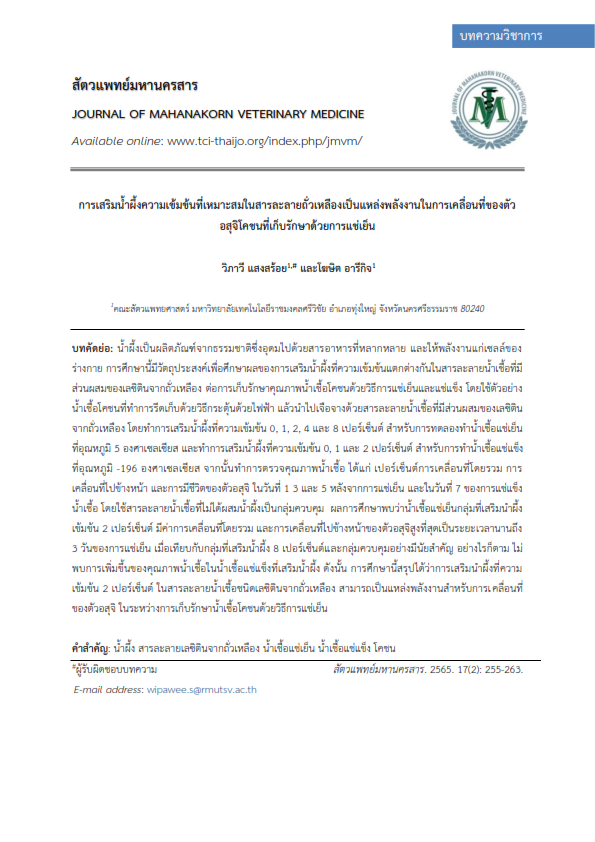
น้ำผึ้งเป็นผลิตภัณฑ์จากธรรมชาติซึ่งอุดมไปด้วยสารอาหารที่หลากหลาย และให้พลังงานแก่เซลล์ของร่างกาย การศึกษานี้มีวัตถุประสงค์เพื่อศึกษาผลของการเสริมน้ำผึ้งที่ความเข้มข้นแตกต่างกันในสารละลายน้ำเชื้อที่มีส่วนผสมของเลซิตินจากถั่วเหลือง ต่อการเก็บรักษาคุณภาพน้ำเชื้อโคชนด้วยวิธีการแช่เย็นและแช่แข็ง โดยใช้ตัวอย่างน้ำเชื้อโคชนที่ทำการรีดเก็บด้วยวิธีกระตุ้นด้วยไฟฟ้า แล้วนำไปเจือจางด้วยสารละลายน้ำเชื้อที่มีส่วนผสมของเลซิตินจากถั่วเหลือง โดยทำการเสริมน้ำผึ้งที่ความเข้มข้น 0, 1, 2, 4 และ 8 เปอร์เซ็นต์ สำหรับการทดลองทำน้ำเชื้อแช่เย็นที่อุณหภูมิ 5 องศาเซลเซียส และทำการเสริมน้ำผึ้งที่ความเข้มข้น 0, 1 และ 2 เปอร์เซ็นต์ สำหรับการทำน้ำเชื้อแช่แข็งที่อุณหภูมิ -196 องศาเซลเซียส จากนั้นทำการตรวจคุณภาพน้ำเชื้อ ได้แก่ เปอร์เซ็นต์การเคลื่อนที่โดยรวม การเคลื่อนที่ไปข้างหน้า และการมีชีวิตของตัวอสุจิ ในวันที่ 1 3 และ 5 หลังจากการแช่เย็น และในวันที่ 7 ของการแช่แข็งน้ำเชื้อ โดยใช้สารละลายน้ำเชื้อที่ไม่ได้ผสมน้ำผึ้งเป็นกลุ่มควบคุม ผลการศึกษาพบว่าน้ำเชื้อแช่เย็นกลุ่มที่เสริมนำผึ้งเข้มข้น 2 เปอร์เซ็นต์ มีค่าการเคลื่อนที่โดยรวม และการเคลื่อนที่ไปข้างหน้าของตัวอสุจิสูงที่สุดเป็นระยะเวลานานถึง 3 วันของการแช่เย็น เมื่อเทียบกับกลุ่มที่เสริมน้ำผึ้ง 8 เปอร์เซ็นต์และกลุ่มควบคุมอย่างมีนัยสำคัญ อย่างไรก็ตาม ไม่พบการเพิ่มขึ้นของคุณภาพน้ำเชื้อในน้ำเชื้อแช่แข็งที่เสริมน้ำผึ้ง ดังนั้น การศึกษานี้สรุปได้ว่าการเสริมนำผึ้งที่ความเข้มข้น 2 เปอร์เซ็นต์ ในสารละลายน้ำเชื้อชนิดเลซิตินจากถั่วเหลือง สามารถเป็นแหล่งพลังงานสำหรับการเคลื่อนที่ของตัวอสุจิ ในระหว่างการเก็บรักษาน้ำเชื้อโคชนด้วยวิธีการแช่เย็น
Article Details

อนุญาตภายใต้เงื่อนไข Creative Commons Attribution-NonCommercial-NoDerivatives 4.0 International License.
เอกสารอ้างอิง
Aires, V.A., Hinsch, K.D., Mueller-Schloesser, F., Bogner, K., Mueller-Schloesser, S. and Hinsch, E. 2003. In vitro and in vivo comparison of egg yolk-based and soybean lecithin-based extenders for cryopreservation of bovine semen. Theriogenology 60(2): 269-279.
Al-Waili, N.S. 2004. Investigating the antimicrobial activity of natural honey and its effects on the pathogenic bacterial infections of surgical wounds and conjunctiva. Journal of Medicinal Food 7(2): 210-222.
Banday, M.N., Lone, F.A., Rasool, F., Rather, H.A. and Rather, M.A. 2017. Does natural honey act as an alternative to antibiotics in the semen extender for cryopreservation of crossbred ram semen? Iranian Journal of Veterinary Research 18(4): 258-263.
Barbas, J.P., and Mascarenhas, R.D. 2009. Cryopreservation of domestic animal sperm cells. Cell and Tissue Banking 10(1): 49-62.
Bogdanov, S. 1997. Nature and origin of the antibacterial substances in honey. LWT - Food Science and Technology 30(7): 748-753.
Bogdanov, S., Jurendic, T., Sieber, R. and Gallmann, P. 2008. Honey for nutrition and health: a review. Journal of the American College of Nutrition 27(6): 677-689.
Borges-Silva, J.C., Silva, M.R., Marinho, D.B., Nogueira, E., Sampaio, D.C., Oliveira, L.O.F., Abreu, U.G.P., Mourão, G.B., Sartori, R., 2015. Cooled semen for fixed-time artificial insemination in beef cattle. Reproduction, Fertility and Development 28(7): 1004-1008.
Bumroongthai, K., Banmairuroy, P., Pisamai, S., Singlor, J., Tummaruk, P., 2012. Cryopreservation of Bull Semen by Using Egg Yolk Based Extender Compared with Soya Bean Extract Based Extender. KKU Veterinary Journal 22(1): 51-61.
El-Nattat, W.S., El-Sheshtawy, R.I., El-Batawy, K.A., Shahba, M.I. and El-Seadawy, I.E. 2016. Preservability of buffalo bull semen in tris-citrate extender enriched with bee’s honey. Journal of Innovations in Pharmaceutical and Biological Sciences 3(1): 180-185.
El-Sherbiny, A. 2013. Effect of bee honey-included egg yolk based extenders on motility, viability and fertilizing ability of frozen rabbit semen. Egyptian Journal of Rabbit Science 23(2):137-148.
El-Sheshtawy, R.I., El-Badry, D.A., El-Sisy, G.A., El-Nattat, W.S. and Abo Almaaty, A.M. 2016. Natural honey as a cryoprotectant to improve Arab stallion post-thawing sperm parameters. Asian Pacific Journal of Reproduction 5(4): 331-334.
El-Sisy, G.A., El-Nattat, W.S., El-Sheshtawy, R.I. and Abo El-Maaty, A.M. 2016. Substitution of egg yolk with different concentrations of soybean lecithin in tris-based extender during bulls' semen preservability. Asian Pacific Journal of Reproduction 5(6): 514-518.
Erejuwa, O.O., Sulaiman, S.A. and Ab Wahab, M.S. 2012. Honey: a novel antioxidant. Molecules 17(4): 4400-4423.
Fakhrildin, M.B. and Alsaadi, R.A. 2014. Honey supplementation to semen-freezing medium improves human sperm parameters post-thawing. Journal of Family and Reproductive Health 8(1):27-31.
Felipe-Pérez, Y.E., Juárez-Mosqueda, M., Hernández-González, E. and Valencia, J. 2008. Viability of fresh and frozen bull sperm compared by two staining techniques. Acta Veterinaria Brasilica 2(4): 123-130.
French, V.M., Cooper, R.A. and Molan, P.C. 2005. The antibacterial activity of honey against coagulase-negative staphylococci. Journal of Antimicrobial Chemotherapy 56(1): 228-131.
Fuller, B.J. 2004. Cryoprotectants: the essential antifreezes to protect life in the frozen state. CryoLetters 25(6): 375-388.
Gil, L., Mascaró, F., Mur, P., Gale, I., Silva, A., González, N., Malo, C. and Cano, R. 2010. Freezing ram semen: The effect of combination of soya and rosemary essences as a freezing extender on post-thaw sperm motility. Reproduction in Domestic Animals 45: 91.
Holt, W. 2000. Basic aspects of frozen storage of semen. Animal Reproduction Science 62(1-3): 3-22.
Jerez-Ebensperger, R.A., Luño, V., Olaciregui, M., González, N., de Blas, I. and Gil, L. 2015. Effect of pasteurized egg yolk and rosemary honey supplementation on quality of cryopreserved ram semen. Small Ruminant Research 130: 153-6.
Kandiel, M.M.M. and Elkhawagah, A.R.M. 2017. Effect of honey supplementation on Egyptian buffalo semen. Animal Reproduction 14(4): 1103-1109.
Layek, S.S., Mohanty, T.K., Kumaresan, A. and Parks, J.E. 2016. Cryopreservation of bull semen: evolution from egg yolk based to soybean based extenders. Animal Reproduction Science 172: 1-9.
Malik, A., Indah, A., Irwan Zakir, M., Sakiman, S. and Nugroho, S. 2019. Cryopresevative effect of adding a honey solution to native chicken spermatozoa. Advances in Animal and Veterinary Sciences 7(4): 261-4.
Nasreen, S., Awan, M.A., ul-Husna, A., Rakha, B.A., Ansari, M.S., Holt, W. and Akhter, S. 2020. Honey as an alternative to antibiotics for cryopreservation of Nili-Ravi buffalo bull spermatozoa. Biopreservation and Biobanking 18(1): 25-32.
Olayemi, F.O., Adeniji, D.A. and Oyeyemi, M.O. 2011. Evaluation of sperm motility and viability in honey included egg yolk based extenders. Global Veterinaria 7(1): 19-21.
Purdy, P.H. 2006. A review on goat sperm cryopreservation. Small Ruminant Research 63(3): 215-225.
Rosiak, E., Madras-Majewska, B., Teper, D., Łepecka, A., Zielińska, D. 2021. Cluster analysis classification of honey from two different climatic zones based on selected physicochemical and of microbiological parameters. Molecules 26(8): 2361.
Thun, R., Hurtado, M. and Janett, F. 2002. Comparison of Biociphos-Plus® and TRIS-egg yolk extender for cryopreservation of bull semen. Theriogenology 57(3): 1087-1094.
Watson, P.F. 2000. The causes of reduced fertility with cryopreserved semen. Animal Reproduction Science 60-61: 481-492.
Yimer, N., Haron, A.W., Saharee, A.A., Yap, K.C., Ganesamurthi, P. and Fahmi, M. 2011. Trans-scrotal ultrasonography and breeding soundness evaluation of bulls in a herd of dairy and beef cattle with poor reproductive performance. Pertanika Journal of Tropical Agricultural Science 34(2): 217-228.
Yimer, N., Muhammad, N., Sarsaifi, K., Rosnina, Y., Haron, A.W., A.M, K. and Kaka, A. 2015. Effect of honey supplementation into Tris extender on cryopreservation of bull spermatozoa. Malaysian Journal of Animal Sciences 18(2): 47-54.
Yoshida, M. 2000. Conservation of sperms: current status and new trends. Animal Reproduction Science 60-61: 349-355.
Zoheir, K.M.A., Harisa, G.I., Abo-Salem, O.M. and Ahmad, S.F. 2015. Honey bee is a potential antioxidant against cyclophosphamide-induced genotoxicity in albino male mice. Pakistan Journal of Pharmaceutical Sciences 28(3): 973-981.
