
ผลของการเสริมไลโซฟอสโฟลิปิดในอาหารต่อสมรรถภาพการผลิต ค่าเคมีโลหิต และลักษณะสัณฐานวิทยาของลำไส้เล็กในไก่เนื้อที่เลี้ยงภายใต้สภาวะเครียดจากสภาพอากาศร้อน
Article Sidebar
Main Article Content
บทคัดย่อ
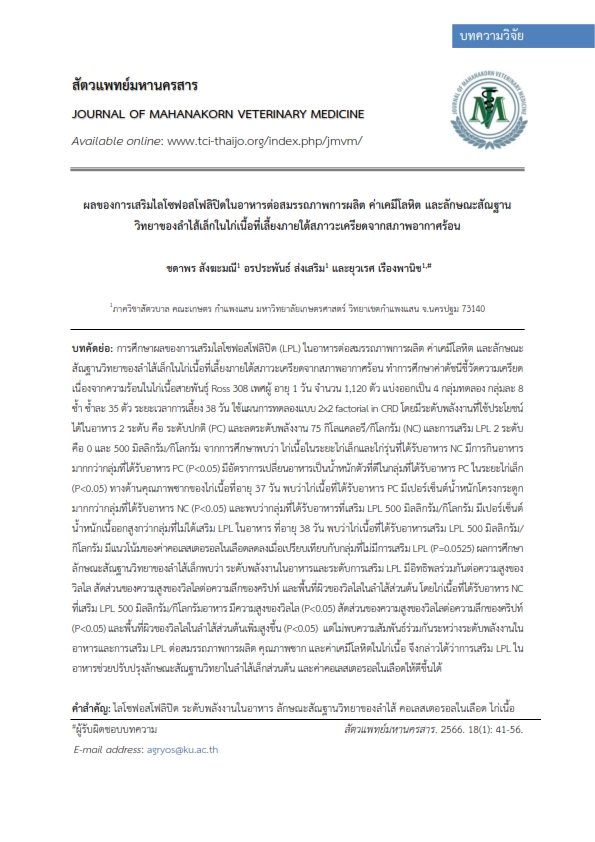
การศึกษาผลของการเสริมไลโซฟอสโฟลิปิด (LPL) ในอาหารต่อสมรรถภาพการผลิต ค่าเคมีโลหิต และลักษณะสัณฐานวิทยาของลำไส้เล็กในไก่เนื้อที่เลี้ยงภายใต้สภาวะเครียดจากสภาพอากาศร้อน ทำการศึกษาค่าดัชนีชี้วัดความเครียดเนื่องจากความร้อนในไก่เนื้อสายพันธุ์ Ross 308 เพศผู้ อายุ 1 วัน จำนวน 1,120 ตัว แบ่งออกเป็น 4 กลุ่มทดลอง กลุ่มละ 8 ซ้ำ ซ้ำละ 35 ตัว ระยะเวลาการเลี้ยง 38 วัน ใช้แผนการทดลองแบบ 2x2 factorial in CRD โดยมีระดับพลังงานที่ใช้ประโยชน์ได้ในอาหาร 2 ระดับ คือ ระดับปกติ (PC) และลดระดับพลังงาน 75 กิโลแคลอรี/กิโลกรัม (NC) และการเสริม LPL 2 ระดับ คือ 0 และ 500 มิลลิกรัม/กิโลกรัม จากการศึกษาพบว่า ไก่เนื้อในระยะไก่เล็กและไก่รุ่นที่ได้รับอาหาร NC มีการกินอาหารมากกว่ากลุ่มที่ได้รับอาหาร PC (P<0.05) มีอัตราการเปลี่ยนอาหารเป็นน้ำหนักตัวที่ดีในกลุ่มที่ได้รับอาหาร PC ในระยะไก่เล็ก (P<0.05) ทางด้านคุณภาพซากของไก่เนื้อที่อายุ 37 วัน พบว่าไก่เนื้อที่ได้รับอาหาร PC มีเปอร์เซ็นต์น้ำหนักโครงกระดูกมากกว่ากลุ่มที่ได้รับอาหาร NC (P<0.05) และพบว่ากลุ่มที่ได้รับอาหารที่เสริม LPL 500 มิลลิกรัม/กิโลกรัม มีเปอร์เซ็นต์น้ำหนักเนื้ออกสูงกว่ากลุ่มที่ไม่ได้เสริม LPL ในอาหาร ที่อายุ 38 วัน พบว่าไก่เนื้อที่ได้รับอาหารเสริม LPL 500 มิลลิกรัม/กิโลกรัม มีแนวโน้มของค่าคอเลสเตอรอลในเลือดลดลงเมื่อเปรียบเทียบกับกลุ่มที่ไม่มีการเสริม LPL (P=0.0525) ผลการศึกษาลักษณะสัณฐานวิทยาของลำไส้เล็กพบว่า ระดับพลังงานในอาหารและระดับการเสริม LPL มีอิทธิพลร่วมกันต่อความสูงของวิลไล สัดส่วนของความสูงของวิลไลต่อความลึกของคริปท์ และพื้นที่ผิวของวิลไลในลำไส้ส่วนต้น โดยไก่เนื้อที่ได้รับอาหาร NC ที่เสริม LPL 500 มิลลิกรัม/กิโลกรัมอาหาร มีความสูงของวิลไล (P<0.05) สัดส่วนของความสูงของวิลไลต่อความลึกของคริปท์ (P<0.05) และพื้นที่ผิวของวิลไลในลำไส้ส่วนต้นเพิ่มสูงขึ้น (P<0.05) แต่ไม่พบความสัมพันธ์ร่วมกันระหว่างระดับพลังงานในอาหารและการเสริม LPL ต่อสมรรถภาพการผลิต คุณภาพซาก และค่าเคมีโลหิตในไก่เนื้อ จึงกล่าวได้ว่าการเสริม LPL ในอาหารช่วยปรับปรุงลักษณะสัณฐานวิทยาในลำไส้เล็กส่วนต้น และค่าคอเลสเตอรอลในเลือดให้ดีขึ้นได้
Article Details

อนุญาตภายใต้เงื่อนไข Creative Commons Attribution-NonCommercial-NoDerivatives 4.0 International License.
เอกสารอ้างอิง
นวพรรณ จารุรักษ์. 2549. ไขมันในเลือด: ความสำคัญทางคลินิกและการตรวจวิเคราะห์ทางห้องปฏิบัติการ. ภาควิชาเวชศาสตร์ชันสูตร คณะแพทยศาสตร์ จุฬาลงกรณ์มหาวิทยาลัย.
ศิขัณฑ์ พงษ์พิพัฒน์. 2553. เทคนิคและการจัดการโรงเรือนระบบ Evap. สำหรับการเลี้ยงสัตว์. สมาคมสัตวบาลแห่งประเทศไทย.
Abdollahi, V. R. a. M. R. 2021. Nutrition and Digestive Physiology of the Broiler Chick: State of the Art and Outlook. Animals (Basel). 11(10): 2795.
Aengwanich, W. 2008. Effects of High Environmental Temperature on the Body Temperature of Thai Indigenous, Thai Indigenous Crossbred and Broiler Chickens. Asian Journal of Poultry Science. 2: 48-52.
Ana Jonas, D.E. Vance and J.E. Vance (Eds.) Biochemistry of Lipids, Lipoproteins and Membranes; Lipoprotein structure. Elsevier Science. (4th edit.)
Boontiam, W., Jung, B., and Kim, Y.Y. 2017. Effects of lysophospholipid supplementation to lower nutrient diets on growth performance, intestinal morphology, and blood metabolites in broiler chickens. Poult, Sci. 96(3): 593-601.
Boontiam, W., Hyun, Y.K., Jung, B., and Kim, Y.Y. 2019. Effects of lysophospholipid supplementation to reduced energy, crude protein, and amino acid diets on growth performance, nutrient digestibility, and blood profiles in broiler chickens. Poult. Sci. 98(12): 6693-6701.
Boroojeni, F. G., Mader, A., Knorr, F., Ruhnke, I. Rohe, I., Hafeez, A., Manner, K. and Zentek, J. 2014. The effects of different thermal treatments and organic acid levels on nutrient digestibility in broilers. Poult. Sci. 93: 1159-1171.
Bouke Poelsma. 2021. Tips and tricks for feeding during heat stress. Poultry world. Misset Uiigoverij, B.V. Retrieved from https://www.poultryworld.net/specials/tips-and-tricks-for-feeding-during-heat-stress/
Chen, C., Jung B., and Kim W.K. 2019. Effects of lysophospholipid on growth performance, carcass yield, intestinal development, and bone quality in broilers. Poult. Sci. 98(9): 3902-3913.
Elmutaz Awad, Z. I., Abdoreza Soleimani Awad, E.A., Idrus, Z., Soleimani Farjam, A., Bello, A.U., and Jahromi, M.F. 2018. Growth performance, duodenal morphology and the caecal microbial population in female broiler chickens fed glycine-fortified low protein diets under heat stress conditions. Br. Poult. Sci. 59(3): 340-348.
Iwata, T. S., Hoshi, F., TakeHSIa, K., Tsutsumi, Y., Furukawa, S., and Kimura. 1992. The effect of dietary safflower phospholipid and soybean phospholipid on plasma and liver lipids in rats fed a hypercholesterolemic diet. J. Nutri. Sci. 38: 471-479.
Kamboh, A.A., and Zhu, W-Y. 2014. Individual and combined effect of genistein and hesperidin onimmunity and intestinal morphometry in lipopolysaccharide-challenged broiler chickens. Poult. Sci. 93(9): 2175-2183.
Khonyoung, D., Yamauchi, K. and Suzuki, K. 2015. Influence of dietary fat sources and lysolecithin on growth performance, visceral organ size, and HIS to logical intestinal alteration in broiler chickens. Livestock. Sci., 176: 111-120.
Langmuir, L. T. 2002. Lecithin: In: Arthur, T. Hubbard (Ed.). Encyclopedia of Surface and Colloid Science. New York, USA: Marcel Dekker Inc.
Laura, C. 2016. Food emulsifier fundamentals. Infoorm. 27(10): 11.
Laura Liscum, D.E. Vance and J.E. Vance (Eds.) Biochemistry of Lipids, Lipoproteins and Membranes; Cholesterol biosynthesis. Elsevier Science. (4th Edit.)
Leeson, S. 2001. Nutrition of chicken. Guelph: University Books, 4th, 179-320.
Miles, G. D. B. R. 2015. Heat Stress Management in Broilers. UF IFAS Extension VM65.
Nascimento, D.R., Murakami, A.E., Guerra, A.F.Q.M., Ospinas-Rojas, I.C., Ferreira, M.F.Z. and Fanhani, J.C. 2014. Effect of different vitamin D source and calcium levels in the diet of layer in the second laying cycle. Braz. J. Poult. Sci. 16(2): 37-42.
Papadopoulos, G.A.T.P., Chalvatzi, S., Dibenedetto, M., Hardas, A., Tsiouris, V., Georgopoulou, I., Arsenos, G., and Fortomaris, P.D. 2018. Effects of lysolecithin supplementation in low energy diets on growth performance, nutrient digestibility, viscosity and intestinal morphology of broilers. Br. Poult. Sci. 59(2): 232-239
Priyankarage N., Silva, S.S.P., and Pirgozliev. V.R. 2011. Energy, energy requirement and different energy systems in poultry. Vet. J. 5(A): 1-12.
Robert, B. 2018. Nutrition and feeding of organic poultry. Faculty of Land and Food Systems The University of British Columbia, Canada. ISBN: 978 1 84593 406 4.
Sklan, Y. N. D. 1995. Digestion and Absorption in the Yung Chick. Poult. Sci. 74: 366-373.
Torrey, S., Kiarie, E., and Widowski, T. 2020. In pursuit of a better broiler: A comprehensive study on 16 strains of broiler chickens differing in growth rates (pp. 1-6, Rep.). Guelph, ON, Canada: University of Guelph.
Tsiouris V., I. G., Batzios, C., Pappaioannou, N., Ducatelle, R., and Fortomaris, P. 2018. Heat stress as a predisposing factor for necrotic enteritis in broiler chicks. Avian Pathology. doi:10.1080/03079457.2018.1524574
Yang, Y., Iji, P.A., Kocher, A., Mikkelsen, L.L., and Choct, M. 2008. Effect of xylanase on growth and gut development of broiler chickens given a wheat-based diet. Asian-Aust. J. Anim. Sci. 21(11): 1659-1664.
Zhao, P. Y., and Kim I.H. 2017. Effect of diets with different energy and lysophospholipids levels on performance, nutrient metabolism, and body composition in broilers. J. Poult. Sci. 96(5): 1341-1347.
